
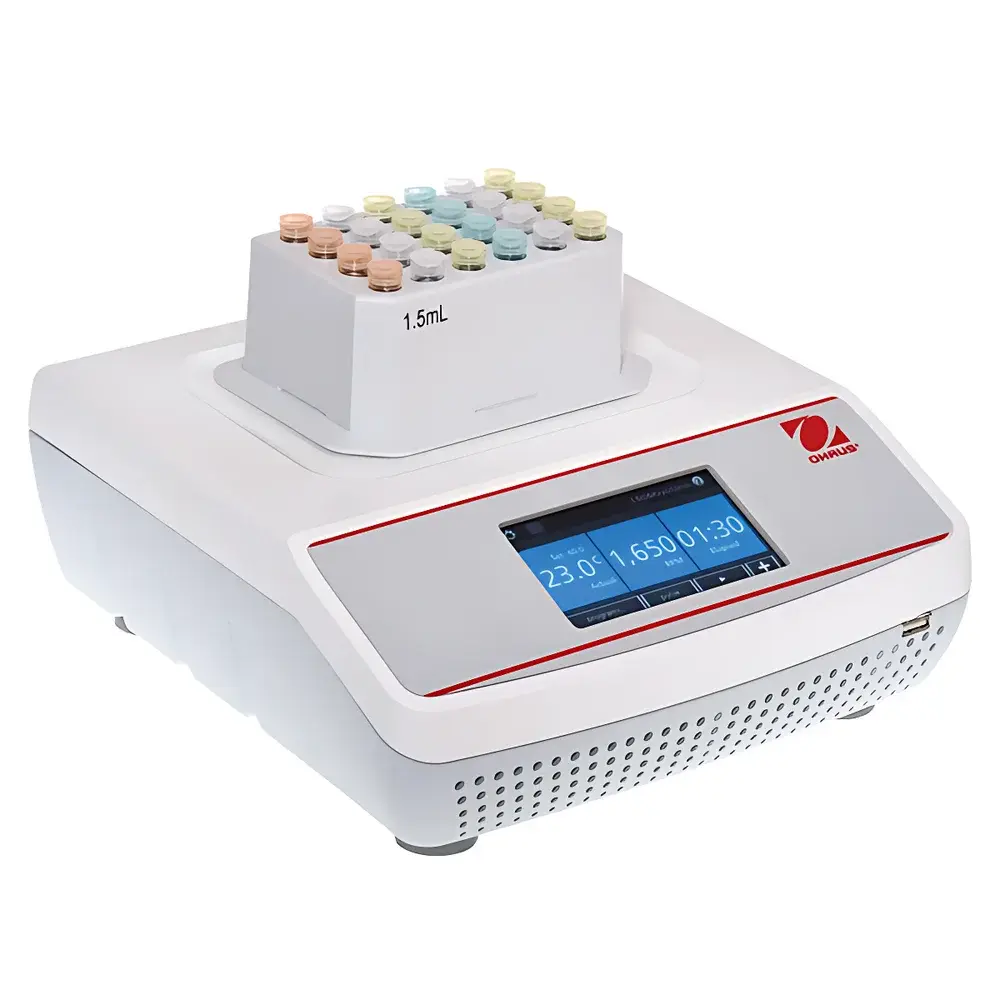
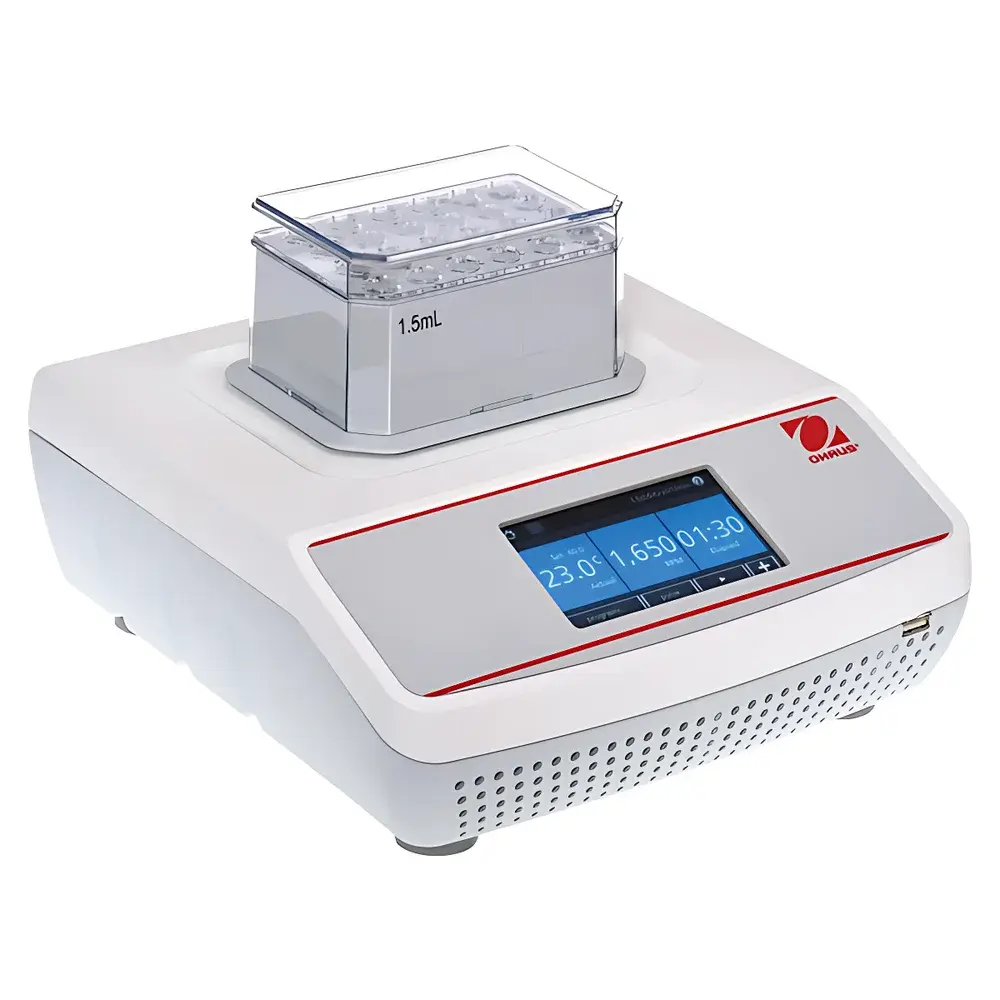
OHAUS ISTHBLCTS Refrigerated Incubator Shaker
| Brand | OHAUS |
|---|---|
| Origin | USA |
| Manufacturer Type | Original Equipment Manufacturer (OEM) |
| Product Category | Imported Instrument |
| Model | ISTHBLCTS |
| Instrument Type | Refrigerated Incubator Shaker |
| Timer Range | 1 min to 99 h 59 min |
| Oscillation Speed | 300–3000 rpm |
| Orbit Diameter | 3 mm |
| Temperature Range | −20 °C to +65 °C |
| Platform Capacity | 11 interchangeable modules (for tubes, microplates, and flasks) |
Overview
The OHAUS ISTHBLCTS Refrigerated Incubator Shaker is an engineered platform for precise temperature-controlled agitation in life science laboratories. It integrates Peltier-based active cooling with resistive heating and high-stability orbital shaking—enabling simultaneous control of thermal environment and mechanical mixing across a wide operational envelope (−20 °C to +65 °C) at speeds from 300 to 3000 rpm. Designed around the Couette flow principle for uniform sample suspension and heat transfer, the system ensures reproducible kinetic conditions essential for sensitive biological workflows including mammalian cell culture, plasmid amplification, enzyme kinetics, and protein solubilization. Its compact low-profile chassis minimizes benchtop footprint while maintaining structural rigidity under dynamic load, supporting long-term stability during overnight or multi-day incubation protocols.
Key Features
- Active thermoelectric (Peltier) cooling combined with PID-regulated resistive heating delivers rapid, bidirectional temperature transitions with ±0.2 °C accuracy across the full range.
- Orbital shaking mechanism with 3 mm orbit diameter provides laminar, non-shearing motion ideal for suspension cultures and viscous reagents.
- Intuitive 5.7-inch capacitive LCD touchscreen interface supports multilingual operation (English, German, French, Spanish, Chinese, Japanese) and glove-compatible input via standard laboratory nitrile or latex gloves.
- Programmable multi-step protocols: up to five user-defined sequences stored internally, each comprising five independent stages (temperature, speed, time, ramp rate); unlimited additional protocols importable/exportable via USB flash drive.
- Configurable ramp rates: heating and cooling rates adjustable in 0.5 °C/min increments, enabling controlled thermal stress studies or gentle thawing of cryopreserved samples.
- Single-point calibration mode allows user-initiated offset correction at up to six discrete temperatures, traceable to NIST-traceable reference standards.
- Pulse mode enables transient high-speed agitation (up to 3000 rpm) for rapid vortexing prior to centrifugation or assay initiation.
- Safety architecture includes cold-touch housing (UL/CSA certified polymer blend), over-temperature cutoff (user-definable limit), real-time thermal fault detection with automatic heater shutdown, and audible/visual alerts for timer expiration and thermal threshold breaches.
Sample Compatibility & Compliance
The ISTHBLCTS accommodates up to 11 independently selectable platforms—including 15 mL and 50 mL conical tube holders, 96-well PCR plates, deep-well microplates, and Erlenmeyer flask clamps—ensuring compatibility with standard ANSI/SLAS footprint formats. All module interfaces are mechanically indexed for repeatable positioning and thermal coupling. The instrument complies with IEC 61010-1:2010 (Safety Requirements for Electrical Equipment for Measurement, Control, and Laboratory Use), meets electromagnetic compatibility (EMC) requirements per EN 61326-1:2013, and supports GLP/GMP data integrity through audit-trail-capable USB logging (timestamped event records, parameter changes, and error codes). While not FDA 21 CFR Part 11–validated out-of-the-box, its firmware architecture permits integration into validated environments via documented configuration management and electronic signature workflows.
Software & Data Management
Data capture and protocol management are handled locally via the embedded touchscreen UI, with all runtime parameters, alarm logs, and calibration events automatically timestamped and stored in non-volatile memory. USB 2.0 host port enables export of CSV-formatted session reports, firmware updates, and protocol libraries; no proprietary software installation is required. For centralized lab informatics, exported files integrate seamlessly with LIMS platforms supporting ISO/IEC 17025-compliant data ingestion pipelines. Audit trails include operator ID (via optional RFID badge reader integration), parameter change history, and thermal deviation flags—supporting traceability requirements under ISO 13485 and CLIA regulations.
Applications
- Mammalian and insect cell culture maintenance under hypothermic or physiological conditions (e.g., CHO, HEK293, Sf9).
- Plasmid DNA miniprep and maxiprep workflows requiring consistent lysis and neutralization kinetics.
- Protein expression and purification steps involving solubilization, refolding, and affinity binding under controlled thermal-agitation profiles.
- Enzymatic assays where reaction velocity depends on both temperature and mixing homogeneity (e.g., kinase activity, ligase efficiency).
- Microbial growth curve analysis across temperature gradients (e.g., psychrophilic, mesophilic, and thermotolerant strains).
- RNA stabilization and extraction protocols minimizing degradation during lysis and binding steps.
FAQ
What is the maximum load capacity per platform module?
Each module is rated for ≤1.5 kg total mass, with dynamic balance maintained across the full speed range when loaded per OHAUS-recommended vessel configurations.
Does the ISTHBLCTS support remote monitoring or network connectivity?
No Ethernet or Wi-Fi interface is built-in; however, scheduled data exports via USB enable integration with networked file servers or cloud-synced directories using external IT infrastructure.
Can temperature and speed be controlled independently within a single program step?
Yes—each of the five programmable steps allows concurrent, independent setpoints for temperature, rpm, duration, and ramp rate.
Is validation documentation available for IQ/OQ/PQ protocols?
OHAUS provides a comprehensive User Requirement Specification (URS) template and factory test reports; site-specific qualification support is available through certified field service engineers.
What maintenance intervals are recommended for optimal performance?
Annual verification of temperature uniformity (per ASTM E2573-19) and speed calibration (per ISO 17025-accredited procedures) is advised; Peltier module cleaning and fan filter inspection should occur quarterly.
Related Products



