
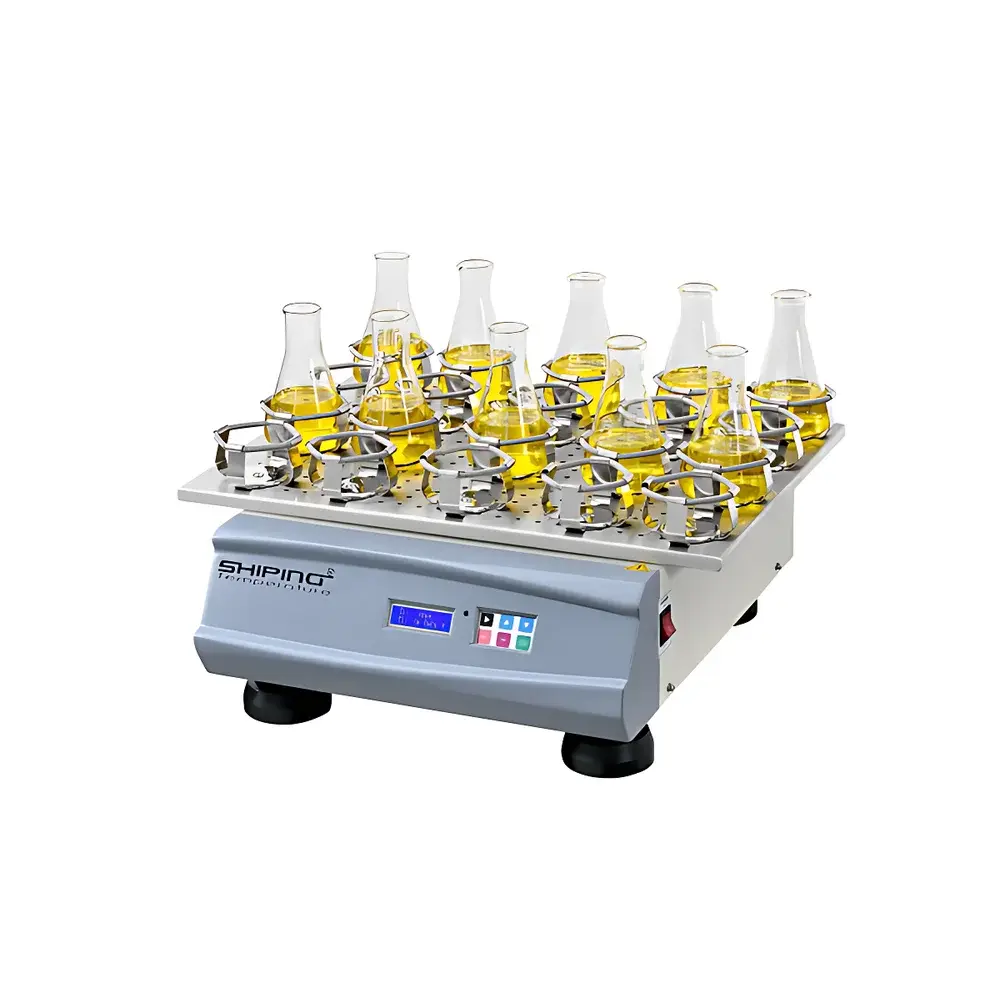
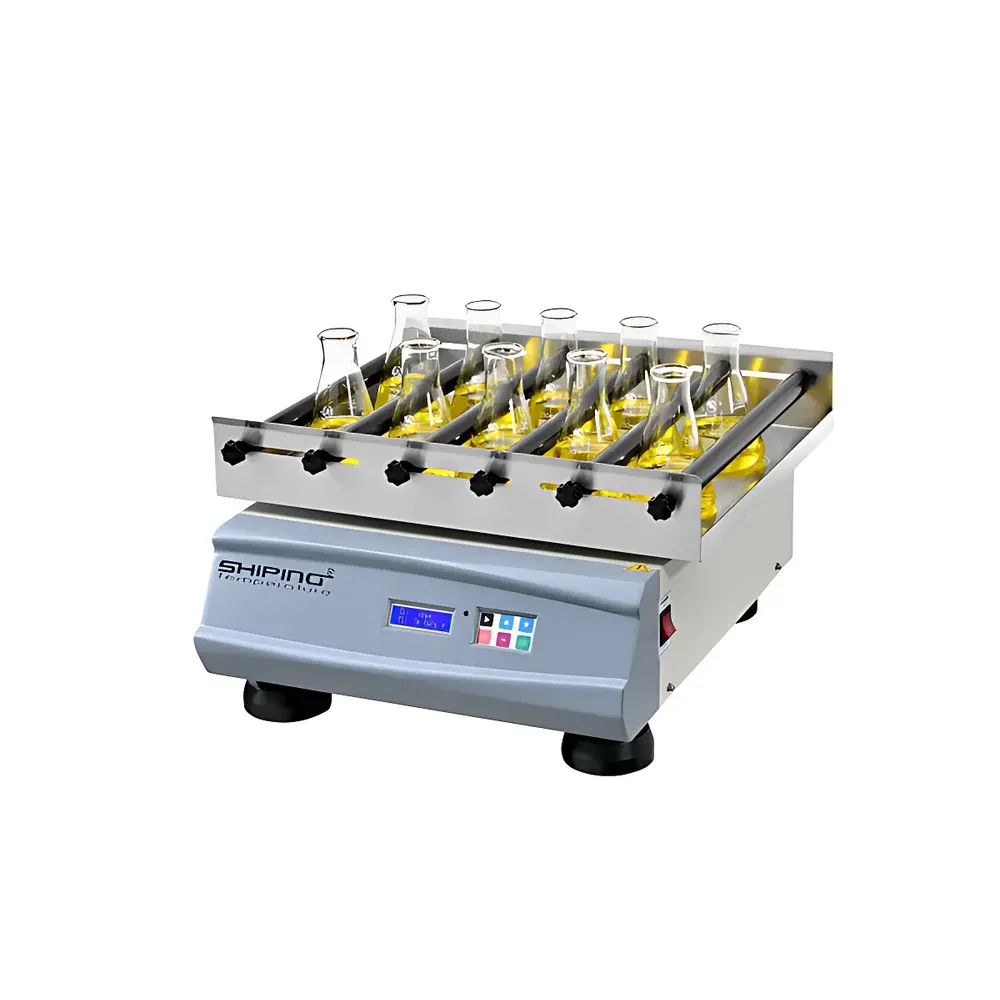
Shanghai Shiping SPH-310A Universal Orbital Shaker
| Brand | Shanghai Shiping |
|---|---|
| Origin | Shanghai, China |
| Manufacturer Type | Direct Manufacturer |
| Product Category | Domestic |
| Model | SPH-310A |
| Price Range | USD 1,400–2,800 |
| Instrument Type | General-Purpose Orbital Shaker |
| Timer Range | 0–999.59 h |
| Oscillation Frequency | 30–300 rpm |
| Oscillation Amplitude | Φ25 mm |
| Temperature Control | Ambient Only |
| Platform Quantity | 1 |
| Display | LCD |
| Control System | PID Microprocessor with Environmental Scan Chip |
| Programming | 8-Stage User-Defined Programs |
| Safety Features | Auto Start/Stop, Timer Mode, Power-Fail Recovery, Parameter Memory, Speed Retention |
| Air Circulation | Natural Convection |
| Drive Mechanism | Single-Axis Balanced Drive |
| Bearing | NSK Imported Double-Row Ball Bearings |
| Shaft Material | Quenched & Tempered 45# Carbon Steel (220–250 HBW) |
| Platform Dimensions | 550 × 400 mm |
| Max Load Capacity | 12 × 1000 mL or 15 × 500 mL or 24 × 250 mL flasks/bottles |
| Net Weight | 40 kg |
| External Dimensions | 550 × 480 × 220/305 mm (H) |
| Power Consumption | 100 W |
| Housing Material | Corrosion-Resistant ABS Engineering Plastic |
| Power Supply | AC 200–240 V, 50–60 Hz |
Overview
The Shanghai Shiping SPH-310A Universal Orbital Shaker is an entry-level yet robust benchtop platform shaker engineered for consistent, low-shear mixing in microbiological culture, cell suspension, reagent homogenization, and general laboratory sample preparation. It operates on the principle of orbital motion—where the platform rotates in a horizontal circular path at adjustable speed—generating gentle but effective fluid agitation without vortex formation or excessive foaming. Unlike reciprocating or linear shakers, orbital motion ensures uniform suspension of cells and particles across multi-well plates, Erlenmeyer flasks, and test tubes. Designed for ambient-temperature environments only, the SPH-310A integrates a PID-controlled microprocessor system that continuously monitors and corrects rotational speed against load-induced fluctuations, ensuring high reproducibility across repeated runs. Its single-platform architecture supports standardized flask configurations widely adopted in academic labs, QC facilities, and bioprocess development workflows.
Key Features
- Eight-stage programmable operation allows users to define complex time–speed profiles for multi-phase incubation protocols (e.g., gradual ramp-up for sensitive cultures followed by steady-state shaking).
- PID-based microprocessor control with environmental scanning logic dynamically compensates for minor voltage variations and mechanical load changes, maintaining speed stability within ±1 rpm.
- NSK double-row precision ball bearings and quenched-and-tempered 45# carbon steel shaft ensure long-term mechanical integrity under continuous operation—even with asymmetric loads up to 24 × 250 mL vessels.
- Corrosion-resistant ABS engineering plastic housing meets ISO 13485-aligned material compatibility standards for cleanroom-adjacent use and routine disinfection with ethanol or quaternary ammonium agents.
- Power-fail recovery function automatically resumes the last active program upon grid restoration—critical for unattended overnight cultures in GLP-compliant labs.
- LCD interface displays real-time timer, setpoint speed, and elapsed time with intuitive navigation; no external software required for basic operation.
Sample Compatibility & Compliance
The SPH-310A accommodates standard laboratory vessels including 250 mL, 500 mL, and 1000 mL Erlenmeyer flasks (up to 12 units), as well as multi-well plates and centrifuge tubes secured via optional clamps. Its Φ25 mm orbital diameter and 30–300 rpm speed range align with ASTM D2240-22 recommendations for polymer solution homogenization and USP guidance for non-sterile compounding agitation. While not equipped with integrated temperature control, its ambient-only design complies with ISO 17025 clause 5.4.2 for equipment used outside regulated thermal envelopes. The unit carries CE marking per Directive 2014/30/EU (EMC) and 2014/35/EU (LVD), and conforms to IEC 61010-1:2010 safety requirements for laboratory electrical equipment.
Software & Data Management
The SPH-310A operates independently of proprietary software—no drivers, cloud accounts, or license keys are required. All operational parameters (speed, timer, program stage) are stored in non-volatile memory and persist through power cycles. For laboratories requiring audit trails, manual log entries can be synchronized with LIMS platforms using timestamped operator records. Though lacking FDA 21 CFR Part 11 electronic signature capability, its parameter memory and power-fail recovery features support ALCOA+ data integrity principles when documented per internal SOPs.
Applications
- Microbial growth enhancement in liquid media (e.g., E. coli, yeast, and fungal cultures).
- Suspension of mammalian or insect cells during transfection or passaging protocols.
- Antibody-antigen binding kinetics studies requiring gentle mixing over extended durations.
- Buffer equilibration, enzyme reaction setup, and solid-phase extraction plate agitation.
- Pre-analytical sample homogenization prior to HPLC, ELISA, or spectrophotometric analysis.
FAQ
Does the SPH-310A support temperature-controlled operation?
No. This model is designed exclusively for ambient-temperature shaking. For thermostatic applications, consider the SPH-311 series with integrated Peltier cooling/heating modules.
Can the shaker accommodate microplates without additional accessories?
The standard platform accepts microplates only when used with optional universal microplate clamps (sold separately). Default configuration is optimized for conical flasks and cylindrical bottles.
Is the unit suitable for GMP-regulated environments?
Yes—as a Class I, non-sterile ancillary device. It satisfies baseline mechanical reliability and documentation requirements for Annex 11-compliant workflows when paired with validated user procedures and maintenance logs.
What is the expected service life under continuous 24/7 operation?
With scheduled bearing lubrication every 12 months and adherence to maximum load specifications, the unit maintains nominal performance for ≥5 years based on accelerated lifecycle testing per IEC 60068-2-6.
How is speed accuracy verified during IQ/OQ qualification?
Speed calibration is performed using a traceable handheld tachometer (e.g., Extech 461923) at three points across the operating range (50 rpm, 150 rpm, 280 rpm), with deviation tolerance ≤±1 rpm per manufacturer specification.





