
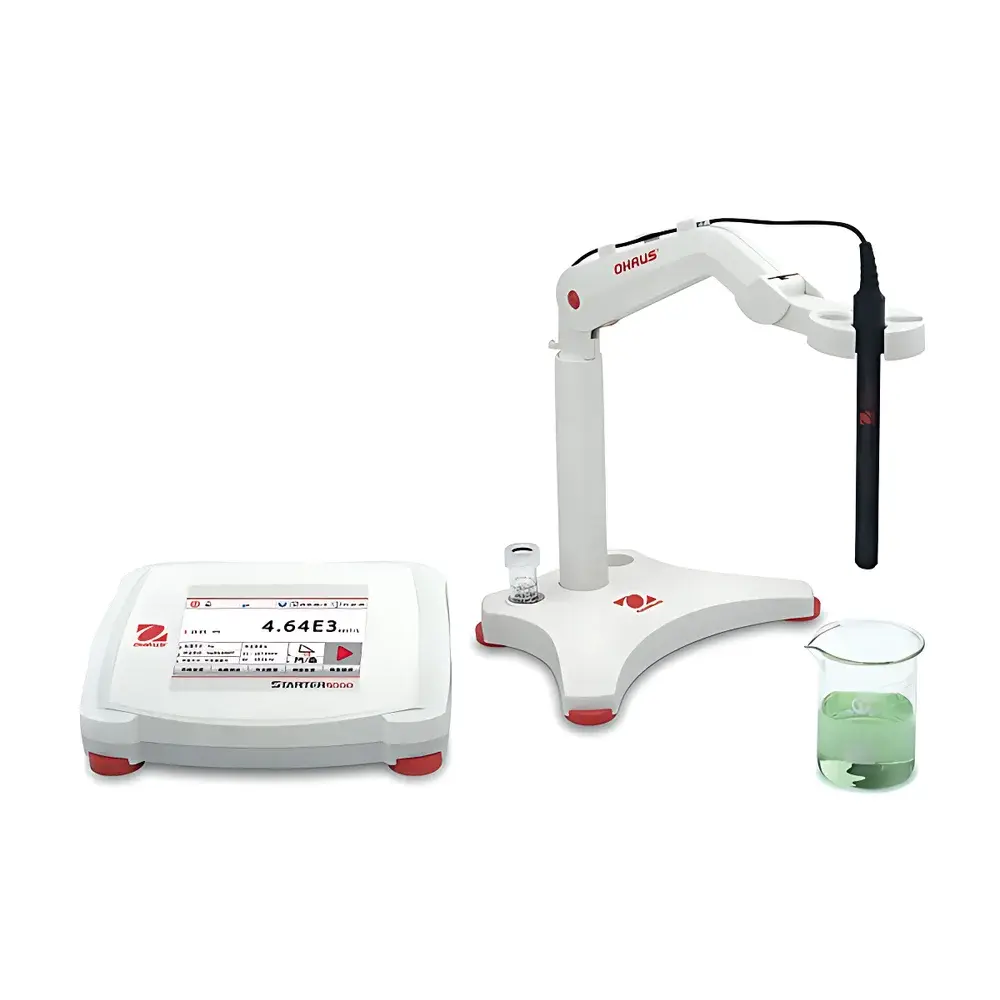
OHAUS Starter 5000i Benchtop Ion Meter
| Brand | OHAUS |
|---|---|
| Origin | Jiangsu, China |
| Manufacturer Type | Manufacturer |
| Product Category | Domestic |
| Model | Starter 5000i |
| Instrument Type | Benchtop |
| Parameter Capability | Dual-Parameter (pX & mV) |
| Measurement Precision | 0.001 pX |
| Measurement Range | 0.000–14.000 pX |
| Resolution | 0.1 / 0.01 / 0.001 pX |
| Accuracy | ±0.002 pX |
| Calibration Solution Requirement | None (Auto-Recognition Supported) |
Overview
The OHAUS Starter 5000i is a high-precision benchtop ion meter engineered for reliable, trace-level quantitative analysis of monovalent and multivalent ions—including F⁻, Cl⁻, NO₃⁻, Ca²⁺, and others—without requiring prior chemical separation or derivatization. Based on potentiometric measurement principles using ion-selective electrodes (ISEs), the instrument measures the electromotive force (EMF) generated at the interface between the sample solution and the selective membrane, converting it into concentration values via the Nernst equation. Its dual-parameter architecture simultaneously displays pX (negative logarithm of ion activity) and millivolt readings, enabling both direct concentration determination and electrode performance verification. Designed for routine QC labs, academic research facilities, and environmental testing centers, the Starter 5000i delivers metrological consistency across diverse aqueous matrices while maintaining full compliance with fundamental electrochemical measurement standards.
Key Features
- High-resolution 4.3-inch color TFT touchscreen with intuitive icon-based navigation—enabling one-touch calibration, measurement initiation, and data review.
- Dual-parameter capability supporting simultaneous pX and mV display, with selectable resolution (0.1 / 0.01 / 0.001 pX) to match analytical rigor requirements.
- IP54-rated enclosure with integrated transparent protective shield—ensuring operational reliability in humid, splash-prone, or particulate-rich laboratory environments.
- Independent electrode holder design—minimizing mechanical stress on ISEs during immersion and improving measurement repeatability.
- Comprehensive GLP-compliant functionality including automatic timestamping, user ID logging, calibration history storage (up to 100 entries), and configurable calibration reminders.
- Multiple endpoint detection modes: stable-slope, timed, and manual—optimizing measurement speed without compromising accuracy for varying sample kinetics.
- Built-in RS232 and USB-B interfaces for seamless data export to LIMS, Excel, or third-party analytical software; supports CSV and TXT formats.
Sample Compatibility & Compliance
The Starter 5000i is validated for use with standard liquid-phase samples having ionic strength between 0.001 M and 1.0 M, pH range 2–12 (dependent on electrode compatibility), and temperature from 5 °C to 50 °C. It supports all commercially available combination and separate-body ion-selective electrodes compliant with ISO 7027 and ASTM D1129. The instrument’s firmware implements automatic electrode recognition (when paired with compatible digital ISEs), eliminating manual electrode-type selection errors. All stored calibration and measurement records include metadata required for GLP/GMP audit trails—including operator ID, date/time stamp, electrode serial number, buffer lot numbers (if entered), and environmental conditions. While not certified under FDA 21 CFR Part 11 out-of-the-box, its data integrity architecture—including non-erasable logs and tamper-evident timestamps—provides a foundation for internal validation against regulatory requirements.
Software & Data Management
Data handling is implemented through embedded firmware—not cloud-dependent applications—ensuring full local control and cybersecurity compliance. Up to 1,000 measurement results can be stored internally with full contextual metadata. Exported files contain raw mV values, calculated pX, temperature, electrode ID, calibration coefficients, and uncertainty estimates derived from calibration slope and offset residuals. USB mass-storage mode allows drag-and-drop file transfer without proprietary drivers. Optional OHAUS LabLink Pro software (Windows/macOS) enables batch report generation, statistical analysis (mean, SD, RSD, confidence intervals), trend charting, and integration with institutional electronic lab notebooks (ELNs). All exported data conforms to ISO/IEC 17025 documentation requirements for test reporting.
Applications
- Environmental monitoring: Fluoride and nitrate quantification in drinking water per EPA Method 300.0 and ISO 10304-1.
- Pharmaceutical QA/QC: Chloride ion content verification in parenteral solutions and excipient raw materials (USP , Ph. Eur. 2.2.16).
- Food & beverage analysis: Calcium and sodium profiling in dairy products, beverages, and processed foods per AOAC 976.23.
- Academic teaching labs: Potentiometric titration experiments, Nernst equation validation, and selectivity coefficient determination (log Kpot).
- Industrial process control: Real-time monitoring of etchant bath composition (e.g., HF in semiconductor cleaning) and wastewater neutralization endpoints.
FAQ
Does the Starter 5000i support automatic temperature compensation (ATC)?
Yes—it accepts input from optional ATC probes (e.g., OHAUS T-1000 series) and applies Nernstian correction based on measured temperature, ensuring accurate pX calculation across 5–50 °C.
Can it store calibration curves for multiple ion types simultaneously?
Yes—up to five independent calibration sets (e.g., F⁻, Cl⁻, NO₃⁻, Ca²⁺, NH₄⁺) can be saved and recalled without reconfiguration.
Is electrode calibration performed using fixed-concentration standards or variable-dilution protocols?
Both methods are supported: single-point, two-point, and multi-point (up to 5 points) calibrations with user-defined standard concentrations; auto-detection of standard identity is available when using digitally encoded buffers.
What is the minimum detectable concentration for fluoride using a LaF₃-based ISE?
Detection limit depends on electrode quality and sample matrix, but typical practical limits are ~0.02 mg/L (1 µM) under optimized conditions with low-interference background electrolytes.
Does the instrument meet ISO/IEC 17025 traceability requirements?
While the meter itself is not individually accredited, its measurement algorithm, calibration traceability path (to NIST-traceable reference solutions), and documented uncertainty budget enable laboratories to establish metrological traceability per ISO/IEC 17025 Clause 6.5.
Related Products




