
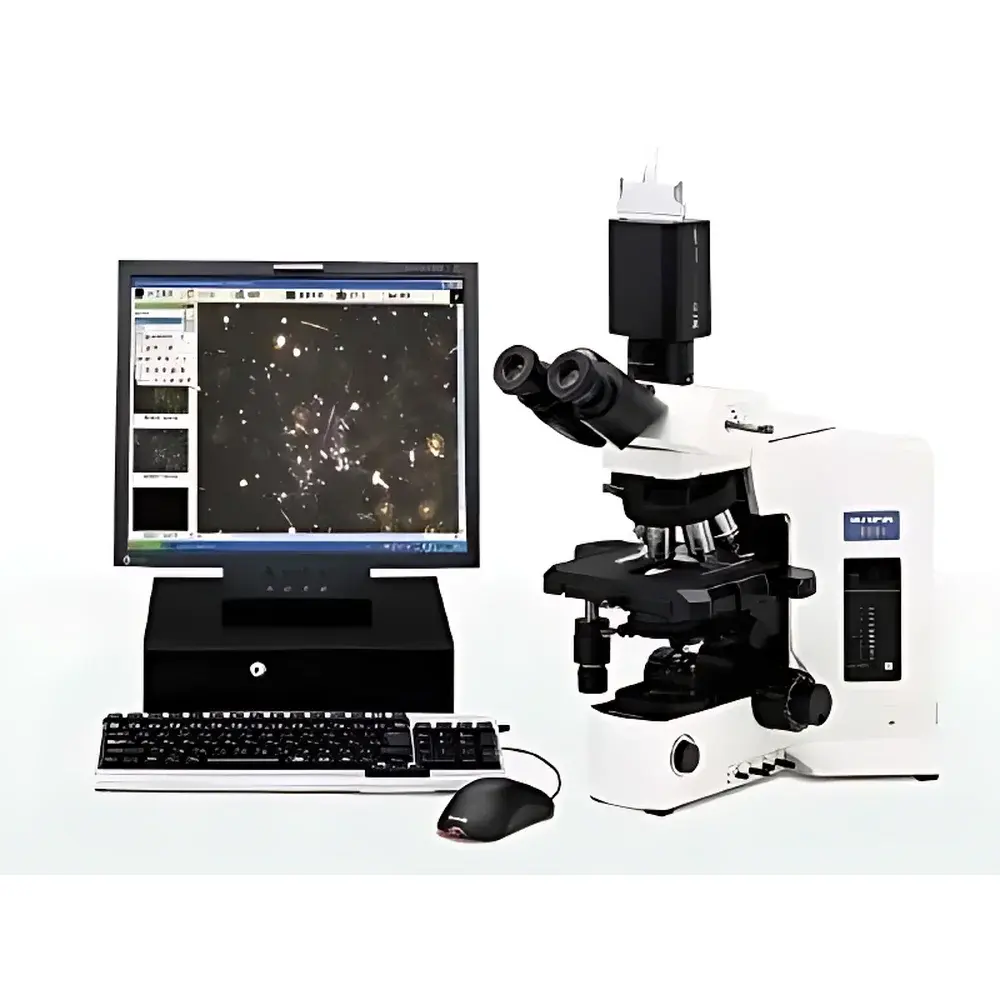

Olympus BX51-P Polarizing Microscope
| Brand | Olympus |
|---|---|
| Origin | Japan |
| Manufacturer | Olympus Corporation |
| Product Type | Imported High-End Polarizing Microscope |
| Model | BX51-P |
| Pricing | Available Upon Request |
Overview
The Olympus BX51-P is a research-grade polarizing microscope engineered for precision crystallographic analysis, geological thin-section evaluation, polymer characterization, and advanced materials science applications. It employs the UIS2 (Universal Infinity System 2) infinite-conjugate optical design—a hallmark of Olympus optical engineering—optimized specifically for polarized light microscopy (PLM). The system operates on the fundamental principle of double-beam interference through orthogonal polarizers (polarizer and analyzer), enabling quantitative birefringence measurement, extinction angle determination, and conoscopic observation of uniaxial and biaxial crystals. Its optical path accommodates full integration of retardation plates (e.g., λ/4, λ, and quartz wedge compensators), Bertrand lens, and strain-free objectives—ensuring high-fidelity polarization contrast with minimal instrumental birefringence. Designed for compliance with ISO 10934-1 (Microscopy — Nomenclature of components for polarizing microscopes) and aligned with ASTM D4124 (Standard Test Method for Determining Birefringence of Polymeric Films), the BX51-P delivers metrologically traceable imaging performance across academic, industrial QC, and regulatory laboratory environments.
Key Features
- UIS2 infinite-corrected optical system with ultra-low intrinsic birefringence in all optical components—including objectives, condenser, and beam splitters—ensuring high-contrast, artifact-free polarized images at all magnifications.
- Strain-free ACHN-P achromatic and UPLFLN-P semi-apochromatic polarizing objectives (5×–100×), each individually corrected for chromatic and spherical aberration under polarized illumination; UPLFLN-P series supports DIC, UV-excited fluorescence, and PLM in a single objective platform.
- Ergonomic Y-frame stand with 35 mm coarse focus travel and 0.1 mm/rev fine focus resolution; integrated tension adjustment for consistent focusing torque across extended usage periods.
- Rotating mechanical stage with 45° detent locking, centerable rotation axis, and dual-axis X–Y translation (76 × 52 mm range); enables precise orientation-dependent measurements of extinction angles and optic axis alignment.
- Dual-mode observation turret supporting rapid switching between orthoscopic (direct image) and conoscopic (interference figure) modes; Bertrand lens is focusable and removable for real-time optimization of interference pattern sharpness and symmetry.
- 100 W halogen transmitted-light illumination (12 V) with field and aperture diaphragm control, Köhler illumination alignment capability, and optional IR-cut filter to minimize thermal drift during long-duration acquisitions.
Sample Compatibility & Compliance
The BX51-P accepts standard 26 mm and 32 mm diameter glass slides, coverslips (0.13–0.17 mm thickness), and specialized mounting media including Canada balsam, Cargille refractive index oils, and epoxy-based embedding resins. Its optical train is fully compatible with ASTM E112 (grain size determination), ISO 9276-3 (particle shape analysis via birefringence), and USP (microscopic identification of pharmaceutical excipients). All polarization components—including the 360° graduated analyzer (0.1° vernier scale), strain-free condenser, and removable polarizer—meet GLP documentation requirements for audit-ready calibration records. The instrument’s mechanical stability and thermal inertia comply with ISO 10934-2 for vibration resistance in shared lab environments.
Software & Data Management
The BX51-P integrates seamlessly with Olympus cellSens™ Digital Imaging Software (v2.4+), supporting time-lapse polarization sequences, multi-channel birefringence quantification (retardation mapping in nm), and automated extinction angle annotation. Raw image metadata includes objective ID, analyzer angle, compensator type, and illumination intensity—all embedded in TIFF/OME-TIFF formats for FDA 21 CFR Part 11–compliant data archiving. Optional hardware modules include motorized analyzer rotation (±0.05° repeatability) and encoded objective turrets for fully traceable acquisition logs. Exported datasets conform to MIAME and MIAPE standards for publication-grade reproducibility.
Applications
- Geological petrography: Quantitative identification of mineral assemblages, optical sign determination, and twinning analysis in thin sections.
- Pharmaceutical solid-state characterization: Polymorph screening, crystallinity assessment, and hydrate/solvate differentiation via birefringence magnitude and orientation.
- Materials science: Stress-induced birefringence mapping in polymer films, liquid crystal alignment verification, and composite fiber orientation analysis.
- Forensic fiber analysis: Discrimination of synthetic vs. natural fibers based on retardation dispersion and interference color sequences.
- Biomedical research: Collagen fiber organization in connective tissue, starch granule morphology in plant histology, and chiral biomolecular assemblies.
FAQ
Is the BX51-P compatible with third-party digital cameras?
Yes—via C-mount or F-mount adapters, provided the camera sensor format (e.g., 1″, APS-C) matches the microscope’s image circle (22 mm field number). Olympus provides mechanical and electrical synchronization protocols for shutter timing and LED illumination control.
Can the BX51-P perform quantitative retardation measurements?
Yes—when used with calibrated compensators (e.g., quartz wedge or gypsum plate) and cellSens software, it enables linear retardation quantification from 0.5 nm to >5,000 nm with ±2% uncertainty (NIST-traceable calibration recommended).
Does the system support reflected-light polarized observation?
No—the BX51-P is configured exclusively for transmitted-light polarized microscopy. For reflected-light PLM, Olympus recommends the BX61-P or BX53-P with dedicated epi-polarizer modules.
What maintenance is required to preserve polarization fidelity?
Annual verification of analyzer zero-point accuracy and objective strain calibration using a quartz reference slide is recommended per ISO 10934-3. Cleaning must use only non-birefringent solvents (e.g., spectroscopic-grade ethanol) and lint-free optical wipes.
Is the BX51-P suitable for GMP-regulated environments?
Yes—when deployed with IQ/OQ/PQ documentation packages, electronic logbooks, and 21 CFR Part 11–enabled software configurations, it meets EMA and FDA expectations for instrument qualification in pharmaceutical quality control labs.





