
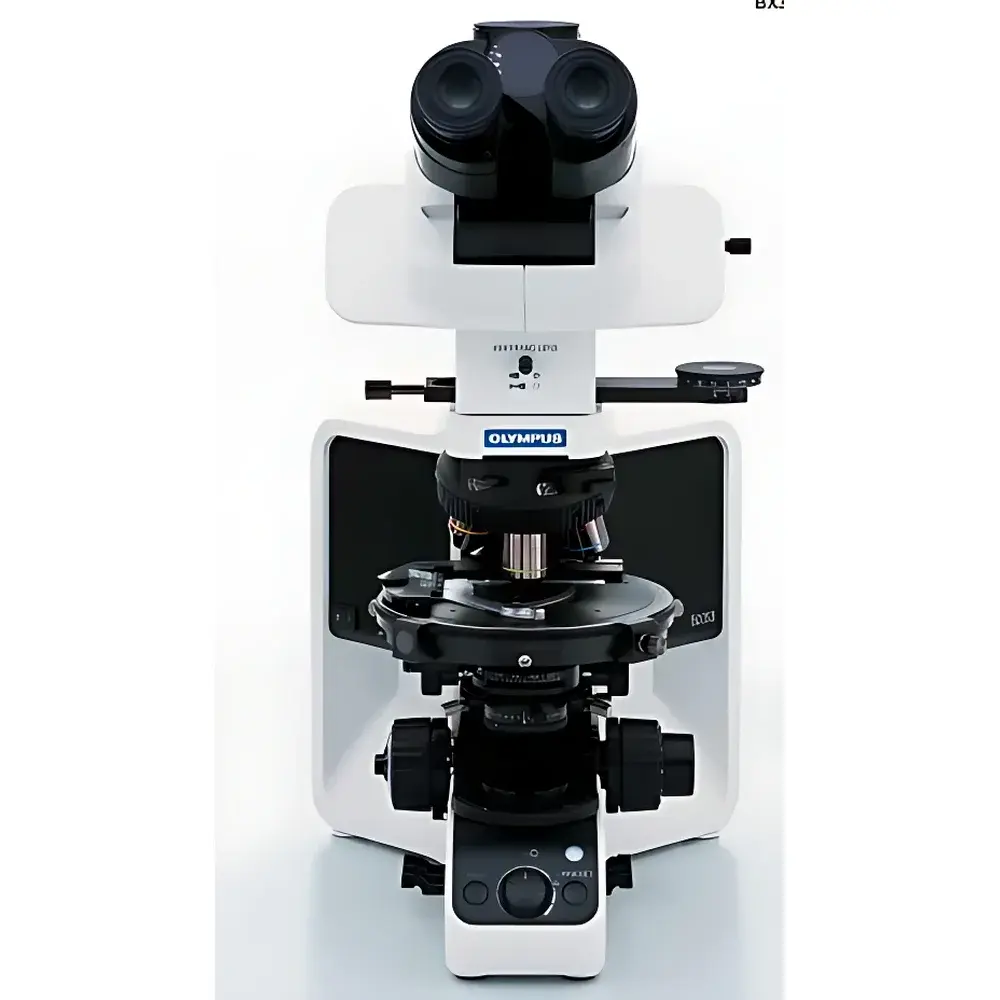
Olympus BX53-P Research-Grade Polarizing Microscope
| Brand | Olympus |
|---|---|
| Origin | Japan |
| Model | BX53-P |
| Optical System | UIS2 Infinity-Corrected |
| Polarization Contrast Mechanism | Rotating Polarizer/Analyzer with Precision Alignment |
| Condenser | U-PCD3 Polarizing Condenser with Centering Adjustment |
| Analyzer | U-AN360 Rotatable Analyzer (0–360°, 1° graduations, 45° detents) |
| Stage | U-PST360 Precision Rotatable Polarizing Stage (3-point centering, 360° rotation, lockable at any position) |
| Bertrand Lens | U-BR360 with Iris Diaphragm for Sharp Conoscopic Imaging |
| Accessories | U-CPA Conoscopy Attachment for Rapid Switching Between Orthoscopic and Conoscopic Modes |
| Compensators | Six Standard Compensators (λ-, λ/4-, Quartz Wedge, Berek, Senarmont, Mica) |
| Retardation Range | 0–20λ (≈0–10,000 nm) |
| Objective Lenses | ACHN-P and UPLFLN-P Strain-Free Plan Apochromat Objectives (EF > 10,000:1) |
| Compatibility | DIC, Fluorescence, and Standard Brightfield Modules |
| Compliance | Designed to Support ISO 9001 Manufacturing Standards |
Overview
The Olympus BX53-P is a research-grade polarizing microscope engineered for quantitative birefringence analysis and high-fidelity anisotropic material characterization. Built upon the UIS2 infinity-corrected optical platform, it delivers exceptional image fidelity, minimal internal stress in optical pathways, and precise polarization control—essential for crystallography, geology, polymer science, and biomedical applications involving birefringent structures. Its core measurement principle relies on controlled orthogonal polarization states combined with calibrated retardation compensation, enabling accurate determination of optical path difference (OPD), fast/slow axis orientation, and extinction angles. The system supports both orthoscopic (direct imaging) and conoscopic (interference figure) observation modes, with seamless transition via the U-CPA attachment. Critical optical components—including the UPLFLN-P strain-free objectives and U-AN360 analyzer—are manufactured under stringent thermal and mechanical stability protocols to ensure long-term reproducibility across laboratories and regulatory environments.
Key Features
- UIS2 infinity-corrected optics optimized for polarized light transmission, minimizing chromatic and polarization aberrations
- U-PST360 precision rotatable stage with three-point centering mechanism, 360° continuous rotation, 1° engraved scale, and positive 45° detents for repeatable angular positioning
- U-AN360 rotatable analyzer featuring fine vernier scale and locking collar for sub-degree angular resolution during extinction angle measurement
- U-BR360 Bertrand lens with integrated iris diaphragm—enables sharp, high-contrast interference figure acquisition without vignetting or diffraction artifacts
- U-CPA conoscopy attachment allows rapid, tool-free switching between orthoscopic and conoscopic observation without realignment
- Six interchangeable compensators (including quartz wedge, Berek, Senarmont, and mica plates) covering a full retardation range from 0 to 20λ (~0–10,000 nm)
- Strain-free UPLFLN-P plan apochromat objectives with EF (extinction factor) exceeding 10,000:1—critical for detecting weak birefringence in biological tissues or thin polymer films
- Modular design compatible with differential interference contrast (DIC), fluorescence, and transmitted brightfield illumination paths
Sample Compatibility & Compliance
The BX53-P accommodates standard 26 mm and 32 mm diameter thin sections (e.g., geological petrographic slides, polymer films, collagen gels, starch granules, and liquid crystal cells). Its stage accepts both manual mechanical stages and motorized XY platforms for automated mapping. All polarizing components meet ISO 10110-7 surface quality standards and are certified for low intrinsic birefringence. While the instrument itself is not FDA-cleared, its architecture supports integration into GLP-compliant workflows when paired with validated digital imaging systems (e.g., Olympus cellSens software with 21 CFR Part 11 audit trail modules). It adheres to IEC 61000-6-3 EMC emission limits and complies with JIS Z 8121 for photometric calibration traceability.
Software & Data Management
When used with Olympus cellSens Dimension software, the BX53-P enables quantitative retardation mapping, multi-channel polarization vector analysis, and time-lapse birefringence tracking. The software supports calibration against NIST-traceable retardation standards and exports OPD data in CSV/TIFF formats for third-party statistical analysis (e.g., MATLAB, Python-based birefringence quantification pipelines). Optional hardware synchronization modules allow coordinated acquisition with external detectors (e.g., sCMOS cameras, photometric sensors) for dynamic polarization studies. All measurement metadata—including analyzer angle, compensator type, objective ID, and exposure parameters—is embedded in TIFF headers for full experimental provenance.
Applications
- Geological petrography: Identification of mineral species, symmetry class determination, and optic sign analysis using interference figures
- Materials science: Characterization of residual stress in injection-molded polymers, liquid crystal alignment uniformity, and fiber orientation in composites
- Pharmaceutical development: Crystallinity assessment of active pharmaceutical ingredients (APIs), polymorph screening, and hydrate/solvate phase identification per USP
- Biomedical research: Quantitative analysis of collagen birefringence in connective tissue pathology, myelin sheath integrity in neural tissue, and starch digestion kinetics
- Forensic science: Fiber evidence comparison based on retardation dispersion profiles and extinction angle distributions
FAQ
What is the extinction factor (EF) specification for the UPLFLN-P objectives?
The UPLFLN-P strain-free objectives achieve an EF > 10,000:1, measured as the ratio of intensity in crossed polars versus parallel polars under standardized Köhler illumination.
Can the BX53-P be configured for automated stage scanning and image stitching?
Yes—when equipped with the U-SIC40 motorized XY stage and cellSens software, it supports programmable grid acquisition, focus stacking, and panoramic mosaic generation.
Is the U-CPA attachment required for conoscopic observation?
While alternative Bertrand lens configurations exist, the U-CPA provides optimized conjugate plane alignment and eliminates need for refocusing during ortho-to-cono mode transitions.
How is calibration traceability maintained for retardation measurements?
Olympus provides factory calibration certificates referencing NIST SRM 2085 (quartz plate standards); users may perform in-house verification using certified λ/4 and λ plates supplied with the system.
Does the BX53-P support fluorescence polarization microscopy?
Yes—the UIS2 optical pathway and UPLFLN-P objectives maintain polarization integrity across UV–VIS–NIR bands, enabling linear dichroism and fluorescence anisotropy measurements when integrated with appropriate excitation/emission filters and polarizers.



