
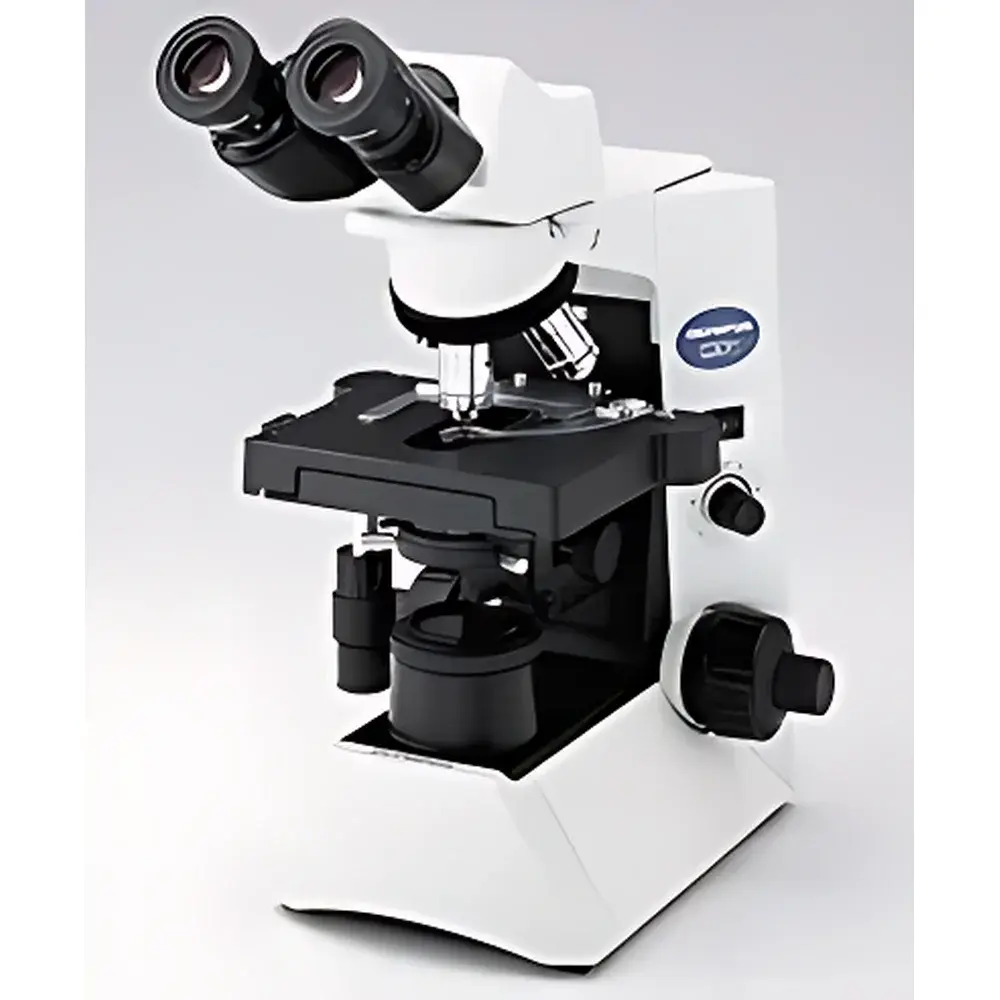
Olympus CX31 Biological Microscope
| Brand | Olympus |
|---|---|
| Origin | Shanghai, China |
| Manufacturer Type | Authorized Distributor |
| Country of Origin | China |
| Model | CX31 |
| Instrument Type | Upright Microscope |
| Optical System | UIS2 Infinity-Corrected Optics |
| Illumination | Built-in Köhler Illumination with 6 V, 30 W Halogen Lamp (100–120 V / 220–240 V, 50/60 Hz) |
| Focus Mechanism | Coaxial Coarse/Fine Adjustment (Coarse Travel: 36.8 mm/rev, Total Vertical Travel: 25 mm |
| Fine Travel | 0.2 mm/rev), with Coarse Limit Stop and Tension Adjustment Ring |
| Nosepiece | Inclined 4-Position Fixed Objective Turret |
| Observation Tube | Binocular or Trinocular, 30° Inclination, Interpupillary Distance: 48–75 mm |
| Field Number | 20 |
| Stage | Mechanical Stage (188 × 134 mm), X–Y Travel: 76 × 50 mm, Dual-Slide Holder with Rubber Caps |
| Condenser | Abbe Condenser (N.A. 1.25 with Oil Immersion), Integrated Daylight Filter and Iris Diaphragm |
| Dimensions & Weight | 233 (W) × 411 (H) × 367.5 (D) mm, Approx. 8 kg |
| Anti-Fungal Treatment | Applied to Eyepieces, Observation Tube, and Objectives |
Overview
The Olympus CX31 Biological Microscope is an upright, infinity-corrected microscope engineered for routine clinical diagnostics, undergraduate and graduate life science education, and applied research in cell biology, microbiology, parasitology, immunology, and plant sciences. It employs the UIS2 (Universal Infinity System 2) optical platform — a robust, field-proven design originally developed for Olympus’ higher-tier research microscopes — adapted for reliability, ergonomic usability, and long-term stability in high-throughput teaching labs and hospital pathology departments. The UIS2 system ensures chromatic and spherical aberration correction across the full visual field, enabling consistent image fidelity from center to periphery at magnifications ranging from 40× to 1000× (with oil immersion). Its Köhler illumination architecture — featuring a built-in 6 V, 30 W halogen lamp, integrated field and aperture diaphragms, and an Abbe condenser with N.A. 1.25 — delivers uniform brightness and optimal contrast across all standard brightfield applications. Designed for daily use under variable environmental conditions, the CX31 incorporates anti-fungal treatment on all major optical components (eyepieces, objectives, observation tube), ensuring sustained optical performance even in humid or tropical climates without degradation of lens coatings or cement integrity.
Key Features
- UIS2 infinity-corrected optical system with Plan C (PLC) achromatic-aplanatic objectives — delivering ≥95% flat-field correction at 10× and 40× magnifications, minimizing edge distortion and enhancing quantitative assessment of cellular morphology.
- Ergonomic coaxial focusing mechanism with adjustable tension control and coarse limit stop — preventing objective-lens collision during rapid focusing, especially critical when switching between low- and high-dry or oil-immersion objectives.
- Inclined 4-position nosepiece with forward-access geometry — facilitating unobstructed sample positioning and rapid objective exchange without repositioning the user’s hands or compromising workspace clearance.
- Mechanical stage with low-profile, wire-driven controls and dual-slide clamps — enabling precise, backlash-free X–Y translation and stable specimen handling during time-lapse observation of live cultures or motile organisms.
- Integrated Abbe condenser with centerable aperture diaphragm and daylight filter — supporting Köhler alignment verification and optimization of resolution vs. contrast trade-offs per ISO 8578 and ASTM E2877 standards for light microscopy validation.
- Trinocular port (optional) compatible with C-mount adapters — enabling seamless integration with digital cameras compliant with USB 3.0 or HDMI output protocols for documentation, archiving, and classroom projection.
Sample Compatibility & Compliance
The CX31 accommodates standard 1″ × 3″ glass slides (including depression and chambered slides), coverslips (No. 1.5, 0.17 mm thickness), and petri dish-mounted specimens via optional stage adapters. It supports routine brightfield imaging of fixed and live unstained specimens (e.g., yeast, protozoa, blood smears), as well as stained preparations (e.g., Gram, Giemsa, H&E). With accessory kits — including CX-PH1/2/3 phase contrast sliders, CH2-DS darkfield stop, and CX-RFL-2 epi-fluorescence illuminator — the platform extends to phase contrast (10×, 40×, 100×), darkfield (4×–40×), and dual-band (blue/green excitation) fluorescence modalities. All optical and mechanical configurations comply with IEC 61000-6-3 (EMC emissions) and IEC 61010-1 (safety requirements for laboratory equipment). The UIS2 optical path maintains alignment stability under GLP/GMP audit conditions, and its reproducible illumination profile supports method validation per CLSI EP17-A2 and ISO/IEC 17025 documentation requirements.
Software & Data Management
While the CX31 itself is hardware-only, its trinocular configuration enables direct coupling with third-party imaging software platforms — including Olympus cellSens Entry (licensed separately), ImageJ/Fiji (open-source), and commercial packages such as Media Cybernetics Image-Pro Premier and Leica LAS X Core. When paired with a compliant USB 3.0 CMOS camera (e.g., Olympus UC50 or equivalent), the system supports timestamped image capture, multi-focus stacking, region-of-interest annotation, and export in TIFF, JPEG2000, or OME-TIFF formats for FAIR data principles compliance. Audit trail functionality (user ID, acquisition timestamp, objective used, exposure settings) is preserved in EXIF metadata — satisfying basic traceability needs under FDA 21 CFR Part 11 for non-GxP educational environments and preliminary research workflows.
Applications
The CX31 serves as a foundational instrument across academic, clinical, and industrial laboratories. In university teaching labs, it supports student-led experiments in mitotic staging, bacterial motility assays, fungal hyphal growth kinetics, and hematology differential counts. In hospital core labs, it remains widely deployed for urinalysis sediment screening, peripheral blood film review, and rapid Gram stain interpretation. Industrial users apply it for QC of microbial cultures in bioproduction, mycological inspection of raw materials, and morphological verification of algae or probiotic strains. Its mechanical stability and thermal inertia make it suitable for extended-duration observation of adherent mammalian cells in CO₂-independent media — though not designed for active environmental control (e.g., stage incubators or motorized Z-drives), limiting its utility in advanced live-cell imaging protocols requiring sub-micron tracking or photostability quantification.
FAQ
Is the CX31 compatible with digital imaging systems?
Yes — the trinocular version accepts standard C-mount adapters and supports USB 3.0 or HDMI cameras up to 5 MP resolution. Olympus provides driver support for UC-series cameras via cellSens software.
Can the CX31 perform fluorescence imaging?
Only with the optional CX-RFL-2 epi-fluorescence attachment, which provides BP450–490 nm (blue) and BP510–550 nm (green) excitation filters and corresponding barrier filters. No built-in fluorescence light source is included.
Does the CX31 meet international safety and electromagnetic compatibility standards?
Yes — certified to IEC 61010-1 (safety) and IEC 61000-6-3 (EMC emissions) for laboratory use in North America, EU, and APAC markets.
What maintenance is required for long-term optical performance?
Annual cleaning of condenser lenses and lamp housing is recommended; objective front lenses should be cleaned only with lens tissue and xylene-free optics cleaner. Anti-fungal coating eliminates need for desiccant storage in humid regions.
Is service and parts support available globally?
Olympus authorized service centers provide calibration, alignment verification, and spare-part fulfillment (e.g., bulbs, fuses, stage components) under regional distributor agreements; UIS2-compatible objectives are cross-interchangeable with CX2/CX33 platforms.



