
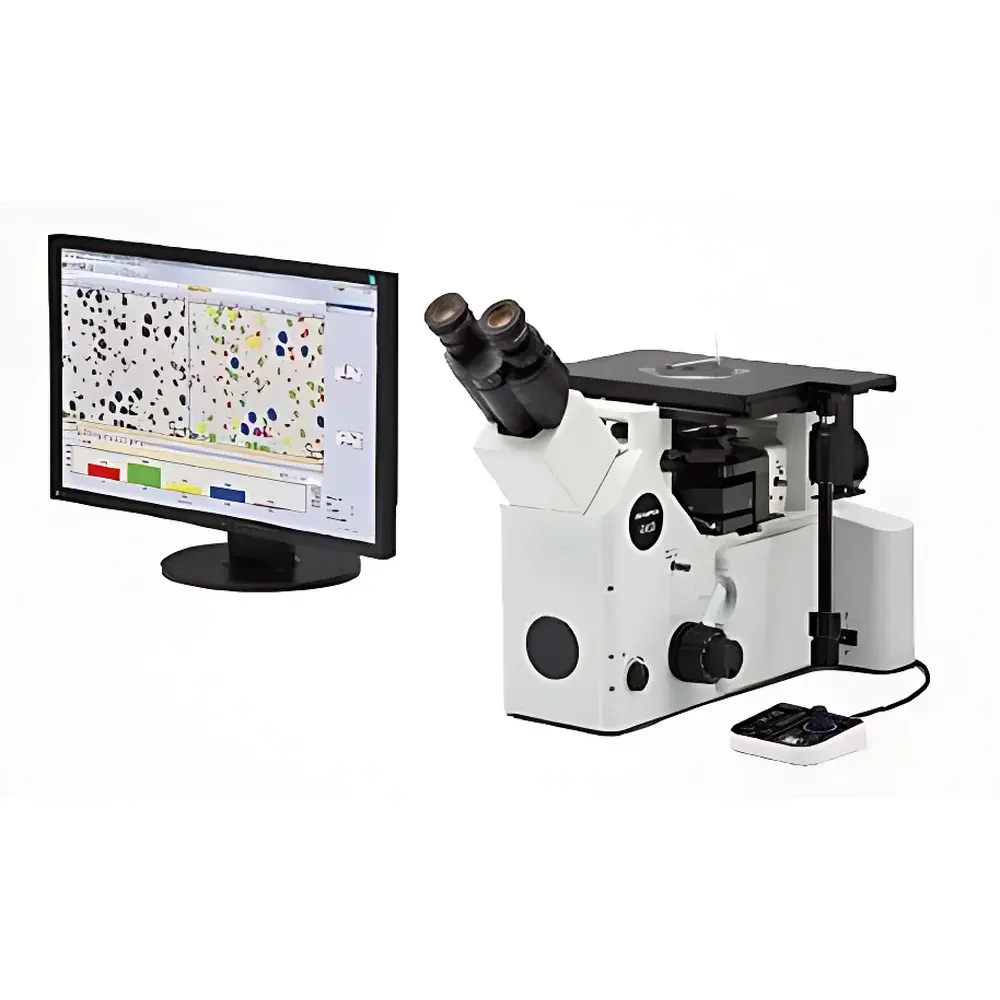
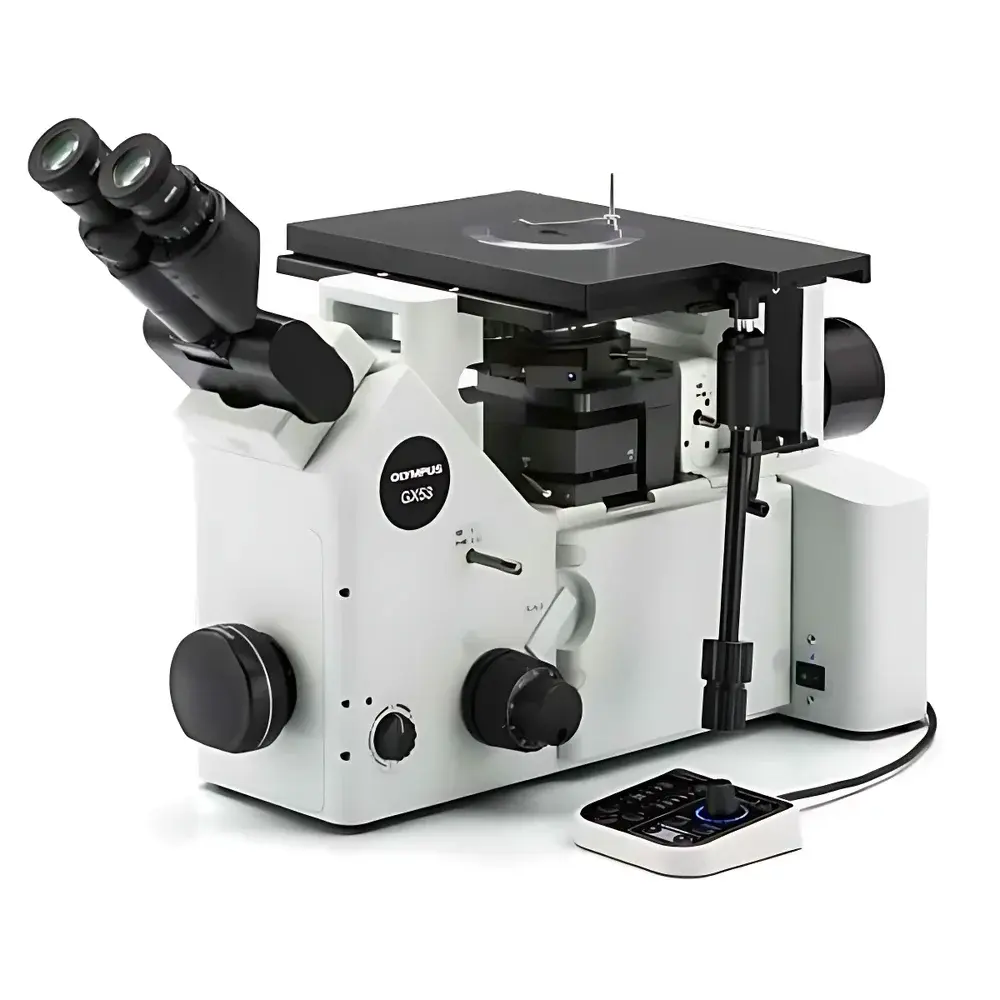
Olympus GX53 Inverted Metallurgical Microscope
| Brand | Olympus |
|---|---|
| Origin | Japan |
| Manufacturer Type | Original Equipment Manufacturer (OEM) |
| Import Status | Imported |
| Model | GX53 |
| Configuration | Inverted |
| Integrated Image Analysis System | Yes |
| Total Magnification Range | 50×–2000× |
| Eyepieces | 2 |
| Objective Lenses | 5 |
Overview
The Olympus GX53 Inverted Metallurgical Microscope is an engineered solution for high-precision microstructural analysis of opaque, polished, and sectioned metallic specimens. Designed around the inverted optical configuration—where objectives are positioned beneath the stage and illumination is delivered from below—the GX53 enables rapid, non-destructive examination of bulky, heavy, or irregularly shaped samples without requiring planar preparation of the specimen base. This architecture eliminates constraints imposed by conventional upright metallurgical microscopes, particularly in industrial quality control labs handling castings, forgings, weldments, or large-sectioned components. The system operates on standard brightfield (BF), darkfield (DF), and differential interference contrast (DIC) optical principles, with integrated MIX illumination combining BF and DF in real time to simultaneously resolve surface topography and subsurface features across heterogeneous microstructures.
Key Features
- Inverted optical design optimized for metallurgical sample handling: accommodates specimens up to 100 mm in height and 5 kg in mass without stage modification.
- MIX illumination technology: dynamic, hardware-synchronized overlay of brightfield and darkfield channels delivering simultaneous contrast enhancement across grain boundaries, inclusions, and phase interfaces.
- Extended Focus Imaging (EFI): automated z-stack acquisition with sub-micron step resolution, generating single composite images with uniform focus depth across steep topographic gradients—validated for ASTM E112 grain size analysis and ISO 9276 particle characterization.
- High Dynamic Range (HDR) imaging: captures full luminance range within a single frame, preserving detail in both highly reflective intermetallic phases and low-reflectivity oxide layers.
- Wavefront aberration-corrected optics: apochromatic objective lenses (5×, 10×, 20×, 50×, 100×) with chromatic and spherical aberration compensation across visible spectrum (400–700 nm).
- Stable white LED illumination: 5700 K correlated color temperature maintained ±150 K over 10,000 hours; intensity digitally regulated with 0.1% linearity.
- Real-time image shadow correction: pixel-level flat-field compensation applied during acquisition to eliminate vignetting and illumination non-uniformity.
- Automated calibration workflow: supports traceable magnification verification per ISO/IEC 17025 requirements using certified stage micrometers and NIST-traceable reference standards.
Sample Compatibility & Compliance
The GX53 accepts standard metallurgical sample formats—including 30 mm, 40 mm, and 50 mm diameter mounts—as well as unmounted sections up to 150 × 100 mm. Its reinforced mechanical stage supports coarse/fine dual-focus mechanisms with 0.1 µm Z-resolution and ±0.02 µm repeatability. The system complies with IEC 61000-6-3 (EMC emissions), IEC 61000-6-2 (immunity), and UL 61010-1 safety standards. When operated with Olympus Stream software configured for audit trail and electronic signature, it satisfies FDA 21 CFR Part 11 requirements for regulated environments. Routine use aligns with ASTM E3, E7, E112, E1245, ISO 643, ISO 4967, and EN 10247 for microstructure evaluation, inclusion rating, and graphite morphology assessment.
Software & Data Management
The GX53 integrates natively with Olympus Stream 2.5+ software—a modular platform supporting GLP/GMP-compliant workflows. Core modules include: Stream Basic (image capture and annotation), Stream Advanced (automated particle analysis, grain boundary detection, phase fraction quantification), and Stream Materials (customizable reporting templates compliant with ISO/IEC 17025 documentation standards). All image metadata—including objective ID, magnification, illumination mode, exposure parameters, and calibration timestamps—is embedded in TIFF and OME-TIFF containers. Audit trails record user actions, parameter changes, and report generation events with immutable timestamps. Data export supports CSV, XML, and PDF/A-2b formats for long-term archival and regulatory submission.
Applications
- Quantitative metallography: grain size distribution (ASTM E112), inclusion rating (ASTM E45, ISO 4967), graphite nodule count and spheroidization index (ISO 945-1) in ductile iron.
- Failure analysis: crack path mapping, fatigue striation measurement, decarburization depth profiling in heat-treated steels.
- Weld inspection: HAZ microstructure characterization, porosity quantification, and intermetallic phase identification in aluminum and nickel alloys.
- Advanced materials R&D: carbide/matrix distribution analysis in tool steels, oxide layer thickness measurement in high-temperature alloys, and second-phase particle dispersion in powder metallurgy compacts.
- Process validation: batch-to-batch consistency monitoring in foundry and forging operations using statistically significant image sets (n ≥ 50 fields per sample).
FAQ
What observation methods does the GX53 support?
Brightfield, darkfield, differential interference contrast (DIC), polarized light, and MIX (simultaneous BF+DF) — all selectable via motorized turret and software-controlled illumination paths.
Is EFI compatible with all objective lenses?
Yes, Extended Focus Imaging is fully supported across the entire 5-objective lineup (5×–100×), with Z-step optimization automatically adjusted per magnification and numerical aperture.
Can the GX53 be integrated into a laboratory information management system (LIMS)?
Stream software provides RESTful API and HL7-compatible data export for bidirectional integration with major LIMS platforms, including LabWare, Thermo Fisher SampleManager, and Siemens Opcenter.
Does the system meet ISO/IEC 17025 calibration traceability requirements?
Yes—when used with Olympus-certified calibration kits and documented procedures, the GX53 supports metrological traceability to national standards (e.g., NIST SRM 2055, PTB B111) for magnification, focus accuracy, and illumination uniformity.
What is the warranty coverage for the optical train?
Olympus provides a 3-year limited warranty on all objective lenses and internal optical assemblies, covering wavefront performance degradation beyond ±0.05 λ RMS under normal operating conditions.





