
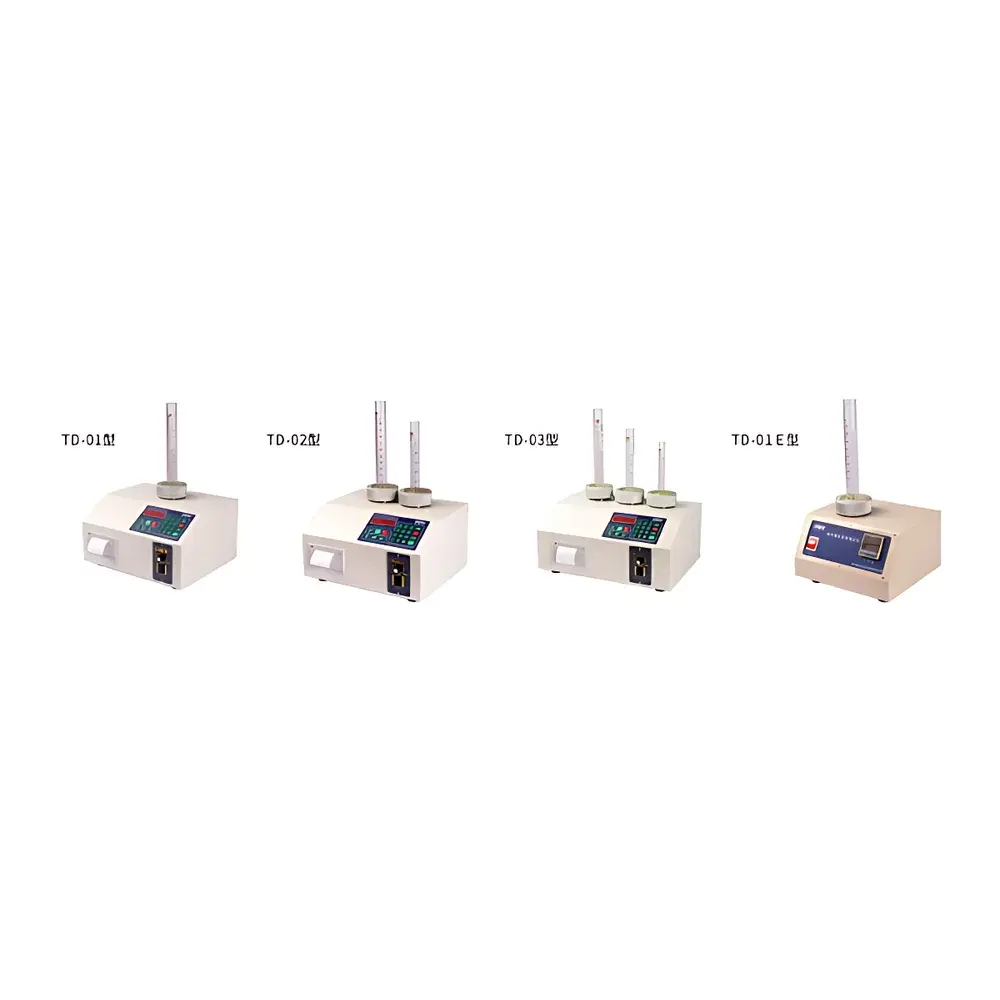
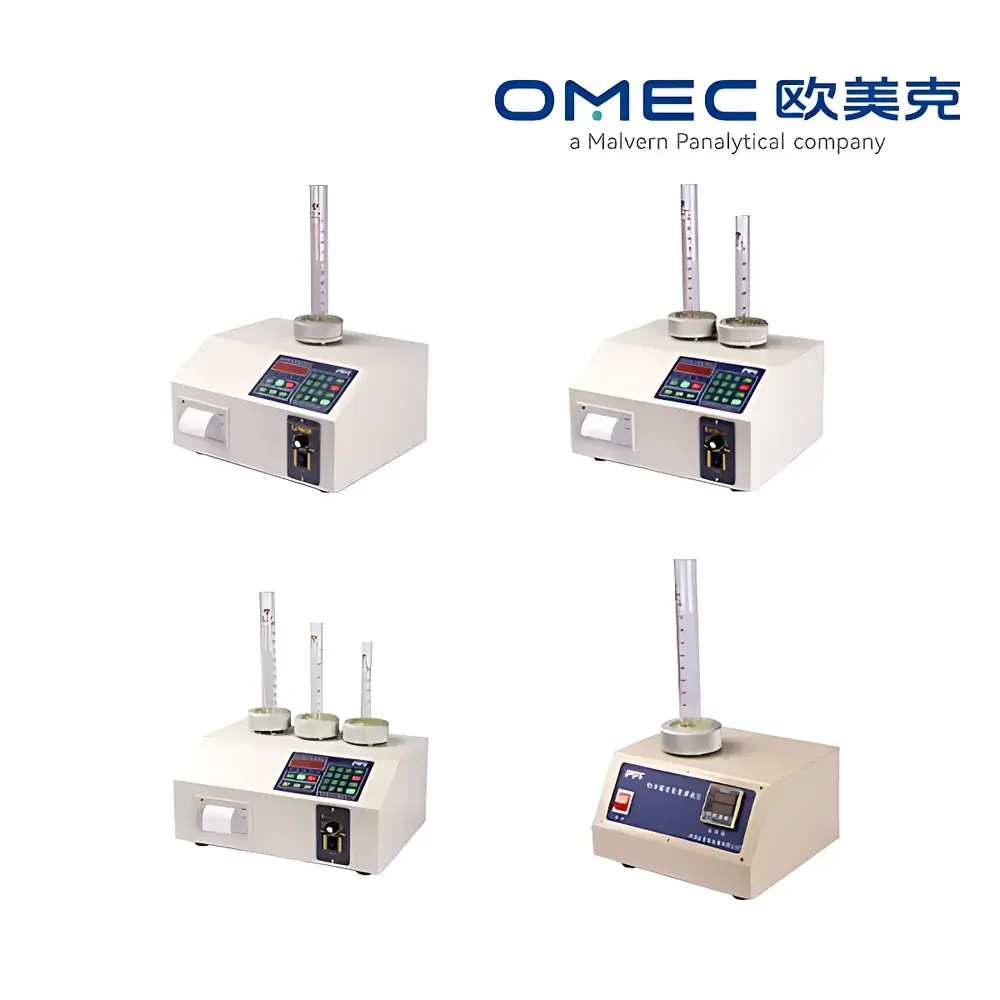
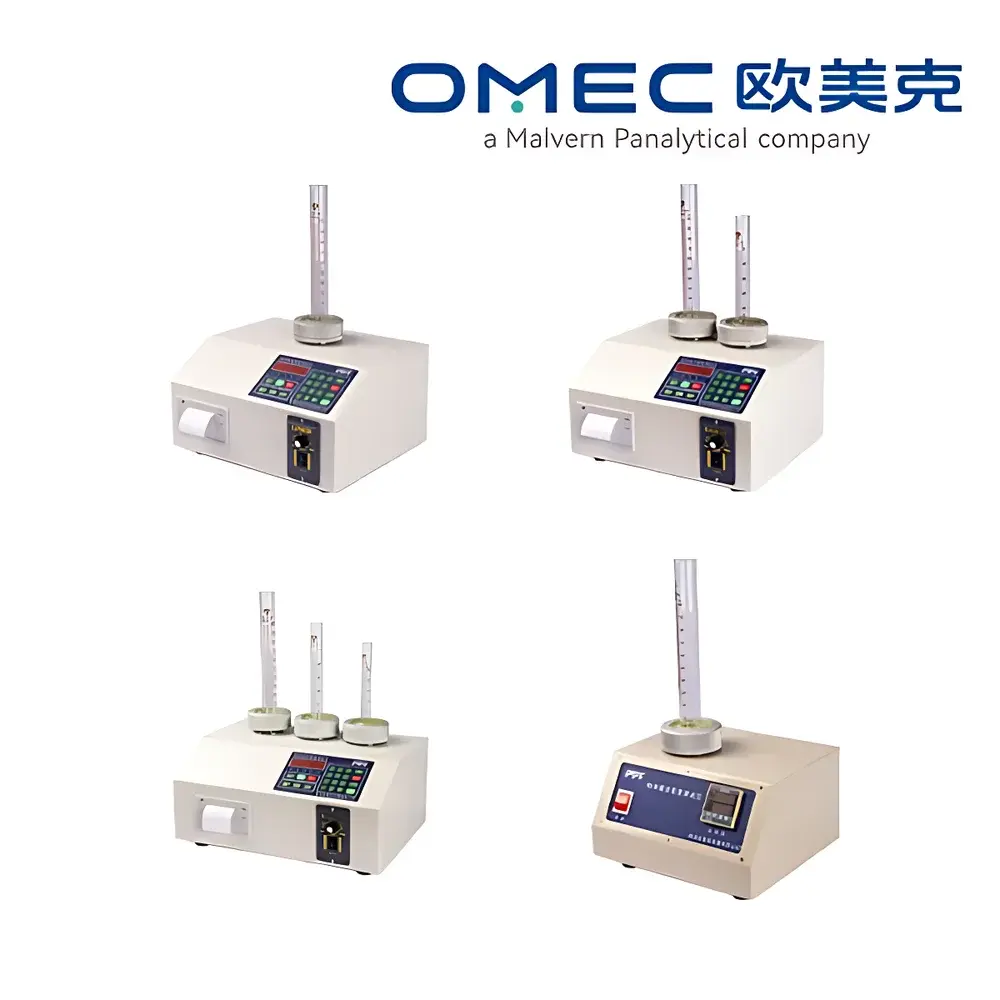
OMEC TD-01/02/03 Tap Density Tester
| Brand | OMEC |
|---|---|
| Origin | Guangdong, China |
| Manufacturer Type | Direct Manufacturer |
| Product Category | Domestic |
| Model | TD-01 / TD-02 / TD-03 |
| Instrument Type | Tap Density Tester |
| Measurable Powder Parameter | Bulk and Tapped Density |
| Maximum Sample Vessel Capacity | 250 mL |
| Minimum Sample Volume | 25 mL |
| Vibration Amplitude Range | 1–15 mm (integer steps) |
| Vibration Frequency Range | 0–300 taps/min (continuously adjustable) |
| Tap Count Range | 0–99,999 (0 = bulk density mode) |
| Power Supply | AC 220 V ±10%, 50 Hz, 40 W |
| Operating Humidity | <85% RH, non-condensing |
| Ambient Requirements | Vibration- and EMI-free environment, dust-free clean space |
Overview
The OMEC TD-01/02/03 Tap Density Tester is an engineered precision instrument designed for the standardized determination of bulk density and tapped density of free-flowing and cohesive powders. Based on the principle of controlled mechanical tapping—where a graduated cylinder containing a defined powder volume undergoes repeated vertical drops from a fixed height—the instrument quantifies volumetric reduction under reproducible mechanical energy input. This method directly reflects interparticle forces, particle shape, surface roughness, and packing behavior, forming a foundational metric in powder characterization workflows. The device complies with ISO 3953:1993 and GB/T 5162–2006 for metallic powders, while its operational flexibility supports broader application across pharmaceutical excipients, battery cathode/anode materials, catalysts, ceramics, and geological samples. Unlike static compaction methods, tap density testing provides high repeatability under defined mechanical stress conditions, making it essential for quality control in GMP-compliant manufacturing environments and pre-formulation development.
Key Features
- Three model variants (TD-01, TD-02, TD-03) support concurrent analysis of 1, 2, or 3 independent samples—enabling efficient comparative studies and statistical validation.
- Digitally controlled vibration amplitude (1–15 mm integer steps) and frequency (0–300 taps/min, continuously adjustable), exceeding the fixed 3 mm amplitude specified in ISO 3953 to accommodate diverse powder rheology profiles.
- Precision optical tap counter with ≤0.01% error per 10,000 cycles ensures traceable, audit-ready cycle logging—critical for FDA 21 CFR Part 11–aligned data integrity requirements.
- Integrated microprocessor controller with real-time parameter display, programmable tap count (0–99,999), and automatic stop functionality upon completion.
- Robust mechanical architecture featuring low-inertia cam-driven tapping mechanism, rigid aluminum frame, and vibration-isolated base—minimizing external interference and ensuring long-term calibration stability.
- Standardized sample vessel compatibility: accepts ASTM D1464–22–compliant cylindrical glass or stainless-steel graduated cylinders (25 mL, 50 mL, 100 mL, and 250 mL volumes supplied).
Sample Compatibility & Compliance
The TD-01/02/03 series accommodates a wide spectrum of dry, granular, and micronized powders—including metal powders (Al, Ni, W, Mo, Cu, Zn), oxide ceramics (TiO₂, Al₂O₃, ZrO₂), pharmaceutical actives and excipients (lactose, microcrystalline cellulose), battery materials (LiCoO₂, graphite, NMC), catalysts, pigments, clays, and geological sediments. All measurements adhere to internationally recognized standards: ISO 3953:1993 (metallic powders), USP (tapped density for pharmaceutical powders), ASTM D4781 (carbon black), and EP 2.9.34 (powder density). The instrument’s design supports GLP/GMP documentation practices, including user-accessible calibration logs, parameter change history, and non-editable test records when paired with optional LIMS integration.
Software & Data Management
While the base configuration operates via embedded firmware with local LCD interface and thermal print output (TD-01/02/03 models), optional PC-based software enables advanced data handling. This software supports CSV export, batch report generation, statistical process control (SPC) charting (e.g., X-bar/R charts), and full audit trail functionality—including operator ID, timestamped parameter settings, raw tap count logs, and final density calculations. Data files comply with ALCOA+ principles (Attributable, Legible, Contemporaneous, Original, Accurate, Complete, Consistent, Enduring, Available) and are compatible with electronic lab notebook (ELN) systems. Thermal printouts include instrument ID, model, serial number, date/time stamp, sample ID, cylinder volume, initial/final volume readings, and calculated densities—satisfying internal QA record retention policies.
Applications
- Pharmaceutical solid dosage development: correlating tapped density with compressibility indices (Carr’s Index, Hausner Ratio) for tablet formulation risk assessment.
- Battery material QC: monitoring electrode powder packing density to predict slurry rheology and calendering behavior.
- Metallurgical powder certification: verifying conformance to MPIF Standard 35 and ISO 3953 specifications prior to sintering.
- Catalyst and adsorbent evaluation: assessing pore accessibility and bed void fraction in fixed-bed reactor design.
- Food and additive processing: quantifying flow consistency across production batches for HACCP-aligned process control.
- Academic research: supporting DEM (Discrete Element Method) model validation through empirical packing density datasets.
FAQ
What standards does the TD-01/02/03 comply with?
It conforms to ISO 3953:1993, GB/T 5162–2006, USP , EP 2.9.34, and ASTM D4781.
Can the instrument measure bulk density only?
Yes—setting tap count to zero initiates bulk density measurement per ASTM D1464 and USP .
Is calibration verification supported?
Yes—users may perform periodic verification using certified reference weights and NIST-traceable volumetric cylinders; calibration certificates are available upon request.
What maintenance is required?
Routine cleaning of cylinder guides and cam surfaces; annual verification of tap height and amplitude using digital calipers and laser displacement sensors.
Does the system support 21 CFR Part 11 compliance?
With optional software and networked user authentication, full electronic signature, audit trail, and data integrity features meet 21 CFR Part 11 requirements.



