
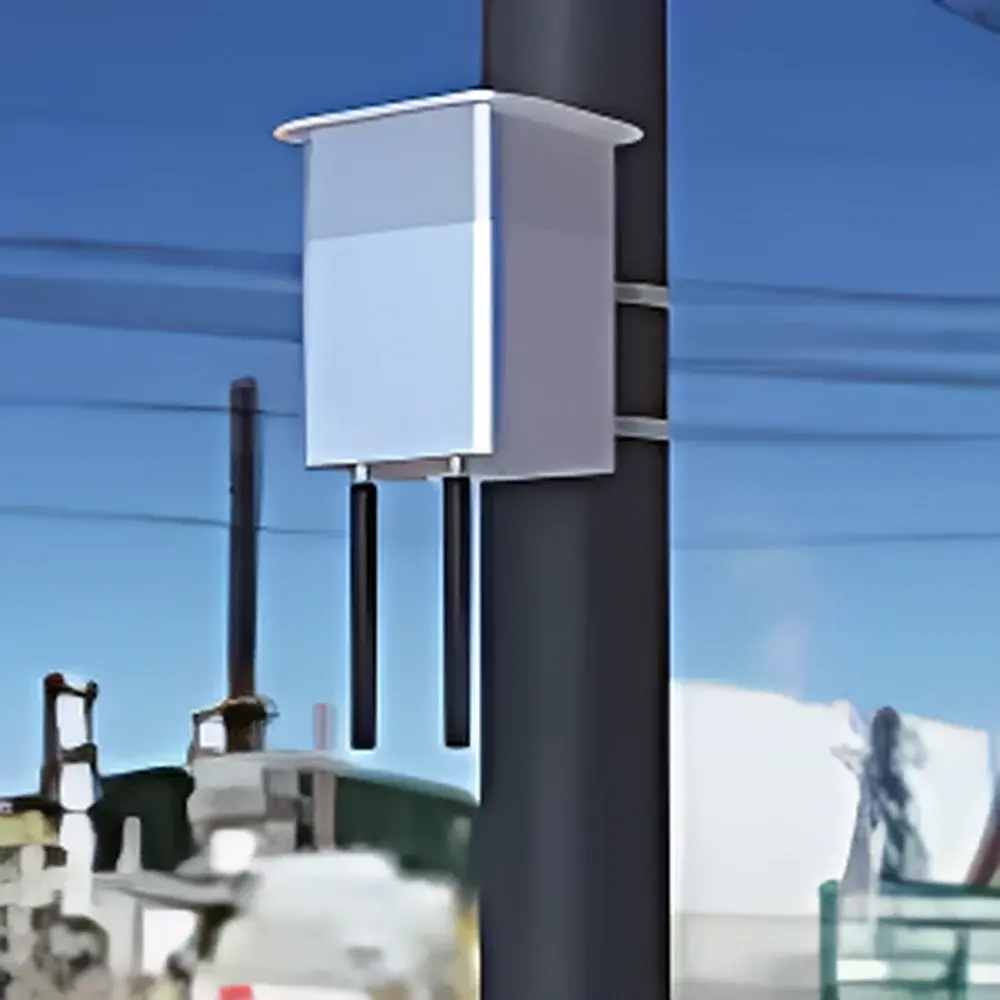
Omni-2100 Distributed Continuous VOC Monitoring System
| Origin | USA |
|---|---|
| Manufacturer Type | Authorized Distributor |
| Origin Category | Imported |
| Model | Omni-2100 |
| Pricing | Available Upon Request |
Overview
The Omni-2100 Distributed Continuous VOC Monitoring System is a field-deployable, cloud-connected analytical platform engineered for real-time, unattended quantification of volatile organic compounds (VOCs) in both indoor and outdoor ambient environments. Unlike traditional grab-sampling or laboratory-based GC-MS workflows, the Omni-2100 employs integrated photoionization detection (PID) coupled with temperature-controlled metal oxide semiconductor (MOS) sensor arrays and embedded multivariate calibration algorithms to deliver simultaneous, selective measurement of up to 20 target VOCs—including benzene, toluene, ethylbenzene, xylenes (BTEX), formaldehyde, acetaldehyde, isoprene, and common aliphatic/aromatic hydrocarbons—at sub-part-per-trillion (ppt) to low-parts-per-trillion (ppb) detection limits. Its architecture follows a distributed sensing paradigm: each unit operates autonomously with on-board signal processing, environmental compensation (temperature, humidity, pressure), and edge-based data reduction—ensuring minimal latency, reduced bandwidth dependency, and compliance with ISO 16000-22 and ASTM D6196 protocols for continuous ambient VOC monitoring.
Key Features
- Simultaneous multi-analyte detection: Quantifies up to 20 VOCs in a single measurement cycle, with calibrated sensitivity down to 1 ppb for key compounds and sub-ppb resolution for select analytes under optimized conditions.
- True real-time operation: Programmable sampling intervals from 30 seconds to 24 hours; response time (T90) < 60 seconds for most target VOCs.
- Zero-carrier-gas design: Eliminates dependency on compressed gas cylinders, reducing operational complexity, maintenance frequency, and total cost of ownership—ideal for long-term unattended deployment.
- Low-power, wide-voltage operation: Rated for 12–24 VDC input; consumes < 8 W average power, enabling solar-battery hybrid configurations for remote off-grid sites.
- Dual-mode connectivity: Integrated dual-band Wi-Fi (2.4 GHz / 5 GHz) and LTE-M/NB-IoT cellular modem (certified for global bands including Band 2/4/5/12/13/20/28) ensures robust communication across heterogeneous network infrastructures.
- Edge-computing architecture: All spectral deconvolution, baseline correction, drift compensation, and calibration application occur locally; only metadata, calibrated concentrations, diagnostic flags, and event-triggered raw snippets are transmitted to the cloud.
Sample Compatibility & Compliance
The Omni-2100 is validated for direct analysis of ambient air without pre-concentration or thermal desorption. It maintains performance across temperature ranges of −20 °C to +50 °C and relative humidity from 10% to 95% non-condensing. Sensor modules are factory-calibrated against NIST-traceable standards and support user-initiated span checks using certified permeation tubes or dynamic dilution sources. The system meets IEC 61000-6-2 (EMC immunity) and IEC 61000-6-4 (EMC emissions) requirements. Data integrity workflows align with GLP principles, supporting audit-ready logs—including sensor health metrics, calibration history, firmware versioning, and timestamped configuration changes. While not FDA-cleared, its data structure and encryption (AES-256 at rest, TLS 1.2+ in transit) are compatible with 21 CFR Part 11-compliant environments when deployed within validated IT infrastructure.
Software & Data Management
The OmniCloud™ Platform provides a unified web-based interface for fleet-wide monitoring, accessible via desktop or mobile browsers. Dashboards display time-series VOC concentration heatmaps, cross-unit correlation matrices, and geolocated device status overlays. Users configure measurement schedules, set dynamic alarm thresholds (e.g., exceedance of WHO indoor air guidelines or EPA Regional Screening Levels), and generate automated PDF reports compliant with ISO 14001 environmental management documentation. Raw and processed datasets export in CSV, NetCDF, or JSON-LD formats—with optional integration into enterprise SCADA, LIMS, or GIS systems via RESTful API. Audit trails record all user actions, parameter modifications, and firmware updates with immutable timestamps and role-based access control (RBAC).
Applications
- Ambient air quality surveillance near industrial perimeters, landfills, and transportation corridors
- Indoor air quality (IAQ) monitoring in schools, hospitals, offices, and residential buildings per ASHRAE Standard 62.1
- Leak detection and repair (LDAR) program support for petrochemical and pharmaceutical facilities
- Post-remediation verification at brownfield sites and vapor intrusion assessment zones
- Research-grade exposure studies requiring high-temporal-resolution VOC profiling across microenvironments
- Early-warning networks for fugitive emissions during chemical manufacturing or storage incidents
FAQ
Does the Omni-2100 require routine calibration with external gas standards?
Yes—while factory calibration remains stable for up to 6 months under typical conditions, quarterly span verification using traceable VOC standards is recommended per ISO 16000-22 Annex B guidance.
Can the system operate offline for extended periods?
Yes—data is buffered locally on industrial-grade eMMC storage (32 GB) for up to 90 days of continuous 1-minute interval logging; synchronization resumes automatically upon network restoration.
Is third-party sensor module replacement supported?
No—sensor cartridges are proprietary, field-swappable units with embedded cryptographic keys; replacement requires authenticated firmware handshake to maintain metrological traceability.
What cybersecurity certifications does the OmniCloud platform hold?
The platform is SOC 2 Type II audited and undergoes annual penetration testing per OWASP ASVS v4.0; it supports SAML 2.0 identity federation and MFA enforcement.
How is interference from humidity or ozone addressed?
Integrated capacitive RH sensors feed real-time compensation coefficients into the PID/MOS fusion algorithm; ozone scrubbers are included upstream of the sampling inlet for environments exceeding 100 ppb background O3.







