
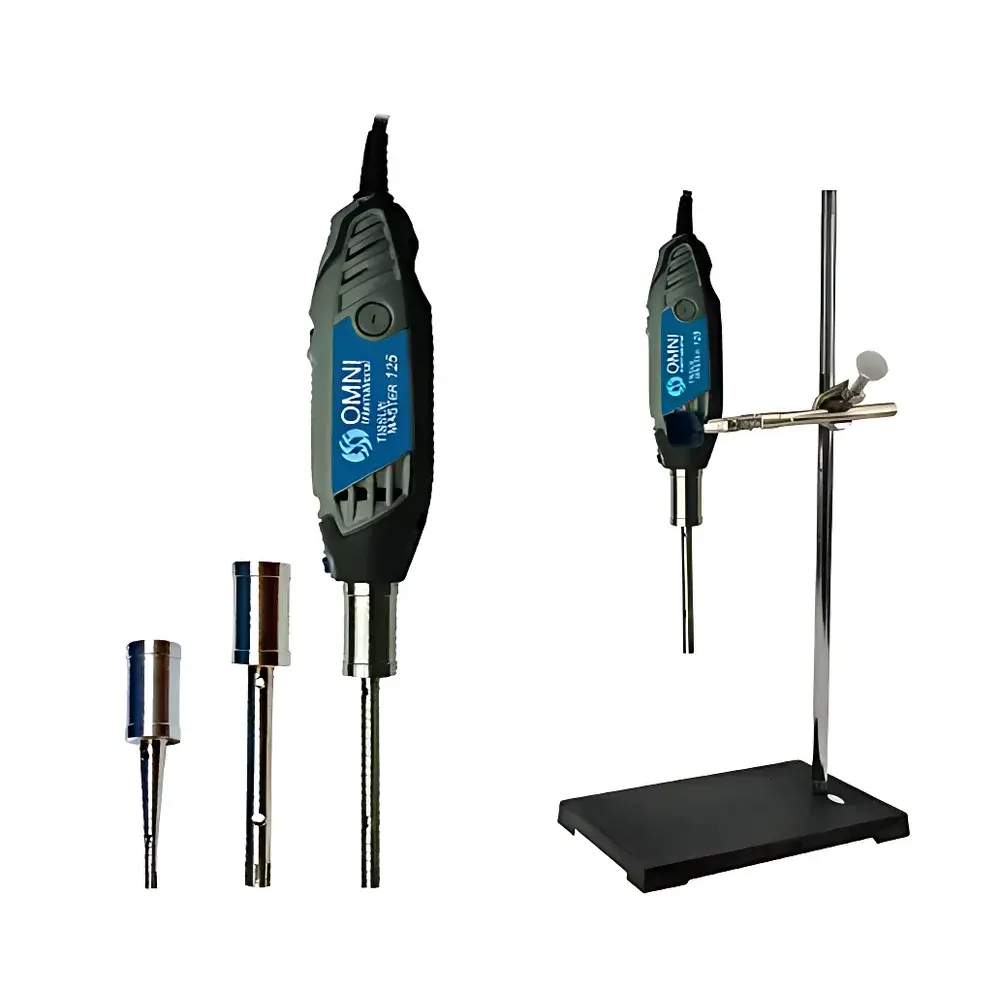
OMNI International Tissue Master Handheld Homogenizer
| Brand | OMNI International |
|---|---|
| Origin | USA |
| Model | Tissue Master |
| Instrument Type | Probe-type Rotor Homogenizer |
| Power | 125 W |
| Speed Range | 5,000–35,000 rpm |
| Noise Level | <72 dB(A) |
| Dimensions (W×D×H) | 40×40×130 mm |
| Sample Volume Range | 0.25–100 mL |
| Available Probe Diameters | 5 mm, 7 mm, 10 mm |
| Probe Length | 85 mm (all diameters) |
| Compatible Vessel Volume per Probe | 5 mm → 0.25–5 mL |
Overview
The OMNI International Tissue Master Handheld Homogenizer is a compact, high-torque probe-based rotor homogenizer engineered for rapid and reproducible mechanical disruption of biological tissues, cells, and soft-to-moderate density samples in research and quality control laboratories. Operating on the principle of high-shear fluid dynamics—where rotational energy from a precisely balanced stainless-steel probe induces turbulent flow, cavitation, and localized shear forces—the Tissue Master achieves efficient lysis and homogenization within seconds. Its ergonomic handheld design, combined with a brushless motor and optimized thermal management, supports routine use across benchtop workflows without requiring external cooling or vacuum systems. The device is particularly suited for applications demanding minimal sample carryover, rapid turnaround between samples, and compatibility with standard microcentrifuge tubes, conical tubes, and small-volume glass or plastic vessels.
Key Features
- Brushless 125 W motor delivering consistent torque across the full speed range (5,000–35,000 rpm), ensuring stable operation even during extended homogenization cycles
- Ergonomic, lightweight housing (40 × 40 × 130 mm) with non-slip grip and integrated on/off switch for single-handed control
- Three interchangeable stainless-steel probes (5 mm, 7 mm, and 10 mm diameter; all 85 mm length) enabling precise matching of probe geometry to sample volume and viscosity—minimizing foaming and heat generation
- Noise level maintained below 72 dB(A) under typical operating conditions, supporting use in shared laboratory environments without dedicated acoustic enclosures
- Probe-specific volume optimization: 5 mm probe for low-volume precision work (0.25–5 mL), 7 mm for general-purpose tissue homogenization (0.5–50 mL), and 10 mm for higher-volume lysates (1.5–100 mL)
- Optional vertical stand available for hands-free operation during repetitive processing or time-course experiments
Sample Compatibility & Compliance
The Tissue Master accommodates a broad spectrum of biological matrices—including mammalian tissues (liver, spleen, muscle), cultured cells, plant leaves, bacterial pellets, and soft food matrices—without requiring pre-chopping or cryogenic pretreatment in most cases. Probes are autoclavable (121 °C, 20 min, standard cycle) and compatible with common laboratory solvents (e.g., ethanol, isopropanol, aqueous buffers, mild detergents). While the instrument itself does not carry CE or FDA 510(k) certification as a medical device, its construction and performance align with ISO 13485-aligned manufacturing practices used by OMNI International. It is routinely employed in GLP-compliant laboratories for sample preparation preceding downstream analyses such as ELISA, Western blotting, qPCR, and protein quantification—where consistency of lysis efficiency directly impacts assay reproducibility.
Software & Data Management
The Tissue Master is a manually operated, analog-controlled instrument with no embedded firmware, touchscreen interface, or digital connectivity. As such, it does not generate electronic records, audit trails, or exportable data logs. This architecture eliminates software validation requirements and supports use in environments where regulatory documentation focuses on procedural SOPs rather than instrument-level electronic records. Users maintain traceability through standardized operating procedures that specify probe type, speed setting, duration (typically 10–30 s), and sample temperature control (e.g., ice bath placement). For labs subject to 21 CFR Part 11 compliance, manual logbook entries—including operator ID, date/time, probe ID, and observed homogenization outcome—are recommended and sufficient when paired with validated protocols.
Applications
- Rapid lysis of fresh or frozen tissue specimens for nucleic acid or protein extraction
- Homogenization of cell suspensions prior to centrifugation or filtration steps
- Preparation of uniform emulsions and suspensions in pharmaceutical excipient development
- Disruption of yeast and Gram-positive bacteria when combined with enzymatic or chemical pretreatment
- Sample conditioning for elemental analysis (ICP-MS/OES) where particulate integrity must be eliminated without introducing metal contamination (probes are 316 stainless steel, low leach potential)
- Quality control testing of raw materials in food, agricultural, and biotech production settings
FAQ
Is the Tissue Master suitable for hard or fibrous tissues such as cartilage or skin?
It is effective for moderately fibrous tissues when used with the 10 mm probe at ≥25,000 rpm and brief pulse-mode operation (e.g., 5 s on / 3 s off); however, highly cross-linked or calcified tissues may require pre-mincing or adjunct methods (e.g., bead beating).
Can the probes be sterilized using ethylene oxide (EtO)?
Yes—316 stainless-steel probes are compatible with EtO sterilization per ANSI/AAMI ST49; users should verify cycle parameters with their sterilization provider due to potential effects on O-ring seals in optional stands.
Does OMNI provide calibration certificates for speed or torque verification?
No—speed is indicated via analog dial with ±5% tolerance; for critical applications requiring metrological traceability, third-party tachometer verification is recommended at installation and annually thereafter.
What maintenance is required?
Routine cleaning with 70% ethanol or mild detergent; periodic inspection of probe threads and motor housing vents for debris accumulation; no scheduled lubrication or internal servicing is required under normal use conditions.
Is the device compatible with hazardous or volatile solvents?
The housing is not explosion-proof; use in fume hoods is mandatory when processing samples containing flammable organic solvents or volatile reagents.



