
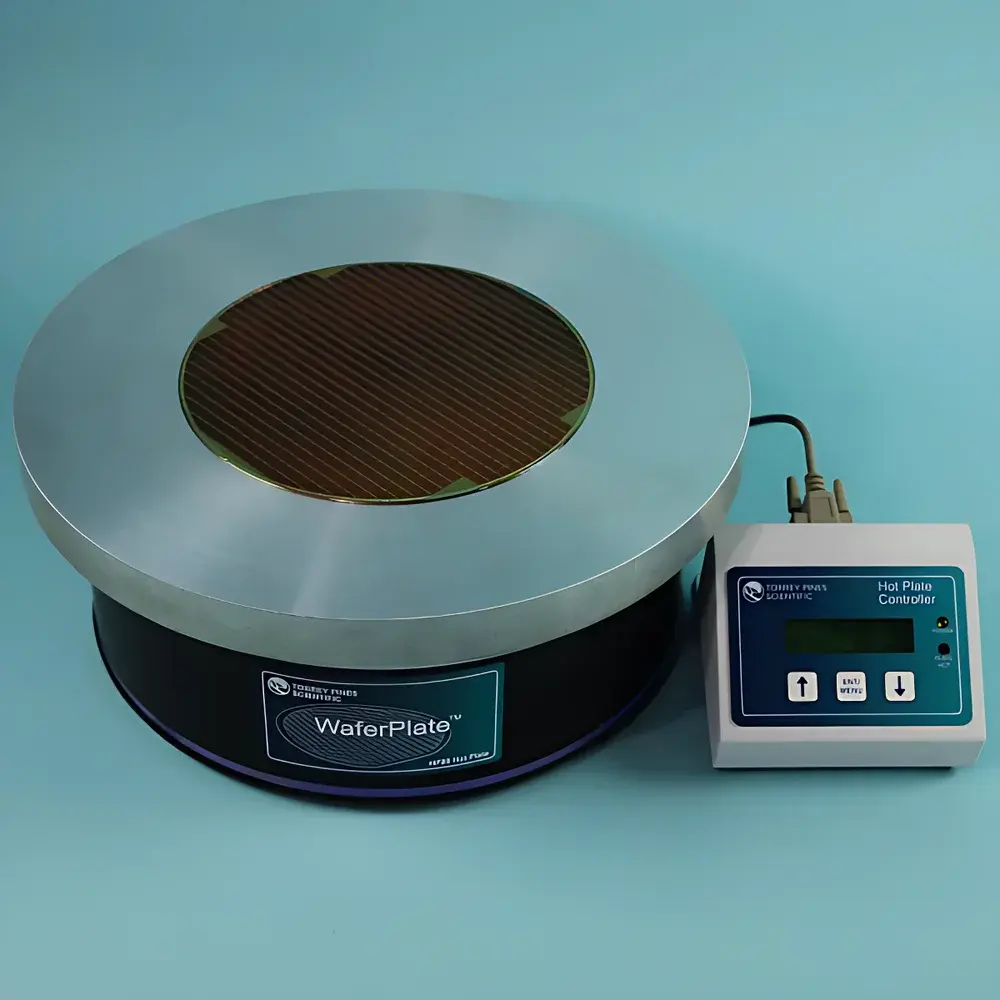
Torrey Pines HP90 Programmable Digital Hotplate for Wafer-Scale Silicon Substrates
| Brand | Torrey Pines |
|---|---|
| Origin | USA |
| Model | HP90 |
| Plate Diameter | 352 mm |
| Max Temperature | 350 °C |
| Temp Stability | ±1 °C |
| Temp Uniformity | <1% deviation within 19 mm radius from center |
| Temp Resolution | 1 °C |
| Temp Accuracy | ±1% of setpoint (calibrated to ±0.1 °C) |
| Heating Rate | 1–450 °C/hr (adjustable in 1 °C increments) |
| Power | 1500 W |
| Plate Material | Anodized Aluminum |
| Compatible Wafer Size | Up to 305 mm diameter |
| Control Interface | Standalone desktop controller + RS232 I/O for PC/PLC integration |
| Programs | 5 user-defined programs, each with up to 10 steps, repeatable 1–99 times or infinite loop |
| Visual Indication | Tri-color LED ring (blue = standby, yellow = 0–50 °C, red = >50 °C |
| Audible Alarm | Built-in countdown timer with auto-shutdown function |
| Dimensions (Heater) | Ø352 × H146 mm |
| Weight (Heater) | 9.5 kg |
| Dimensions (Controller) | 127 × 64 × 102 mm |
| Weight (Controller) | 0.5 kg |
Overview
The Torrey Pines HP90 is a precision-engineered programmable digital hotplate specifically designed for thermal processing of semiconductor-grade silicon wafers and other flat, temperature-sensitive substrates in cleanroom-compatible laboratory and pilot-line environments. Utilizing resistive heating elements embedded beneath a high-purity anodized aluminum plate, the HP90 delivers controlled, uniform surface heating via conductive heat transfer—optimized for applications requiring reproducible thermal profiles across large-area wafers up to 305 mm (12-inch) diameter. Its closed-loop PID temperature control architecture ensures stable thermal output under variable load conditions, while the integrated calibration traceability to ±0.1 °C supports compliance with ISO/IEC 17025–accredited metrology practices. The system operates over a broad range—from ambient to 350 °C—with programmable ramp rates and dwell times essential for annealing, pre-bake, dehydration, and solvent evaporation protocols in microfabrication, thin-film deposition, and wafer-level packaging workflows.
Key Features
- 352 mm circular aluminum heating surface engineered for minimal thermal distortion and optimal lateral heat conduction
- Five independent thermal programs, each supporting up to ten discrete steps with customizable ramp rates (1–450 °C/hr), hold durations, and cycle counts (1–99 or continuous)
- Dual-mode control: intuitive front-panel desktop controller with tactile keypad and LCD display, plus RS232 serial interface for integration into automated test systems, SCADA platforms, or custom LabVIEW/Python-based control suites
- Real-time visual feedback via tri-color annular LED indicator: blue (standby), yellow (0–50 °C), red (>50 °C); rapid blinking indicates achievement of ±0.2 °C thermal stability at setpoint
- Configurable audible alarm with countdown timer and programmable auto-shutdown—critical for unattended operation and process safety compliance
- Temperature uniformity validated to <1% deviation across a 19 mm radial zone centered on the plate, ensuring consistent thermal exposure for photolithography alignment, spin-coating cure, or wafer bonding prep
Sample Compatibility & Compliance
The HP90 accommodates silicon wafers, glass substrates, quartz plates, and ceramic carriers up to 305 mm in diameter. Its non-magnetic, non-contaminating anodized aluminum surface meets SEMI F28-0201 standards for particle generation in Class 100 cleanrooms. The unit is CE-marked and conforms to IEC 61010-1:2010 for electrical safety in laboratory equipment. While not inherently FDA 21 CFR Part 11–compliant, its RS232 logging capability enables third-party audit-trail implementation when paired with validated data acquisition software meeting GLP/GMP documentation requirements. Temperature calibration certificates are available upon request, traceable to NIST standards.
Software & Data Management
No proprietary software is bundled; however, the RS232 interface supports ASCII command protocol for bidirectional communication (e.g., “SET TEMP=180”, “READ TEMP?”, “START PROGRAM 3”). Users may implement custom scripts using Python (pySerial), MATLAB, or industrial PLCs to log temperature vs. time, trigger external actuators (e.g., vacuum chucks), or synchronize with ellipsometers or interferometers. All program parameters—including ramp rate, dwell time, and cycle count—are stored in non-volatile memory and retained after power loss.
Applications
- Silicon wafer pre-bake and post-exposure bake (PEB) in photolithography processes
- Thermal curing of photoresists, dielectric films (e.g., SiO₂, SiNₓ), and polymer encapsulants
- Controlled dehydration of MEMS devices prior to wafer-level capping
- Substrate temperature conditioning for Raman spectroscopy, XRD sample staging, or AFM tip calibration
- Process development for low-temperature bonding (e.g., Cu-Cu, Si-Si) where precise thermal history impacts interfacial adhesion
- Calibration reference platform for infrared thermography validation across large-area surfaces
FAQ
Is the HP90 suitable for use in nitrogen-purged or vacuum environments?
No—the unit is rated for ambient atmospheric operation only. The heating plate and electronics are not sealed for inert gas or vacuum compatibility.
Can multiple HP90 units be synchronized for parallel thermal processing?
Yes, via RS232 daisy-chaining or master-slave configuration using external TTL triggers and shared clock signals—requires custom firmware scripting.
Does the system support external temperature monitoring via PT100 or thermocouple inputs?
No—the HP90 relies solely on its internal calibrated sensor array. External probe integration requires third-party DAQ hardware and software abstraction layers.
What maintenance is required to sustain temperature accuracy over time?
Annual recalibration against a certified reference thermometer is recommended. Clean the plate surface regularly with IPA and lint-free wipes to prevent thermal impedance from residue buildup.
Is firmware upgrade capability available?
Firmware updates are provided by Torrey Pines upon request and installed via RS232 using the manufacturer’s utility tool—no field-upgradable bootloader is exposed to end users.



