
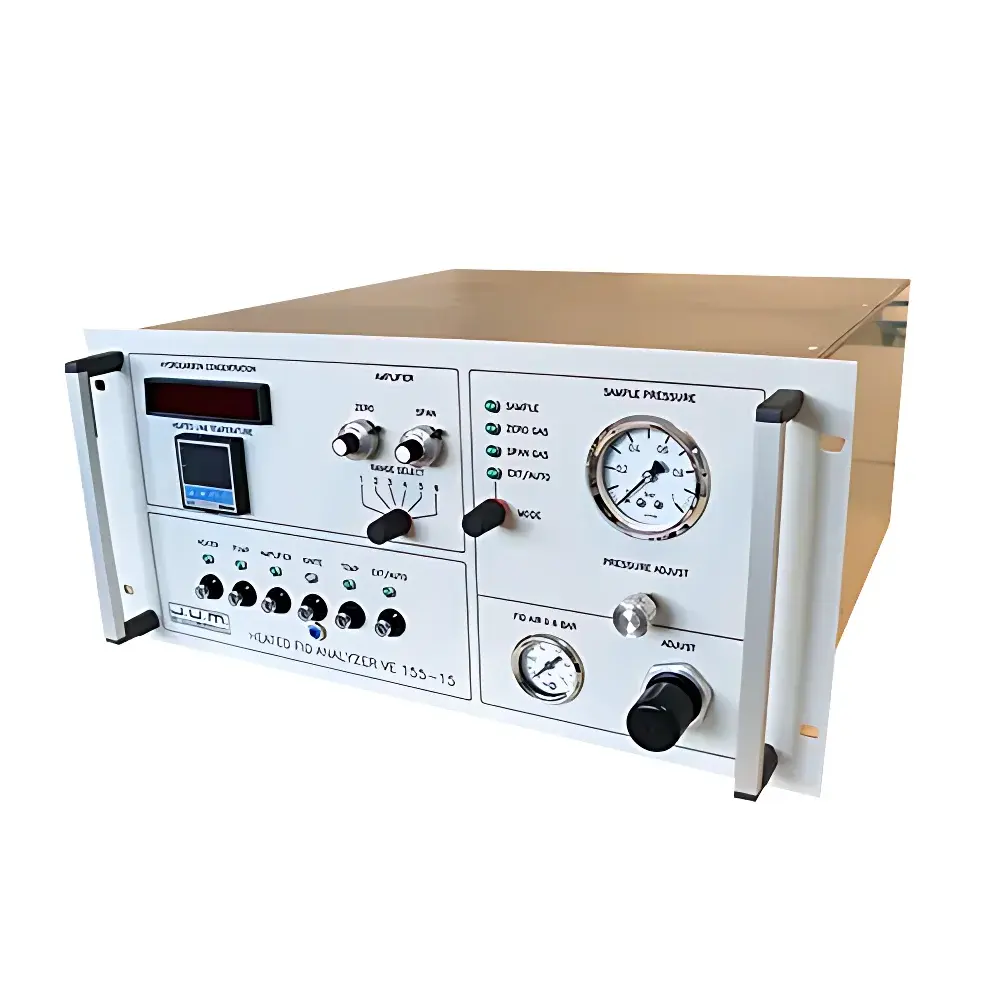
J.U.M. 155-15 Heated Low-Flow SHED FID Total Hydrocarbon Analyzer
| Brand | J.U.M. |
|---|---|
| Origin | Germany |
| Model | 155-15 |
| Sample Flow Range | 10–30 mL/min |
| Operating Temperature | 180 °C (heated sample path) |
| Detector Type | Flame Ionization Detector (FID) |
| Compliance | Designed for ASTM D5114, ISO 8712, and EPA Method 25A-compliant SHED testing |
| Power Supply | 100–240 VAC, 50/60 Hz |
| Enclosure | 19″ rack-mountable (5 U) or top-mount configuration |
Overview
The J.U.M. 155-15 is a purpose-engineered, heated low-flow total hydrocarbon (THC) analyzer based on flame ionization detection (FID) technology, specifically optimized for micro-scale and mini-scale Sealed Housing for Evaporative Determination (SHED) systems used in automotive evaporative emission testing. Unlike conventional FID analyzers requiring high sample flow rates (typically ≥1 L/min), the 155-15 operates at ultra-low volumetric flows—10 to 30 mL/min—enabling precise quantification of hydrocarbon emissions under extremely low air exchange conditions (e.g., ≤0.02 h⁻¹). Its core measurement principle relies on catalytic combustion of organic compounds in a hydrogen–air flame, generating ions proportional to carbon mass concentration; signal amplification and linear response are maintained across sub-ppb to low-ppm THC ranges. All sample-wetted components—including capillary transfer lines, pressure regulators, flow controllers, and the FID burner assembly—are fully integrated within a thermostatically controlled 180 °C heated zone. This architecture eliminates condensation losses of higher-boiling hydrocarbons (C₆–C₁₂), ensuring quantitative recovery and metrological traceability in compliance with ASTM D5114 (Standard Test Method for Determination of Hydrocarbon Emissions from Evaporative Emission Canisters) and ISO 8712 (Road vehicles — Evaporative emission test procedure).
Key Features
- Fully heated sample path at 180 °C, including integrated sample pump, pressure regulator, and flow control module—prevents adsorption and condensation of semi-volatile hydrocarbons
- Ultra-low sample consumption: selectable nominal flows of 10, 12, 15, or 20 mL/min (600–1200 L/h total equivalent), minimizing dilution and preserving chamber integrity during SHED testing
- Self-contained combustion air supply: built-in diaphragm compressor eliminates dependency on external compressed air cylinders or generators—reducing infrastructure complexity and operational overhead
- Modular, field-replaceable heated components: rapid maintenance without disassembly of external tubing or recalibration
- Dual-mode calibration interface: manual zero/span valves plus optional 4–20 mA or Modbus RTU remote actuation for integration into automated SHED control systems
- FID flame supervision with automatic fault detection: real-time monitoring of ignition status, flame current, and burner temperature; configurable alarm output upon flame-out
- Optional auto-ignition and auto-reignition logic, reducing operator intervention during unattended overnight testing cycles
- Low hydrogen fuel consumption (<15 mL/min H₂ at standard conditions), enhancing safety and reducing consumables cost over lifetime
- Rear-mounted particulate filter with tool-free access—designed for frequent replacement in high-dust laboratory or vehicle test cell environments
Sample Compatibility & Compliance
The 155-15 is validated for direct analysis of SHED exhaust gas streams containing ambient air, nitrogen, CO₂, and trace hydrocarbons—including methane, ethane, propane, butanes, benzene, toluene, and C₈–C₁₀ aliphatics. It meets the thermal stability and dynamic response requirements of EPA Method 25A for total gaseous organic (TGO) measurement and supports GLP-aligned data acquisition when paired with compliant software. All wetted materials (316 stainless steel, fused silica capillaries, high-temp Viton® seals) are selected for inertness toward reactive hydrocarbons and resistance to oxidation at elevated temperatures. The instrument’s design facilitates audit-ready documentation per ISO/IEC 17025 and supports 21 CFR Part 11-compliant electronic records when used with validated data acquisition platforms.
Software & Data Management
While the 155-15 operates as a standalone analog/digital transmitter (0–10 V / 4–20 mA output), it is fully compatible with third-party SCADA, LabVIEW, or custom SHED control software via RS-485 (Modbus RTU) or Ethernet/IP interfaces. Optional firmware enables timestamped analog output logging, internal zero-drift compensation, and configurable alarm thresholds. Raw FID current signals (pA range) are digitized with 16-bit resolution and filtered using programmable digital low-pass filtering (0.1–10 Hz cutoff) to suppress noise without compromising transient response. All calibration events—including manual zero/span and remote-triggered adjustments—are logged with operator ID, timestamp, and pre/post-calibration values for full traceability.
Applications
- Regulatory evaporative emission testing per US EPA Tier 3, EU R101-03, and China GB 18352.6 standards using Micro-SHED and Mini-SHED configurations
- Hydrocarbon breakthrough studies in activated carbon canisters and vapor recovery systems
- Benchmarking of fuel permeation through polymer fuel system components (e.g., hoses, tanks, seals)
- Real-time THC monitoring in environmental chambers simulating hot-soak and diurnal breathing loss conditions
- Validation of hydrocarbon scrubber efficiency and catalyst aging in laboratory-scale emission control research
FAQ
What is the minimum detectable limit (MDL) for total hydrocarbons?
The MDL is instrument- and configuration-dependent; typical system-level MDLs range from 0.01 to 0.05 ppmC (as propane equivalent) under optimal SHED sampling conditions with 15 mL/min flow and 1-second averaging.
Can the 155-15 measure methane separately from non-methane hydrocarbons (NMHC)?
No—it reports total hydrocarbons only. For NMHC determination, a parallel methane-specific analyzer (e.g., GC-FID or NDIR) and subtraction methodology are required per ASTM D5114 Annex A.
Is the heated zone temperature user-adjustable?
The nominal setpoint is fixed at 180 °C for optimal hydrocarbon transmission; deviation outside ±2 °C requires factory recalibration and is not supported in field operation.
Does the unit comply with ATEX or IECEx hazardous area certifications?
No—the 155-15 is rated for use in non-hazardous laboratory and test cell environments only (IP20 enclosure rating). External explosion-proof enclosures must be used if deployed near fuel-handling zones.
What maintenance intervals are recommended for routine operation?
Filter replacement every 200 hours of operation; FID jet cleaning every 1,000 hours; annual verification of flow accuracy and detector linearity using certified gas standards.
Related Products







