
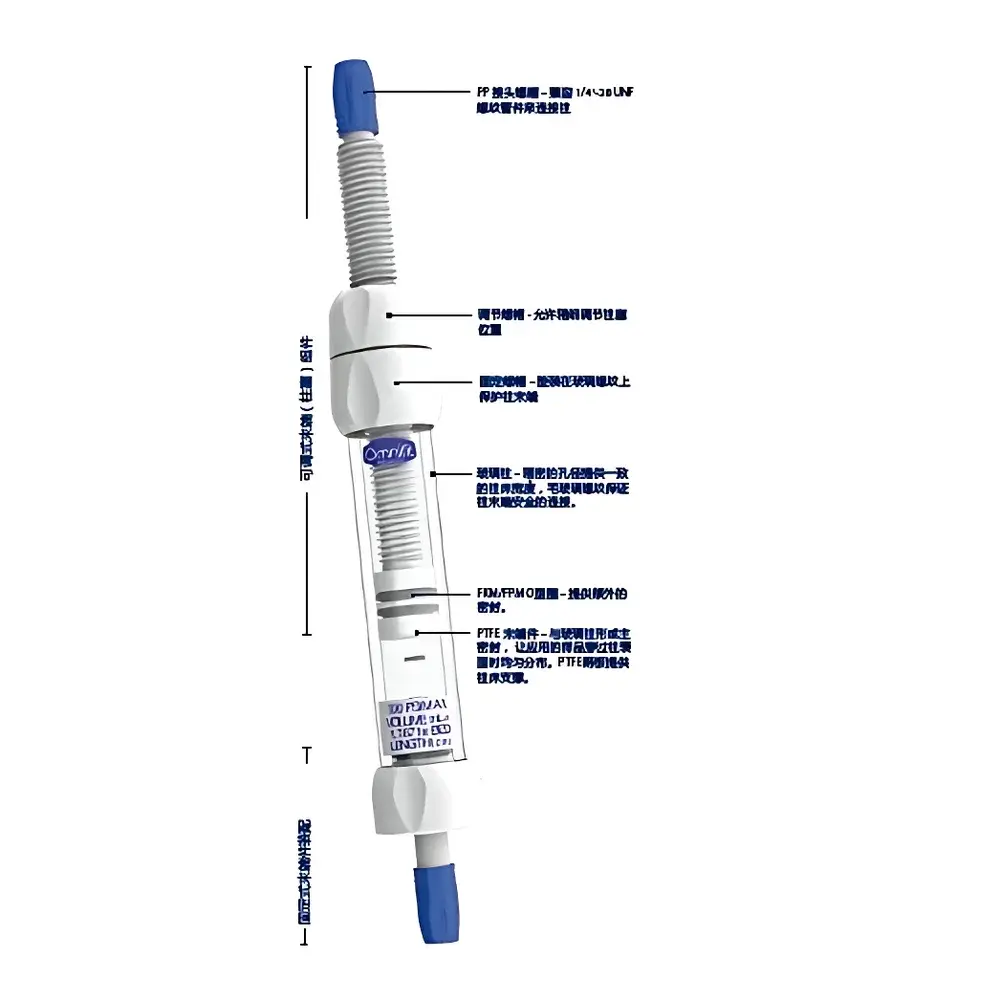
Omnifit EZ SolventPlus Medium-Pressure Glass Chromatography Column (Sanotac OEM, UK-Made)
| Brand | Sanotac |
|---|---|
| Origin | United Kingdom |
| Manufacturer Type | Original Equipment Manufacturer (OEM) |
| Category | Imported Instrumentation |
| Model | 006EZS-25-33-AF |
| Pressure Rating (ID 25 mm) | 150 psi (10 bar) |
| Material | Borosilicate glass column tube, PTFE frits & O-rings, Chemraz® seals, ETFE end fittings, acetal compression nuts |
| Temperature Range | 4–40 °C |
| pH Stability | 1–14 |
| Chemical Compatibility | Compatible with aqueous buffers, methanol, acetonitrile, DMSO, DMF, chloroform, dichloroethane, pyridine, toluene, formamide |
| Available Internal Diameters | 5–50 mm |
| Available Lengths | 50–500 mm |
| Compression Options | Fixed-Fixed (FF), Adjustable-Fixed (AF), Adjustable-Adjustable (AA) |
| Fitting Standard | 1/4"-28 UNF |
Overview
The Omnifit EZ SolventPlus Medium-Pressure Glass Chromatography Column is an engineered solution for preparative and analytical liquid chromatography applications requiring chemical inertness, dimensional stability, and operational flexibility under moderate pressure. Designed and manufactured in the United Kingdom by Omnipore (Omnifit® Labware), this column series employs a modular, all-inert fluidic path architecture based on borosilicate glass tubing and high-performance polymeric components. Its measurement principle relies on axial flow through a packed bed supported by chemically resistant PTFE frits, enabling precise control of linear velocity, backpressure, and bed homogeneity—critical parameters in protein purification, natural product isolation, and synthetic chemistry workflows. Unlike stainless-steel or polymer columns, the glass construction provides optical transparency for real-time bed inspection, eliminates metal ion leaching, and ensures compatibility with aggressive solvents used in reversed-phase, ion-exchange, and size-exclusion chromatography. The column is rated for continuous operation up to 150 psi (10 bar) at 25 mm internal diameter, making it suitable for integration with medium-pressure systems such as Cytiva AKTA avant, Sanotac Biolot, and Bio-Rad NGC platforms.
Key Features
- Chemically inert fluid path: Borosilicate glass column body, PTFE frits (10 µm pore size), Chemraz® elastomeric seals, ETFE end caps and fittings, and acetal compression hardware ensure compatibility with strong acids, bases, and organic solvents—including DMSO, DMF, chloroform, and pyridine.
- Modular axial compression design: Three configuration options—Fixed-Fixed (FF), Adjustable-Fixed (AF), and Adjustable-Adjustable (AA)—allow precise bed consolidation to prevent channeling and maintain column efficiency across repeated packing cycles.
- Dimensional scalability: Available in six standard internal diameters (5, 6.6, 10, 15, 25, 35, and 50 mm) and lengths from 50 mm to 500 mm, supporting column volumes from <1 mL to 940 mL—ideal for analytical screening, pilot-scale purification, and process development.
- Standardized mechanical interface: 1/4″-28 UNF threaded connections enable direct coupling to common chromatography manifolds, fraction collectors, and pump modules without adapters; includes two pre-cut PTFE capillary segments (2 m and 0.5 m, 1/16″ ID) with ETFE ferrules.
- Thermal and pH resilience: Operational range of 4–40 °C and pH stability from 1 to 14 support use in denaturing and native purification protocols, including His-tag elution with imidazole gradients or low-pH antibody elution.
Sample Compatibility & Compliance
The Omnifit EZ SolventPlus column is routinely deployed in GMP-aligned protein purification processes where material traceability and extractables profiling are essential. Its construction conforms to USP Class VI biocompatibility standards for polymeric components and meets ISO 10993-5 cytotoxicity requirements. All wetted materials—including Chemraz® (a perfluoroelastomer), PTFE, ETFE, and borosilicate glass—are listed in FDA’s Inert Materials Database for pharmaceutical manufacturing contact surfaces. The column supports method validation per ICH Q5A (viral clearance), Q5D (cell substrate characterization), and Q2(R2) (analytical procedure validation). When operated within specified pressure and temperature limits, it complies with GLP audit requirements for raw data integrity, particularly when paired with chromatography data systems (CDS) that enforce 21 CFR Part 11 electronic signature and audit trail functionality.
Software & Data Management
While the column itself is hardware-only, its mechanical consistency enables robust method transfer between platforms. When integrated with Cytiva UNICORN, Sanotac ChromaControl, or Bio-Rad BioFusion software, users benefit from reproducible gradient programming, automated fraction triggering, and pressure-triggered safety shutdowns. The standardized geometry facilitates column performance qualification (CPQ) using ASTM E260-17 (standard practice for calibration of liquid chromatographic systems) and supports retention time modeling via retention factor (k) and selectivity (α) calculations. Optional pressure transducer integration allows real-time monitoring of column backpressure trends—critical for detecting frit clogging or resin degradation during multi-cycle runs.
Applications
- Recombinant protein purification (e.g., monoclonal antibodies, fusion proteins) using affinity, ion-exchange, or hydrophobic interaction chromatography.
- Small-molecule natural product isolation from plant extracts via flash chromatography or step-gradient elution.
- Continuous-flow synthesis workups where inline column scavenging removes catalysts or byproducts.
- Method development for scale-up to industrial chromatography systems—column geometry and packing density are directly translatable to stainless-steel preparative columns.
- Educational and research labs requiring visual verification of packing quality, bed settling behavior, or solvent front migration.
FAQ
What is the maximum recommended operating pressure for the 25 mm ID column?
The 006EZS-25-33-AF model is rated for continuous operation at ≤150 psi (10 bar) at ambient temperature. Short-term excursions up to 180 psi are permissible but not advised for routine use.
Can this column be autoclaved?
No. Borosilicate glass is heat-resistant, but PTFE frits, Chemraz® seals, and ETFE fittings degrade above 60 °C. Sterilization must be performed via 0.22 µm filtration of buffers and 70% ethanol rinse followed by UV exposure.
Is axial compression necessary for every application?
Axial compression is strongly recommended for any application involving rigid resins (e.g., agarose-based media >4% crosslinking) or high-flow-rate conditions (>5 mL/min at 25 mm ID) to minimize void formation and radial heterogeneity.
How does this column compare to stainless-steel alternatives in terms of resolution?
Resolution is primarily governed by particle size distribution, packing uniformity, and flow dynamics—not column material. However, the optical clarity of glass enables superior visual assessment of packing quality, leading to higher inter-operator reproducibility in manual packing protocols.
Does Sanotac provide column packing services or resin compatibility guidance?
Yes. Sanotac offers technical support documentation covering resin swelling ratios, recommended slurry concentrations, and packing flow rates for common media (e.g., Ni-NTA Agarose, SP Sepharose FF, Phenyl Sepharose CL-4B), aligned with manufacturer specifications from Cytiva, Bio-Rad, and Tosoh.




