
Onefive SYNC Pulse Repetition Rate Synchronization Module
| Brand | Onefive |
|---|---|
| Origin | Switzerland |
| Model | SYNC |
| Form Factor | Plug-in Module for Femtosecond/Picosecond Laser Drivers |
| Compatibility | ORIGAMI (fs), MAGURO (ps), SUMO (single-frequency) Laser Systems |
| Phase Noise Performance | Ultra-low (optimized for external RF reference locking) |
| Timing Jitter | < 35 fs rms (10 Hz – 1 MHz, with low-noise reference input) |
| Footprint | 160 mm × 100 mm |
| Operation | Standalone, button-controlled, no PC required |
| Compliance | Designed for 24/7 unattended operation in metrology-grade optical laboratories |
Overview
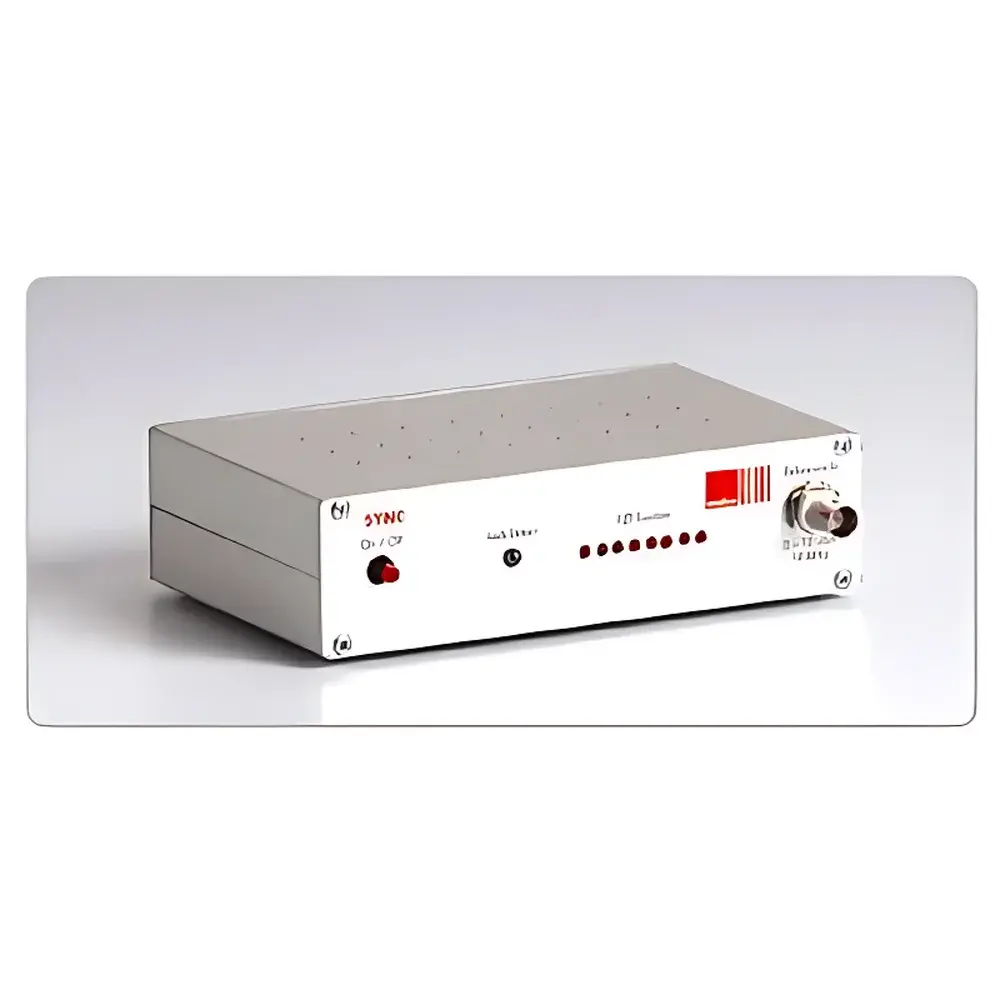
The Onefive SYNC Pulse Repetition Rate Synchronization Module is a precision-engineered, standalone plug-in unit designed to phase-lock the repetition rate of mode-locked femtosecond and picosecond lasers to an external radio-frequency (RF) reference signal. Operating on the principle of optical-electronic feedback control, the SYNC module implements a high-bandwidth, low-latency servo loop that actively stabilizes the cavity round-trip time by adjusting the pump laser diode current or piezoelectric cavity length actuator—depending on the host laser platform. This enables sub-femtosecond-level timing stability between pulse trains and external clocks, making it essential for applications demanding strict temporal coherence across multiple optical or electro-optical subsystems, such as optical frequency comb referencing, pump-probe spectroscopy, attosecond science, and photonic analog-to-digital conversion.
Key Features
- Standalone operation: No PC, software driver, or external controller required—fully functional via front-panel push-button interface.
- Ultra-compact form factor (160 mm × 100 mm footprint) optimized for integration into space-constrained laser heads or OEM optical benches.
- Plug-and-play compatibility with Onefive’s ORIGAMI (femtosecond) and MAGURO (picosecond) laser platforms, as well as SUMO single-frequency lasers via optional wavelength-locking variants (LOCK module).
- Sub-35 fs RMS timing jitter (measured over 10 Hz – 1 MHz offset bandwidth) when locked to a low-phase-noise RF source (e.g., ultra-stable 10 MHz or 100 MHz oven-controlled crystal oscillator).
- Engineered for continuous 24/7 operation under laboratory conditions—no thermal recalibration or manual drift compensation needed.
- Supports both analog and digital reference inputs (SMA, 50 Ω), with configurable lock range and gain settings accessible via DIP switches.
Sample Compatibility & Compliance
The SYNC module is fully qualified for use with Onefive’s commercially available ultrafast laser systems, including ORIGAMI XP/XF (780–2000 nm, <100 fs), MAGURO HP (1030–1080 nm, <10 ps), and SUMO series (1064 nm, single-frequency, narrow linewidth). It conforms to IEC 61000-6-3 (EMC emission standards) and IEC 61000-6-2 (immunity), ensuring robust performance in multi-instrument optical labs. While not certified to FDA 21 CFR Part 11 or ISO 13485 (as it is a component-level synchronization tool, not a medical device), its design supports GLP/GMP-aligned traceability when deployed in regulated R&D environments—particularly where timestamped pulse train alignment is critical for audit trails in ultrafast metrology or quantum optics validation protocols.
Software & Data Management
The SYNC operates entirely without embedded firmware or host-based software. All configuration—including lock enable/disable, reference input selection, and coarse/fine tuning modes—is managed via tactile push buttons and LED status indicators. For system-level integration, analog monitoring outputs (e.g., error signal, lock status TTL) are provided on rear-panel BNC connectors, enabling connection to oscilloscopes, data acquisition systems, or custom LabVIEW/Python-based supervisory logic. No proprietary drivers, SDKs, or cloud connectivity are implemented—ensuring deterministic real-time behavior and long-term maintainability without software obsolescence risks.
Applications
- Optical frequency comb stabilization and cross-referencing between independent laser sources.
- Synchronization of pump and probe pulses in time-resolved spectroscopy setups (e.g., transient absorption, THz generation/detection).
- Coherent beam combining of multiple ultrafast amplifiers requiring precise inter-pulse timing alignment.
- Trigger distribution in multi-channel single-photon detection systems used in quantum optics experiments.
- Phase-coherent microwave photonics links, where optical pulse trains serve as low-jitter sampling clocks.
- Calibration-grade timing distribution in national metrology institutes and advanced photonics foundries.
FAQ
Is the SYNC module compatible with third-party mode-locked lasers?
No—it is specifically designed and factory-calibrated for seamless integration with Onefive’s ORIGAMI, MAGURO, and SUMO laser families. Interfacing with non-Onefive lasers requires custom electrical and mechanical adaptation and is not supported under warranty.
Does SYNC support automatic re-lock after power interruption?
Yes—the module retains its last operational state and initiates auto-relock within ≤2 seconds upon power-up, provided the external reference remains stable and within lock range.
Can SYNC be used simultaneously with the PICK pulse picker module?
Yes—SYNC and PICK are electrically and functionally independent modules; they may be installed concurrently on compatible ORIGAMI/MAGURO platforms to provide both repetition-rate stabilization and variable pulse picking (extinction ratios up to >50 dB available).
What is the maximum allowable reference frequency deviation for stable lock?
The standard SYNC variant supports ±100 ppm frequency tolerance around nominal reference values (e.g., 80 MHz ±8 kHz); wider-range versions are available upon request for specialized OEM integration.
Is optical isolation or additional RF shielding required during installation?
No—internal RF filtering and galvanic isolation between optical and electronic domains eliminate the need for external shielding; however, best practices recommend routing reference cables away from high-current pump drivers to avoid coupling-induced jitter degradation.




