
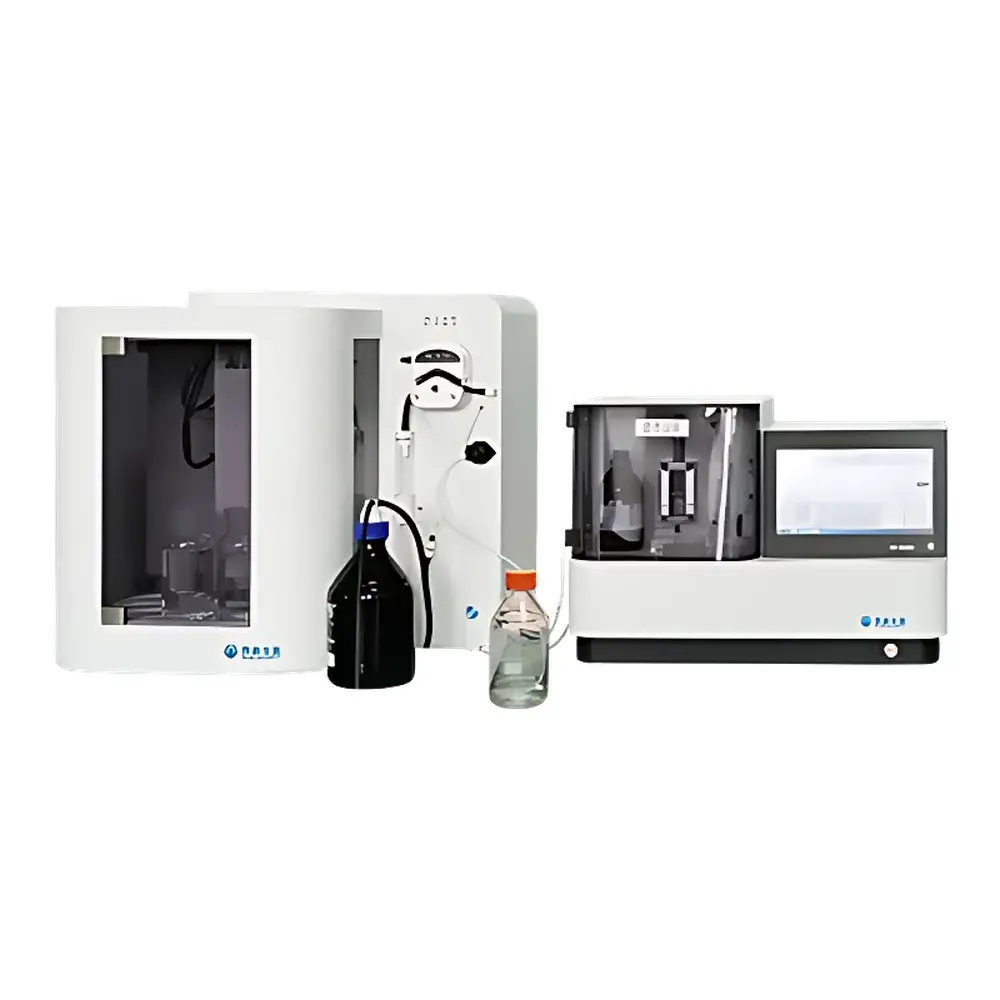
Online Instrument OL1020 Fully Automated Infrared Oil Content Analyzer
| Brand | Online Instrument |
|---|---|
| Origin | Shanghai, China |
| Manufacturer Type | Direct Manufacturer |
| Regional Classification | Domestic (China) |
| Model | OL1020 Fully Automated Infrared Spectrophotometric Oil Analyzer |
| Instrument Category | Laboratory-Based |
| Measurement Principle | Infrared Spectrophotometry (C–H Stretch Absorption at 2930 cm⁻¹, 2960 cm⁻¹, and 2850 cm⁻¹) |
| Measurement Range | 0–50,000 mg/L (with automatic dilution for over-range samples) |
| Detection Limit | 0.03 mg/L |
| Accuracy | ±2% of reading |
| Resolution | 0.001 mg/L |
Overview
The Online Instrument OL1020 Fully Automated Infrared Oil Content Analyzer is a laboratory-grade, regulatory-compliant instrument engineered for precise quantification of total petroleum hydrocarbons (TPH), petroleum hydrocarbons (oil), and non-petroleum hydrocarbons (e.g., animal and vegetable oils) in aqueous environmental matrices. It operates on the principle of mid-infrared absorption spectroscopy—specifically targeting the asymmetric C–H stretching vibrations at 2930 cm⁻¹ (CH₂), 2960 cm⁻¹ (CH₃), and 2850 cm⁻¹ (CH₂) — enabling selective, interference-resistant measurement per HJ 637–2018 and ASTM D7066–22. Unlike manual or semi-automated methods, the OL1020 integrates sample introduction, solvent extraction, phase separation, adsorption cleanup, spectral acquisition, and quantitative calculation into a single unattended workflow—eliminating operator-dependent variability and ensuring high reproducibility across batched environmental water samples.
Key Features
- Fully automated, closed-system operation from sample loading to waste collection—no manual transfer, no exposure to tetrachloroethylene (C₂Cl₄) or other hazardous solvents.
- Non-contact volumetric recognition of wide-mouth sampling bottles (per HJ/T 91–2002), with automatic volume registration and error <2%—ensuring traceable, auditable sample intake without graduated cylinder use.
- Dual-channel simultaneous analysis: concurrent determination of petroleum hydrocarbons and ester-based oils (animal/vegetable) via programmable MgSiO₃ adsorption column switching and real-time column depletion monitoring.
- Triple-stage solvent–water separation: liquid–liquid extraction → gravity-assisted phase separation in dedicated extraction tubes → membrane-based dehydration (hydrophobic PTFE membrane) or anhydrous Na₂SO₄ drying—minimizing water carryover and spectral baseline drift.
- Self-cleaning separation module: reverse-pressure solvent flush between samples prevents cross-contamination and maintains long-term flow-path integrity.
- Integrated activated carbon exhaust treatment system compliant with OSHA 29 CFR 1910.1200 and EU Directive 2004/37/EC for chronic solvent exposure control.
- Automated reagent recovery: spent C₂Cl₄ is segregated, collected, and stored in sealed containment vessels for off-site recycling or disposal per local hazardous waste regulations (e.g., EPA 40 CFR Part 261).
Sample Compatibility & Compliance
The OL1020 accepts standard 500 mL or 1 L wide-mouth HDPE or glass sampling bottles used in field programs under HJ/T 91–2002 and ISO 5667-3:2018. It accommodates turbid, suspended-solid-laden, or emulsified wastewater without pre-filtration—phase separation efficiency exceeds 99.8% even at TSS > 100 mg/L. All analytical protocols align with Chinese national standards HJ 637–2018 (Infrared Spectrophotometric Determination of Petroleum Hydrocarbons in Water) and HJ 1051–2019 (Determination of Animal and Vegetable Oils in Water). Instrument firmware and data handling support audit-ready compliance with GLP and ISO/IEC 17025:2017 requirements—including electronic signatures, full metadata logging, and raw spectral archive retention.
Software & Data Management
The embedded Windows-based control software provides intuitive touchscreen operation and optional remote access via secure HTTPS web interface or VNC-enabled desktop connection. All measurements are timestamped, geotagged (when paired with external GPS loggers), and stored with full chain-of-custody metadata: bottle ID, operator ID, calibration status, column usage count, solvent batch number, and raw interferogram files (in .SPA format). Data export supports CSV, PDF analytical reports, and XML for LIMS integration. Audit trail functionality meets FDA 21 CFR Part 11 requirements—including user-level permissions, immutable event logs, and electronic signature validation for QA/QC sign-off.
Applications
The OL1020 is deployed across municipal and industrial environmental laboratories for routine monitoring of oil content in influent and effluent streams at wastewater treatment plants (WWTPs), refinery outfalls, cooling water circuits, and stormwater runoff. It serves regulatory compliance testing for discharge permits (e.g., NPDES, GB 8978–1996), source identification in spill investigations, and long-term trend analysis in surface water bodies. Additional application domains include boiler feedwater quality control in thermal power plants, bilge water screening in maritime facilities, agricultural runoff assessment, and method validation studies in academic and governmental research institutions (e.g., MEE Key Lab networks, provincial EPBs).
FAQ
Does the OL1020 comply with international infrared oil analysis standards such as ASTM D7066 or ISO 9377-2?
Yes—the optical path design, wavelength accuracy (±1 cm⁻¹), and spectral resolution (4 cm⁻¹) meet the instrumental specifications outlined in ASTM D7066–22 and ISO 9377-2:2021 for hydrocarbon quantification in water.
Can the instrument be integrated into an existing LIMS environment?
Yes—via configurable ODBC drivers and RESTful API endpoints supporting HL7 and ASTM E1384 message formats for bidirectional data exchange.
What maintenance intervals are recommended for the MgSiO₃ adsorption columns and separation membranes?
Column lifetime is tracked in real time; replacement is triggered automatically after 120 sample runs or when breakthrough is detected via spectral residual analysis. Membranes are rated for ≥500 extractions and flagged for service at 450 cycles.
Is tetrachloroethylene the only extractant supported?
The system is optimized for C₂Cl₄ per HJ 637–2018, but method validation packages are available for alternative IR-transparent solvents including FC-40 and cyclohexane upon request.
How is data integrity ensured during power interruption or network failure?
All active measurements are checkpointed every 15 seconds to non-volatile flash memory; resumed automatically upon recovery without data loss or sample re-injection.







