
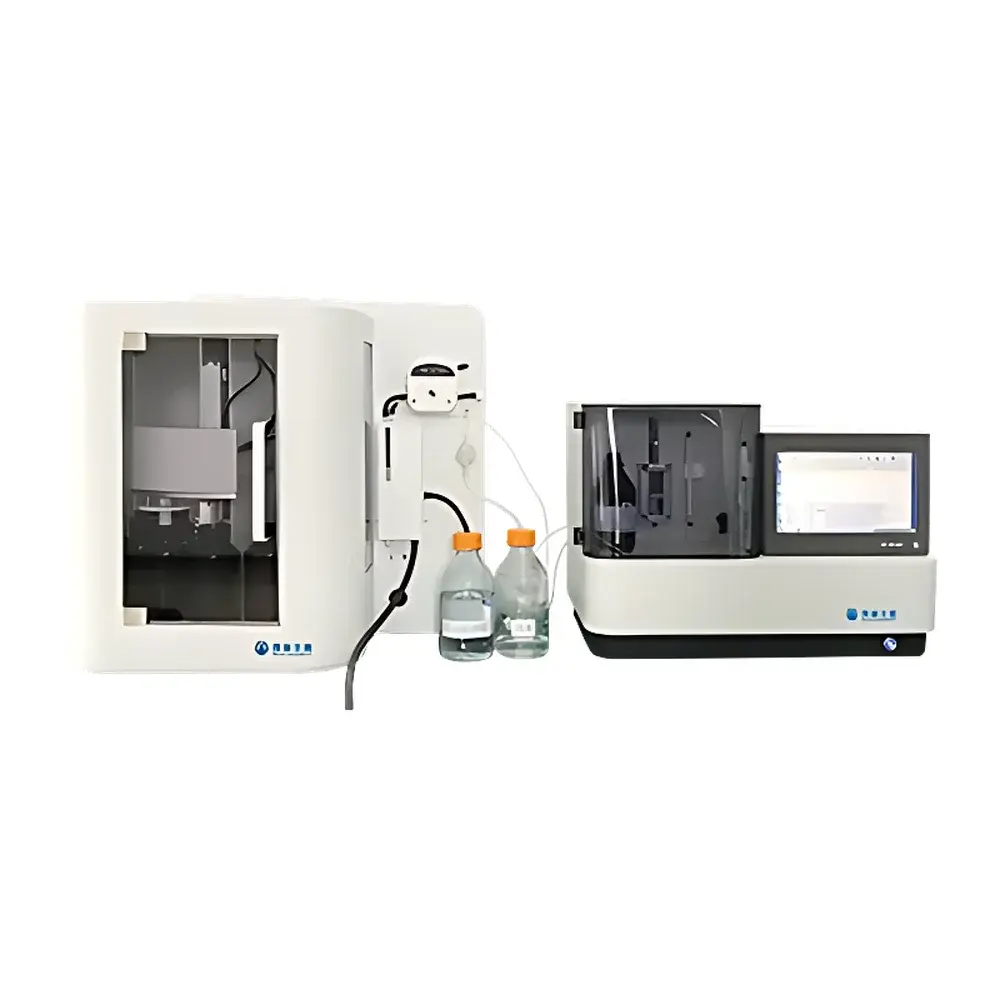
Online Instrument OL1041 Fully Automated UV Oil Content Analyzer
| Brand | Online Instrument |
|---|---|
| Origin | Shanghai, China |
| Manufacturer Type | Manufacturer |
| Product Origin | Domestic (China) |
| Model | OL1041 |
| Instrument Type | Laboratory-Based |
| Measurement Principle | UV Absorption Spectrophotometry (225 nm) |
| Measurement Range | 0–16 mg/L (with automatic dilution for over-range samples) |
| Detection Limit | 0.005 mg/L |
| Accuracy | ±2% of reading |
| Resolution | 0.001 mg/L |
| Analysis Time | <6 minutes per sample |
Overview
The Online Instrument OL1041 Fully Automated UV Oil Content Analyzer is a laboratory-grade, regulatory-compliant instrument engineered for precise quantification of total petroleum hydrocarbons (TPH) — specifically “petroleum类” as defined in China’s environmental standards — in aqueous matrices including surface water, groundwater, seawater, estuarine, and coastal waters. It operates on the principle of ultraviolet absorption spectrophotometry at 225 nm, a method standardized in HJ 970–2018 (Determination of Petroleum Hydrocarbons in Water by Ultraviolet Spectrophotometry) and aligned with the technical foundation of EPA Method 1664A (for extractable non-polar compounds) and ISO 9377-2:2000 (Water quality — Determination of hydrocarbon oil index). Unlike conventional manual UV methods, the OL1041 integrates fully automated liquid handling, solvent extraction, phase separation, and spectral measurement into a single closed-loop workflow—eliminating operator-dependent variability and ensuring high reproducibility across batched analyses.
Key Features
- Fully automated sample processing: Direct analysis from standard wide-mouth sampling bottles (per HJ/T 91–2002), with non-contact volumetric recognition (±2% error) and auto-input of sample volume—no manual transfer to graduated cylinders or pipetting required.
- Integrated solvent-based extraction: Uses n-hexane or petroleum ether as extractant; reagent delivery, mixing, and phase separation are precisely controlled via programmable peristaltic and pressure-driven fluidics.
- Triple-stage separation system: Combines extraction tubing, hydrophobic membrane filtration, and anhydrous Na₂SO₄ drying to achieve complete water/organic phase separation and residual moisture removal prior to UV measurement.
- Self-monitoring adsorption column: Silicon magnesium adsorbent column for selective removal of biogenic oils (e.g., plant/animal fats); real-time remaining capacity feedback via integrated sensor and software alerting.
- Closed-system architecture: All wetted pathways remain sealed during operation; volatile organic compound (VOC) emissions are captured by activated carbon filtration, eliminating need for fume hood installation and enhancing occupational safety.
- Automated reagent recovery: N-hexane is separated from aqueous waste and collected in dedicated reservoirs for potential reuse or safe disposal—reducing consumable cost and environmental footprint.
- Remote operation & monitoring: Web-enabled interface supports mobile device access; real-time status tracking, data retrieval, method execution control, and alarm notifications via secure HTTPS connection.
Sample Compatibility & Compliance
The OL1041 accommodates sample volumes ranging from 10 mL to 1000 mL (automatically recognized), and supports up to 14 sample positions (expandable upon customization). It complies with national Chinese environmental monitoring protocols—including HJ 970–2018, HJ/T 91–2002, and HJ 493–2009—and maintains functional alignment with international frameworks governing hydrocarbon analysis in water. Its design meets GLP-ready requirements: audit-trail enabled software logs all user actions, method parameters, calibration events, and raw absorbance data with timestamp and operator ID. While not pre-certified to FDA 21 CFR Part 11, its data integrity architecture supports validation for regulated environments requiring electronic record retention and user-access controls.
Software & Data Management
The embedded Windows-based control software provides intuitive touchscreen operation and optional external PC integration. It supports customizable method templates, multi-point calibration curves (linear and quadratic), QC check sample scheduling, and automatic report generation in PDF/CSV formats. Spectral scanning (190–400 nm) is available for qualitative assessment of organic contaminants beyond petroleum hydrocarbons. All raw UV spectra, baseline corrections, peak integration parameters, and dilution factors are stored with metadata (sample ID, date/time, analyst, instrument conditions). Data export conforms to LIMS-compatible structures and includes MD5 checksums for file integrity verification.
Applications
- Regulatory environmental monitoring: Routine TPH analysis for municipal wastewater discharge permits, drinking water source surveillance, and ecological impact assessments.
- Industrial effluent compliance: Quantitative verification of oil-in-water levels in refinery outfalls, petrochemical plant discharges, and offshore platform produced water.
- Research & education: Teaching laboratories use the OL1041 as a dual-purpose UV-Vis spectrophotometer for both oil quantification and general organic compound characterization (e.g., aromaticity assessment, conjugated system analysis).
- Marine and coastal studies: High-sensitivity detection of low-level hydrocarbon contamination in nearshore ecosystems and sediment porewater extracts.
FAQ
What extraction solvents are compatible with the OL1041?
n-Hexane and petroleum ether (30–60 °C boiling range) are validated and recommended. Other UV-transparent aliphatic solvents may be used subject to method validation.
Does the system require a fume hood?
No—the fully enclosed fluid path and onboard activated carbon VOC scrubber eliminate mandatory fume hood dependency, though installation in a ventilated lab is still advised for general safety.
Can the instrument perform calibration curve generation automatically?
Yes—software supports multi-point standard addition, bracketing calibration, and forced-zero intercept options with R² and residual error reporting.
Is the silicon magnesium adsorption column replaceable in the field?
Yes—modular cartridge design allows tool-free replacement; column lifetime is tracked via cumulative sample count and adsorbent saturation modeling.
How is data integrity ensured for audit purposes?
All analytical sessions generate immutable digital records with electronic signatures, time-stamped audit trails, and tamper-evident file hashing—fully traceable to individual users and instrument events.







