
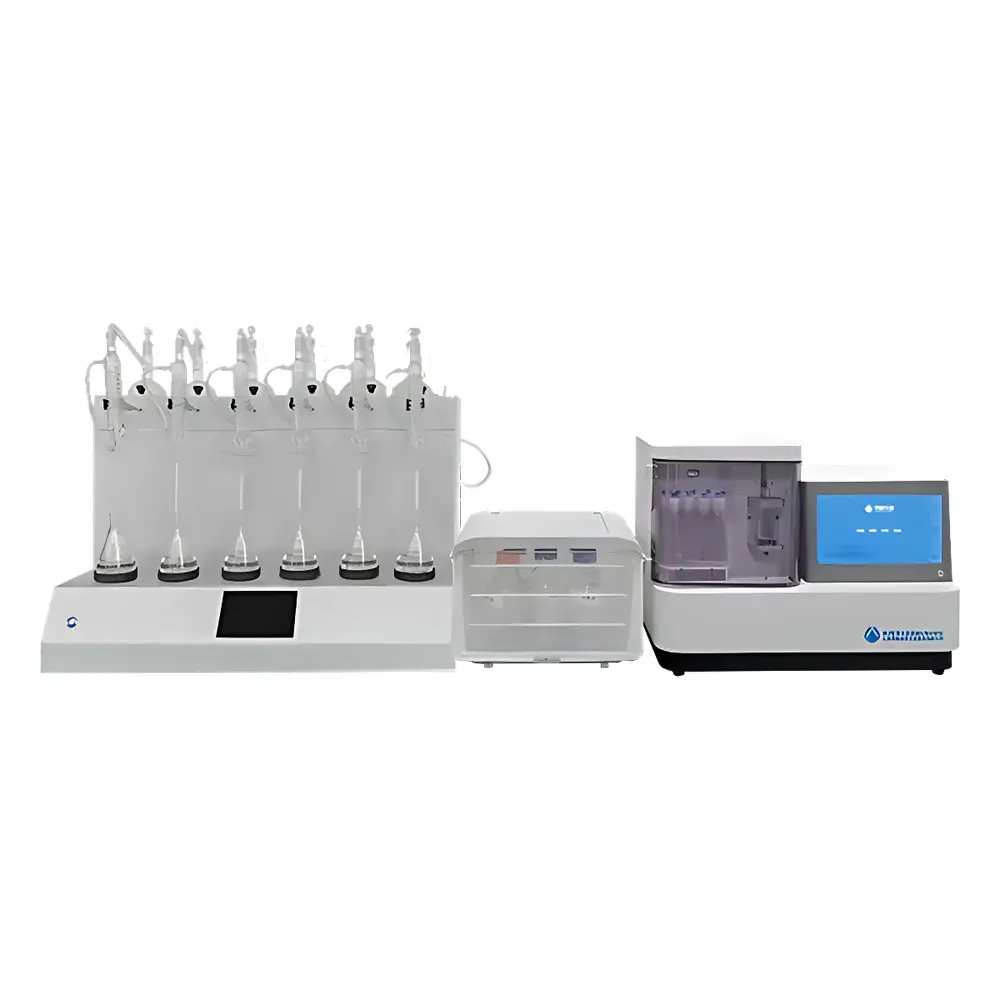
Online Instrument OL2070 Fully Automated Sulfide Analyzer
| Brand | Online Instrument |
|---|---|
| Origin | Shanghai, China |
| Manufacturer Type | Manufacturer |
| Product Category | Domestic |
| Model | OL2070 |
| Instrument Type | Laboratory Benchtop Analyzer |
| Pricing | Upon Request |
Overview
The Online Instrument OL2070 Fully Automated Sulfide Analyzer is a laboratory-grade benchtop system engineered for precise, reproducible quantification of total sulfide (H₂S, HS⁻, S²⁻) in aqueous environmental matrices. It operates on the principle of acid distillation followed by spectrophotometric detection using the methylene blue method (ISO 16384:2015, EPA Method 376.1, and HJ 1226–2021). The instrument integrates sequential fluidic handling, temperature-controlled distillation interface compatibility, and dual-path optical measurement to deliver trace-level sensitivity (detection limit ≤ 0.005 mg/L as S) with high inter-run repeatability (RSD < 2.5% at 0.1 mg/L). Designed for regulatory-compliant water quality laboratories, the OL2070 eliminates manual intervention across the entire analytical workflow—from sample introduction to final report generation—while maintaining full physical containment of hazardous reagents and volatile sulfide species.
Key Features
- Fully automated analytical sequence: programmable sample transfer, reagent dispensing (HCl, FeCl₃, N,N-dimethyl-p-phenylenediamine, and FeCl₂), standard curve preparation (multi-point calibration across low- and high-range modes), vortex-assisted mixing, timed color development (±0.5 s precision), volumetric final dilution, absorbance measurement at 670 nm, system rinsing, and waste segregation.
- Modular distillation interface: compatible with third-party automated distillation units (6-, 25-, or 50-position configurations), enabling seamless integration into existing lab automation ecosystems without proprietary lock-in.
- Dual-path optical detection: fixed 1 cm and 3 cm pathlength cuvettes selectable via software; optimized for linear dynamic range extension (0.005–2.0 mg/L and 0.5–20 mg/L, respectively), with correlation coefficients ≥ 0.999 for all calibration curves.
- Integrated safety architecture: fully enclosed reaction chamber with negative-pressure ventilation, sealed reagent reservoirs, and real-time leak monitoring; all toxic vapors (e.g., H₂S) are trapped and neutralized prior to exhaust.
- Self-cleaning protocol: post-analysis automatic aspiration, high-purity water flush (≥3 cycles), air purge, and waste line evacuation to prevent cross-contamination and carryover.
- Remote operational capability: web-based instrument control and data access via secure HTTPS interface; supports mobile device monitoring, event-triggered notifications, and audit-ready session logging.
Sample Compatibility & Compliance
The OL2070 accepts liquid samples from diverse environmental sources—including surface water, groundwater, domestic wastewater, and industrial effluents—with minimal pretreatment (filtration only, if suspended solids > 20 mg/L). It complies with ISO/IEC 17025:2017 requirements for test method validation and meets critical elements of US EPA Contract Lab Program (CLP) and China’s HJ 1226–2021 standard methodology. All electronic records adhere to ALCOA+ principles (Attributable, Legible, Contemporaneous, Original, Accurate, Complete, Consistent, Enduring, Available) and support 21 CFR Part 11-compliant user authentication, electronic signatures, and immutable audit trails when deployed with validated LIMS integration.
Software & Data Management
The embedded OL-Soft v3.2 platform provides intuitive one-click method execution, multi-curve library management (with version-controlled naming and metadata tagging), and real-time QC charting (Levey-Jennings, Shewhart). Raw absorbance values, calibration parameters, reagent lot tracking, and environmental sensor logs (temperature, pressure, humidity) are stored in encrypted SQLite databases. Export formats include CSV, PDF analytical reports (with embedded chromatogram-style time-series plots), and XML for direct ingestion into ELN or LIMS systems. Software updates are delivered via signed firmware packages with SHA-256 verification.
Applications
This analyzer serves routine and compliance-driven sulfur speciation workflows in national and provincial environmental monitoring stations, municipal water utilities (intake and effluent monitoring), petrochemical refineries (cooling water and produced water analysis), electroplating facilities (wastewater discharge verification), and mining operations (acid mine drainage assessment). It is routinely deployed in GLP-certified contract labs performing Tier I and II environmental testing under contractual obligations to MEE (Ministry of Ecology and Environment, P.R. China) and equivalent international regulatory frameworks.
FAQ
Does the OL2070 require dedicated distilled water or specific reagent grades?
Yes—Type I ultrapure water (resistivity ≥ 18.2 MΩ·cm) and ACS-grade reagents are required to maintain calibration stability and minimize blank interference.
Can the system be validated for ISO 17025 accreditation?
Yes—the instrument includes built-in performance verification protocols (system suitability tests, intermediate precision checks, and spike recovery assessments) aligned with ISO/IEC 17025:2017 Annex A.3.
Is method transfer supported between OL2070 units?
Yes—calibration models, method files, and QC templates are exportable/importable in standardized .olm format, ensuring consistent operation across multi-site deployments.
What maintenance intervals are recommended?
Daily: visual inspection of tubing integrity and waste container level; quarterly: photometer wavelength verification and pump calibration; annually: full optical alignment and distillation interface pressure testing per manufacturer service bulletin OL-SV-2070-REV4.
Related Products







