
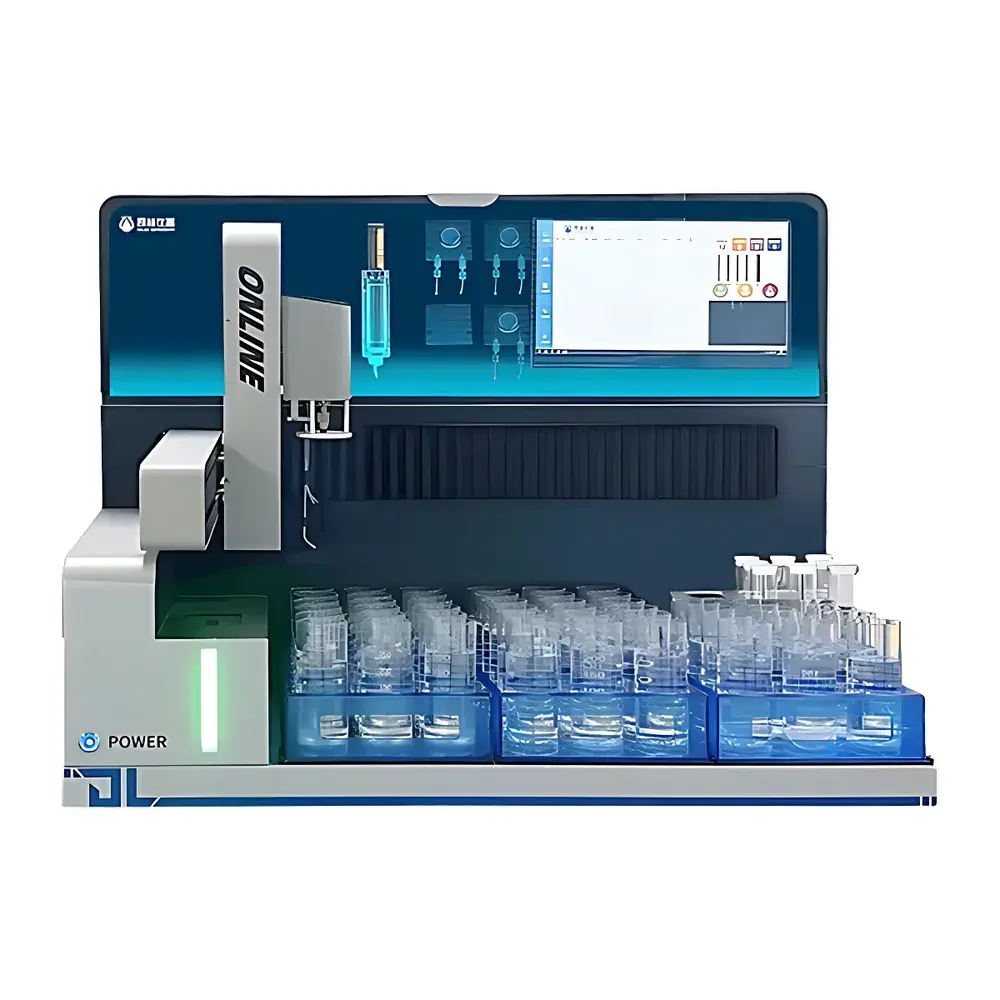
Online Instrument OL2800N Online Hexavalent Chromium (Cr(VI)) Water Analyzer
| Brand | Online Instrument |
|---|---|
| Origin | Shanghai, China |
| Model | OL2800N |
| Measurement Principle | Diphenylcarbazide Spectrophotometry (GB 7467–1987, GB/T 5750.6–2023) |
| Automation Level | Fully Automated Sample Handling, Reagent Dispensing, Standard Preparation, Curve Fitting, Dilution, Mixing, Cuvette Conditioning, Measurement, Cleaning & Waste Collection |
| Compliance | Aligned with Chinese National Standards for Drinking Water and Environmental Monitoring |
| Connectivity | Remote Web-Based Control via Mobile/Tablet |
| Data Management | Audit-Trail Enabled Reporting with Timestamped Metadata |
| Sample Throughput | Continuous Unattended Operation with Priority Queueing |
| Detection Range | Adjustable Multi-Range Calibration (Auto-Dilution Supported) |
| Waste Handling | Closed-Loop Waste Recovery System |
Overview
The Online Instrument OL2800N is a fully automated online water analyzer engineered for the quantitative determination of hexavalent chromium (Cr(VI)) in diverse aqueous matrices using the standardized diphenylcarbazide spectrophotometric method (GB 7467–1987 and GB/T 5750.6–2023). It implements a robust, closed-system fluidic architecture grounded in photometric absorbance measurement at 540 nm following chromogenic complex formation between Cr(VI) and 1,5-diphenylcarbazide under acidic conditions. Designed for regulatory-grade environmental monitoring, the OL2800N delivers trace-level Cr(VI) quantification with high reproducibility across municipal drinking water, raw surface/groundwater, secondary distribution systems, and industrial effluents—without manual intervention. Its operational workflow integrates precise volumetric metering, temperature-stabilized reaction incubation, optical path calibration, and real-time signal processing to ensure compliance with routine quality control and long-term trend analysis requirements.
Key Features
- Fully automated analytical sequence: sample aspiration, reagent addition (H2SO4, diphenylcarbazide solution), mixing, reaction timing, photometric measurement, and post-run cleaning—all executed under programmable protocol control.
- Integrated standard preparation module: automatic serial dilution of stock standards, generation of multi-point calibration curves (up to 8 points), and on-demand recall of stored curve sets optimized for low-, medium-, and high-concentration ranges.
- Intelligent auto-dilution capability: real-time absorbance feedback triggers dynamic dilution for out-of-range samples, maintaining measurement integrity without operator input.
- Priority queue management system: supports urgent sample insertion during ongoing runs; flagged samples are scheduled immediately after completion of the current measurement cycle.
- Remote operation interface: web-based dashboard accessible via tablet or smartphone; enables instrument status monitoring, method editing, report retrieval, and diagnostic logging from off-site locations.
- Closed-loop waste handling: all liquid waste—including reagents, standards, and sample residuals—is pneumatically directed into a dedicated containment vessel, minimizing exposure risk and supporting GLP-aligned disposal documentation.
Sample Compatibility & Compliance
The OL2800N accommodates turbid, colored, or particulate-laden water samples within defined matrix tolerance limits. It is validated for use with potable water (per GB 5749–2022), source water (GB 3838–2002), and industrial wastewater (GB 8978–1996). While not certified to ISO/IEC 17025 as a standalone testing laboratory, its methodology conforms to the technical basis of ISO 11085 (water quality — determination of chromium — spectrometric method) and supports data traceability required under China’s Environmental Monitoring Technical Specifications (HJ/T 91–2002). All measurement records include timestamps, operator IDs (where applicable), calibration history, and version-controlled method parameters—facilitating internal QA audits and regulatory review.
Software & Data Management
The embedded firmware features a secure, role-based access control system compliant with basic data integrity principles. Raw absorbance values, calculated concentrations, curve statistics (R², LOD, LOQ), and instrument diagnostics are stored locally with optional encrypted cloud backup. Reports export in PDF and CSV formats, retaining full metadata including sample ID, analysis date/time, calibration reference, and system error logs. The software maintains an immutable audit trail per ICH-GCP and CNAS-CL01 guidelines, recording every user action (e.g., method modification, curve deletion, result override) with digital signature and timestamp—enabling retrospective verification during GLP or environmental inspection processes.
Applications
- Continuous compliance monitoring of Cr(VI) at water treatment plant intake and finished water outlets.
- Periodic surveillance of groundwater wells near electroplating, leather tanning, or pigment manufacturing facilities.
- Quality assurance for bottled water production lines where Cr(VI) is a specified contaminant parameter.
- Research applications requiring high-frequency temporal profiling of Cr(VI) dynamics in aquatic ecosystems or constructed wetlands.
- Support for environmental impact assessments (EIAs) and discharge permit verification under local ecological authorities’ mandates.
FAQ
Does the OL2800N comply with U.S. EPA Method 7196A or ISO 11085?
The OL2800N implements the diphenylcarbazide principle common to these methods but is configured and validated specifically against GB/T 5750.6–2023. Cross-method equivalence requires site-specific performance qualification per EPA guidance.
Can the system be integrated into a SCADA or LIMS environment?
Yes—via Modbus TCP or OPC UA protocol support; custom API endpoints are available for LIMS synchronization upon request.
What maintenance intervals are recommended for long-term reliability?
Daily: visual inspection of fluidic paths and waste level. Weekly: photometer baseline verification and pump tubing assessment. Quarterly: full optical alignment check and reagent line priming.
Is operator training provided with installation?
Comprehensive remote and on-site training modules are included, covering method setup, troubleshooting, data export, and routine maintenance procedures.
How is interference from iron(III), molybdenum(VI), or vanadium(V) managed?
The instrument applies built-in correction algorithms based on co-measured absorbance at 500 nm and 580 nm, consistent with GB/T 5750.6–2023 interference mitigation protocols.







