
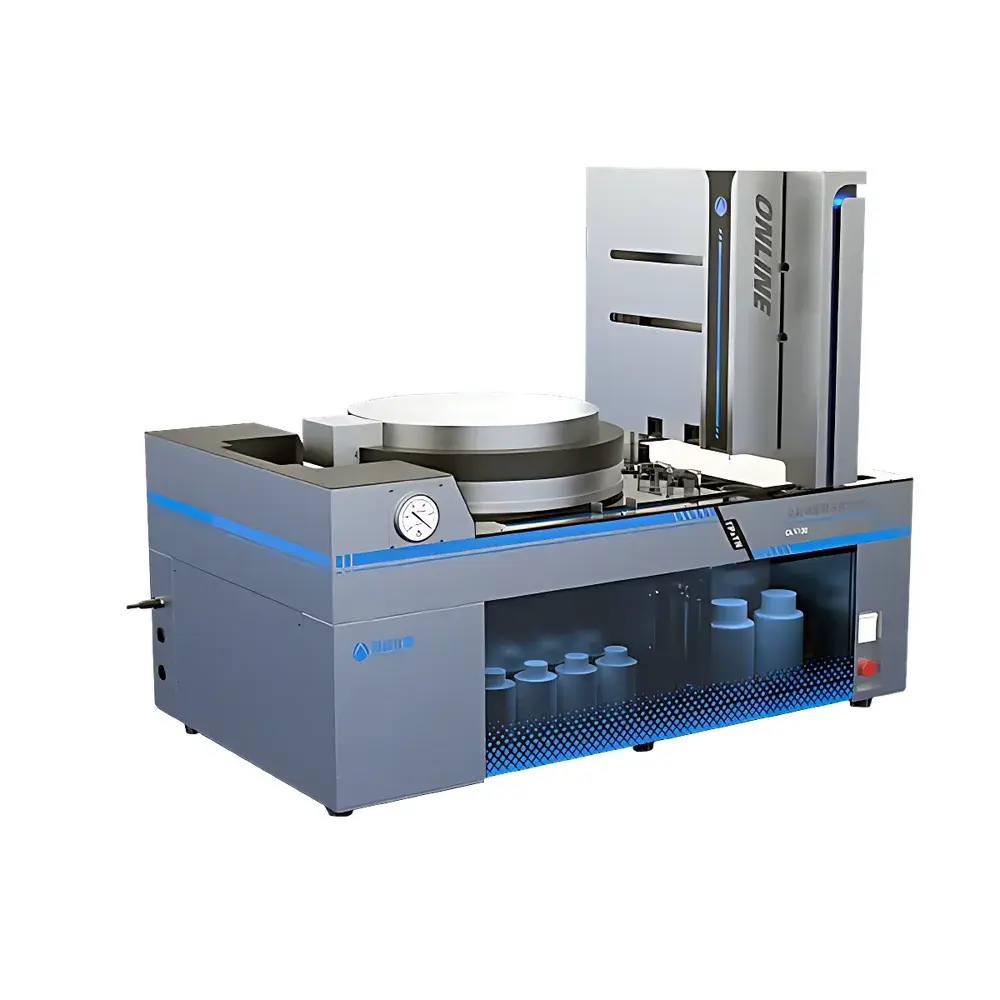
Online Instrument OL5100 Total Phosphorus and Total Nitrogen Analyzer
| Brand | Online Instrument |
|---|---|
| Origin | Shanghai, China |
| Manufacturer Type | Authorized Distributor |
| Country of Origin | China |
| Model | OL5100 |
| Measurement Parameters | Total Phosphorus (TP) and Total Nitrogen (TN) |
| Instrument Type | Laboratory Benchtop Analyzer |
| Measurement Principle | Spectrophotometry (Molybdate Blue Method for TP |
| Sample Capacity | 64 positions |
| Digestion Capacity | 64 positions |
| Reagent Handling | Fully Automated Transfer |
| Digestion Method | Automated High-Pressure Digestion |
| Calibration | Auto-Curve Calibration |
| Cleaning | Programmable Self-Cleaning with Fresh-Water Rinse |
| Waste Management | Automated Waste Collection & Gas Adsorption |
| Operation Mode | One-Touch Start |
| Remote Access | Mobile/Tablet-Based Control via Secure Web Interface |
| Compatibility | Integrates with Unmanned Lab Platforms (e.g., LIMS, ELN, SCADA) or Operates Standalone |
Overview
The Online Instrument OL5100 Total Phosphorus and Total Nitrogen Analyzer is a fully automated, benchtop laboratory system engineered for precise, high-throughput quantification of total phosphorus (TP) and total nitrogen (TN) in aqueous environmental samples. It implements two standardized spectrophotometric methodologies: the molybdate blue method per GB 11893–1989 for TP determination, and the alkaline potassium persulfate digestion–UV spectrophotometric method per HJ 636–2012 for TN analysis. The instrument integrates high-pressure digestion, precision liquid handling, optical detection, and intelligent waste management into a single compact architecture. Its core measurement principle relies on stoichiometric colorimetric reactions—phosphate forms a blue phosphomolybdate complex reduced by ascorbic acid under acidic conditions, while TN is converted quantitatively to nitrate via thermal-oxidative digestion and measured via dual-wavelength UV absorbance correction (A220 – 2×A275). Designed for regulatory compliance and method traceability, the OL5100 supports full audit trails, calibration verification logs, and instrument performance checks aligned with ISO/IEC 17025 requirements for environmental testing laboratories.
Key Features
- Fully integrated high-pressure digestion module operating at 120–124 °C with programmable pressure control, ensuring complete oxidation of refractory nitrogen species and organic phosphorus compounds.
- Adaptive elastic sealing mechanism replaces conventional rotary lids—eliminates mechanical wear, prevents cross-contamination between sample cycles, and maintains consistent digestion chamber integrity across >10,000 operational cycles.
- High-precision 3-axis robotic arm with sub-10 µL volumetric accuracy and >4 million cycle MTBF (Mean Time Between Failures) for pipetting; coupled with smart diaphragm pumps rated for >40 million actuations.
- Dual-channel photometric detection system featuring stabilized deuterium-tungsten light sources, thermoelectrically cooled CCD array detectors, and wavelength-specific optical filters for 220 nm and 275 nm (TN), plus visible-range detection (650–850 nm) for TP.
- Automated reagent dispensing, turbulent mixing, and fresh-water rinse protocols—minimizes carryover (<0.05% memory effect), validated per USP and EPA Method 365.4 guidelines.
- Voice-enabled and text-based interactive assistant embedded in the onboard OS; supports remote diagnostics, real-time status queries, and contextual troubleshooting via mobile web interface (HTTPS/TLS 1.3 secured).
Sample Compatibility & Compliance
The OL5100 accepts raw water matrices without pre-filtration—including turbid surface water, saline groundwater, municipal wastewater effluents, and industrial discharges with suspended solids ≤500 mg/L. It complies with national and international standard methods: GB 11893–1989 (TP), HJ 636–2012 (TN), ISO 15681-1:2003 (phosphate), and ASTM D1428–20 (total nitrogen). All digestion and measurement sequences are logged with timestamped metadata, supporting GLP/GMP documentation workflows. Data export formats include CSV, PDF analytical reports, and XML-compatible structured output for integration into LIMS platforms compliant with FDA 21 CFR Part 11 (electronic signatures and audit trail retention ≥6 months).
Software & Data Management
The embedded Linux-based control software (v4.2+) provides intuitive touchscreen operation and remote browser access via responsive HTML5 interface. It includes automated calibration curve generation using up to 8-point standard series, dynamic range adjustment, outlier rejection algorithms (Dixon’s Q-test), and QC flagging per ISO 8466-1. Raw absorbance data, digestion temperature/pressure profiles, and pump actuation logs are stored locally on encrypted SSD and synchronized to optional cloud backup (AES-256 encrypted). Audit trail functionality records all user actions, parameter changes, and instrument events with immutable timestamps—fully compliant with ISO/IEC 17025:2017 clause 7.9 and EU Annex 11 for computerized system validation.
Applications
The OL5100 serves as a primary analytical tool in environmental monitoring laboratories, municipal water quality control centers, industrial effluent compliance units, and research institutions conducting nutrient cycling studies. Typical use cases include routine TP/TN profiling of river basins under China’s “Blue Sky and Clear Water” initiative, quarterly discharge reporting for electroplating and food processing plants subject to GB 8978–1996 limits, and long-term eutrophication trend analysis in lake sediments. Its 64-position capacity enables unattended overnight batch processing (up to 48 samples/hour), while its modular design allows seamless integration into automated lab ecosystems—supporting bidirectional communication with Siemens Desigo CC, Thermo Fisher SampleManager LIMS, and custom Python-based orchestration scripts.
FAQ
Does the OL5100 require external cooling water or compressed air?
No—it operates with internal Peltier-based detector cooling and integrated air compressor for valve actuation; only standard 220 V AC power and deionized water supply are required.
Can the instrument perform TP and TN measurements independently—or only simultaneously?
Both modes are supported: users may select TP-only, TN-only, or concurrent dual-parameter analysis within the same run sequence.
What is the minimum detectable concentration for TP and TN?
Based on method validation per HJ 636–2012 and GB 11893–1989, typical LODs are 0.01 mg/L (as P) and 0.05 mg/L (as N) under optimal calibration conditions.
Is method validation documentation provided with the system?
Yes—each unit ships with a Factory Validation Report including linearity, precision (RSD <2.5%), spike recovery (92–105%), and inter-laboratory reproducibility data against certified reference materials (CRM-NIST SRM 1643e, CRM-GBW(E) 080396).
How is firmware updated and cybersecurity maintained?
Firmware updates are delivered via signed OTA packages; the system enforces TLS 1.3 encryption, role-based access control (RBAC), and automatic security patch deployment every 90 days per NIST SP 800-53 Rev. 5 baseline.







