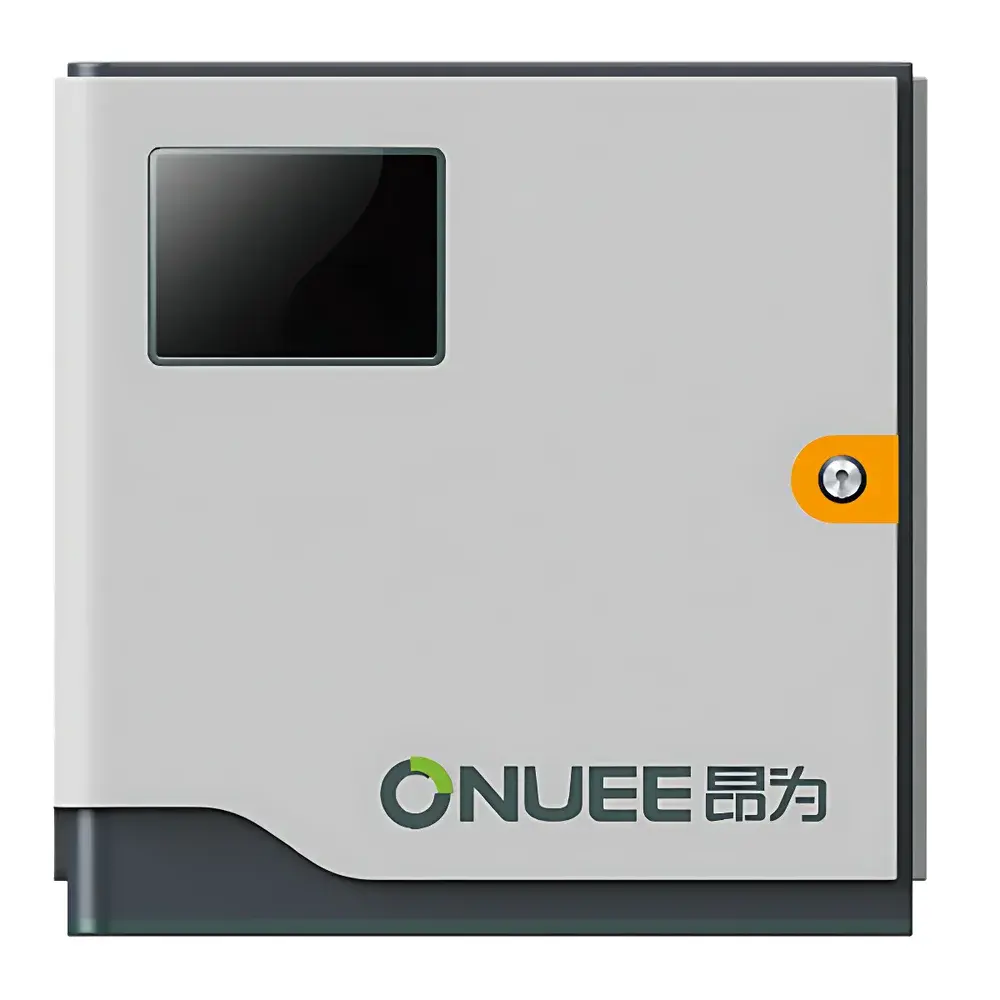
ONUEE UE5033/UE5034 Online Hydrogen Analyzer
| Brand | ONUEE |
|---|---|
| Origin | Guangdong, China |
| Manufacturer Type | Authorized Distributor |
| Origin Category | Domestic (China) |
| Model | UE5033 / UE5034 |
| Price Range | USD 4,200 – 7,000 |
| H₂ Range (UE5033) | 0–100% vol |
| H₂ Range (UE5034) | 0–100% vol |
| Lower Detection Limit (LDL) | 0.5% vol |
| CO Range (UE5033) | 0–100 ppm |
| CO Range (UE5034) | 0–20% vol |
| H₂S Range (UE5033) | 0–1000 ppm |
| H₂S Range (UE5034) | 0–3% vol |
| T90 Response Time | ≤60 s (UE5033), ≤90 s (UE5034) |
| Accuracy (UE5033/UE5034) | ±0.4% (0–10%), ±0.7% (10–30%), ±1.0% (30–70%), ±1.2% (70–100%) |
| Repeatability | ±0.2–±0.5% |
| Operating Pressure | 0.95–1.1 bar abs (recommended), up to 7 bar abs |
| Process Gas Temperature | −40 °C to +60 °C |
| Flow Rate | 0.1–10 NL/min (¾″ hose) |
| Humidity | <95% RH (non-condensing) |
| Digital Output | RS485, Modbus RTU, 19200 baud, 8N2 |
| Analog Output | Optional 4–20 mA module |
| Relay Output | Optional 4× SPDT relays |
| Power Supply | 9–48 VDC, 10 W |
| Dimensions | 151 × 40 × 40 mm |
| Weight | 0.4 kg |
| Enclosure Rating | IP68 |
| Operating Temperature | −40 °C to +70 °C |
| Storage Temperature | −40 °C to +105 °C |
| Certifications | CE, FCC, RoHS, WEEE, Conflict Minerals Compliance |
Overview
The ONUEE UE5033 and UE5034 are industrial-grade, in-situ hydrogen analyzers engineered for continuous, real-time monitoring of hydrogen concentration in process gas streams across demanding industrial environments. These analyzers employ a solid-state, non-consumptive electrochemical sensing principle—specifically, a proprietary metal-oxide semiconductor (MOS) sensor architecture optimized for selective H₂ detection without reliance on catalytic combustion or thermal conductivity differentials. Unlike traditional thermal conductivity (TCD) or paramagnetic analyzers, the UE5033/UE5034 sensor exhibits negligible cross-sensitivity to CO, CH₄, N₂, O₂, CO₂, and hydrocarbons under typical process conditions—enabling accurate measurement even in complex, multi-component gas matrices. The instrument is designed for direct insertion into process lines (via ¾″ NPT or compression fitting) with no requirement for sample extraction, conditioning systems, carrier gases, or reference gas supplies. Its zero-drift auto-calibration algorithm continuously compensates for baseline drift using internal reference compensation logic, eliminating scheduled manual calibration while maintaining traceable measurement integrity over extended deployment cycles.
Key Features
- Solid-state, non-consumptive MOS sensor with >5-year operational lifetime under continuous exposure to H₂-rich streams
- True in-situ measurement: no sample probe, no extractive system, no external pump or filter required
- Auto-compensating drift correction: real-time baseline stabilization without external calibration gas or user intervention
- Compact, ruggedized housing (IP68-rated) with M12 power interface and ¾″ NPT sensor port—designed for panel mounting or direct pipe integration
- Wide operating range: −40 °C to +60 °C process gas temperature; compatible with pressures up to 7 bar abs (factory calibrated at 1 bar abs)
- Low-power operation (10 W max) supporting 9–48 VDC wide-range input—suitable for hazardous area installations with intrinsically safe power supplies (pending IS certification add-on)
- Modbus RTU over RS485 as standard digital interface; optional 4–20 mA analog output and four programmable SPDT relays for alarm/control integration
Sample Compatibility & Compliance
The UE5033 and UE5034 maintain measurement stability in presence of common industrial background contaminants—including sulfur compounds (H₂S up to 1000 ppm for UE5033; 3% for UE5034), carbon monoxide (up to 100 ppm or 20% depending on model), and condensable vapors—provided gas stream dew point remains below ambient temperature and particulate loading is <1 µm. Units comply with EU directives CE (2014/30/EU EMC, 2014/35/EU LVD), FCC Part 15 Class A, RoHS 2011/65/EU, WEEE 2012/19/EU, and U.S. Conflict Minerals Reporting Standards (Dodd-Frank Section 1502). While not certified to ATEX or IECEx out-of-the-box, the analyzer’s low-energy design and modular architecture support third-party intrinsic safety barrier integration for Zone 1/2 applications. All firmware and configuration logs adhere to ALCOA+ principles (Attributable, Legible, Contemporaneous, Original, Accurate, Complete, Consistent, Enduring, Available) to facilitate GLP/GMP-aligned validation protocols.
Software & Data Management
Configuration, diagnostics, and data logging are managed via ONUEE’s PC-based ConfigTool (Windows 10/11 compatible), which supports device parameterization, firmware updates, and event log export (CSV/Excel). The embedded Modbus RTU register map exposes real-time H₂ concentration (% vol), sensor status flags (e.g., “Sensor OK”, “Calibration Active”, “Overpressure Alert”), temperature-compensated signal health metrics, and cumulative operational hours. For enterprise SCADA or DCS integration, the analyzer supports standard Modbus function codes (03h, 04h, 06h, 10h) with configurable polling intervals (1–30 s). Audit trails—including timestamped parameter changes and relay state transitions—are retained in non-volatile memory for ≥12 months and can be retrieved remotely via serial command set. No cloud connectivity or proprietary cloud platform is embedded; all data remains on-premise unless interfaced externally through customer-owned infrastructure.
Applications
- Petrochemical Refining: Catalytic reformer off-gas monitoring, hydrotreater H₂-to-hydrocarbon ratio control, flare gas composition verification, fuel gas header quality assurance
- Natural Gas Conditioning: Wobbe index calculation via H₂ dilution tracking, biogas upgrading verification, pipeline blending point compliance (EN 16726, ISO 8573-1)
- Hydrogen Economy Infrastructure: PEM electrolyzer outlet purity verification (ISO 8573-8 Class 1), fuel cell anode feed monitoring (SAE J2719), hydrogen compressor discharge analysis
- Chemical & Polymer Production: Ethylene cracker purge stream H₂ content, polyolefin reactor inert gas blanket control, ammonia synthesis loop purge optimization
- Power Generation: Generator cooling gas (H₂/N₂ mix) leakage detection, turbine enclosure atmosphere safety interlock
FAQ
Does the UE5033/UE5034 require periodic calibration gas?
No. The analyzer performs continuous self-compensation using internal reference elements and does not require external calibration gas. Factory calibration is performed at 1 bar abs and 25 °C; field accuracy remains within published specifications across its rated pressure and temperature envelope.
Can it measure hydrogen in high-CO or high-H₂S environments?
Yes—model-specific ranges are validated: UE5033 tolerates up to 100 ppm CO and 1000 ppm H₂S; UE5034 extends to 20% CO and 3% H₂S without signal interference or sensor poisoning.
Is the sensor affected by moisture or condensation?
The sensor operates reliably at up to 95% RH non-condensing. Condensed water must be excluded upstream via coalescing filters or heated sample lines; prolonged liquid contact will damage the sensing element.
What is the expected service life of the sensor?
Under continuous operation in clean, dry H₂ streams at ≤60 °C, the solid-state sensor demonstrates >5 years MTBF. Lifetime decreases proportionally with cumulative exposure to high-concentration H₂S (>500 ppm) or temperatures exceeding 60 °C.
How is traceability maintained for regulatory audits?
Each unit ships with a factory calibration certificate (NIST-traceable reference gas), and all configuration changes are time-stamped and logged locally. Full audit trail export capability supports FDA 21 CFR Part 11 compliance when deployed with validated IT infrastructure.
Related Products