
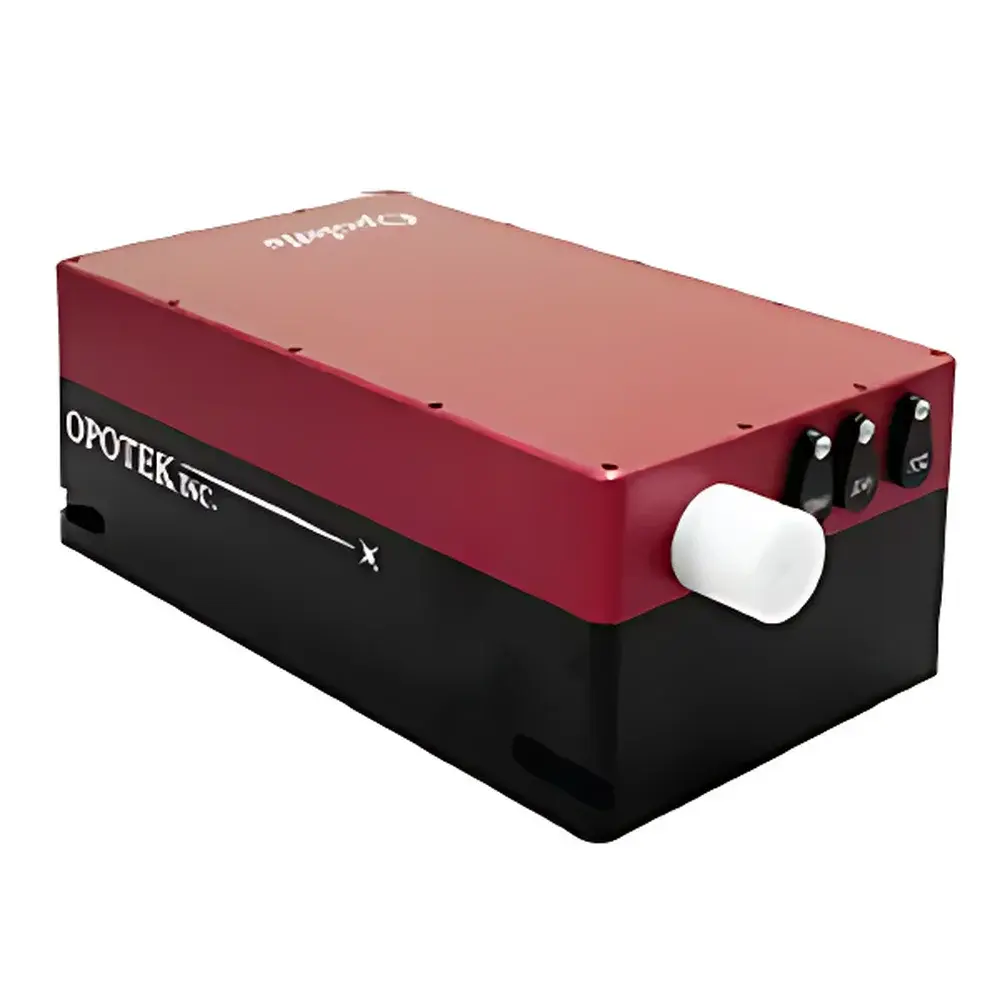
OPOTEK Opolette (HR) Series Integrated Low-Energy Compact OPO Laser
| Brand | OPOTEK |
|---|---|
| Origin | USA |
| Manufacturer Type | Authorized Distributor |
| Product Category | Imported |
| Model | Opolette (HR) Series |
| Pump Wavelength Options | 1064 nm, 532 nm, 355 nm |
| Repetition Rate | Up to 100 Hz |
| Tuning Range (Signal + Idler) | ~650–2600 nm (with UV Extension: 210–410 nm) |
| Output Configuration | Coaxial signal and idler beams via polarization-based separation |
| Laser Head Dimensions | 305 × 178 × 93 mm |
| Control Interface | Fully automated software-controlled wavelength, energy, and repetition rate adjustment |
| Core Architecture | Monolithic, hermetically sealed pump + OPO module |
Overview
The OPOTEK Opolette (HR) Series is a fully integrated, compact optical parametric oscillator (OPO) laser system engineered for high-reliability, turnkey operation in demanding laboratory and industrial research environments. Unlike conventional OPO configurations requiring external pump lasers and complex alignment-sensitive resonators, the Opolette (HR) integrates a solid-state Q-switched Nd:YAG pump source and a thermally stabilized, critically phase-matched OPO crystal assembly within a single hermetically sealed optomechanical housing. This monolithic architecture eliminates inter-module coupling losses, reduces sensitivity to environmental perturbations (e.g., vibration, thermal drift), and ensures long-term pointing stability and pulse-to-pulse energy reproducibility—critical for quantitative nonlinear optical measurements. The system operates on the principle of parametric amplification in nonlinear crystals (e.g., BBO or KTP), where a fixed-wavelength pump photon is converted into two lower-energy photons—signal and idler—whose wavelengths satisfy energy conservation (ωp = ωs + ωi) and phase-matching conditions. With selectable fundamental pump wavelengths (1064 nm, 532 nm, or 355 nm), the Opolette (HR) delivers broadly tunable output across the visible and near- to mid-infrared spectrum (650–2600 nm), extendable into the deep ultraviolet (210–410 nm) using optional harmonic generation modules.
Key Features
- Monolithic integration of pump laser and OPO cavity in a single, ruggedized 305 × 178 × 93 mm enclosure—enabling benchtop deployment without external water cooling or acoustic isolation.
- Coaxial output of signal and idler beams via intracavity polarization routing; eliminates need for realignment during spectral scanning or multi-wavelength experiments.
- Software-driven, motorized grating and crystal angle control enabling fully automated, repeatable wavelength selection with sub-nanometer resolution and <±0.2 nm absolute accuracy over full tuning range.
- Independent digital control of pulse energy (via intra-cavity attenuation), repetition rate (1–100 Hz), and pump wavelength selection—all accessible through a standardized USB/Ethernet API compliant with LabVIEW, MATLAB, and Python.
- Hermetic sealing and active temperature stabilization of nonlinear crystals ensure >95% mode-matching stability over 8-hour continuous operation—meeting GLP-compliant instrument uptime requirements.
Sample Compatibility & Compliance
The Opolette (HR) is designed for compatibility with standard optical tables, fiber-coupled spectrometers (e.g., Andor Shamrock, Ocean Insight QE Pro), time-resolved fluorescence detectors (e.g., Becker & Hickl SPC-150), and PIV camera synchronization interfaces (e.g., LaVision DaVis TTL trigger). Its TEM00 beam profile (M² < 1.2), pulse duration (~5–8 ns FWHM), and low spatial chirp (<0.1 mrad/nm) ensure optimal coupling into single-mode fibers and high-efficiency excitation of narrow-linewidth fluorophores or Raman-active vibrations. The system complies with IEC 60825-1:2014 Class 4 laser safety standards and includes integrated interlocks, emission indicators, and key-switch access control. Firmware supports audit-trail logging per FDA 21 CFR Part 11 requirements when operated under validated SOPs in regulated environments.
Software & Data Management
OPOTEK provides the OpoControl Suite—a cross-platform application (Windows/macOS/Linux) supporting real-time wavelength calibration, energy normalization, and batch-scan scripting. All parameter changes are timestamped and stored in HDF5-formatted log files containing metadata (e.g., crystal temperature, grating position, photodiode readings). The SDK exposes RESTful HTTP endpoints and native C/C++/C# libraries for integration into custom acquisition pipelines. Export formats include CSV, ASCII, and vendor-neutral .SPE for direct import into Igor Pro, OriginLab, or Python-based analysis workflows (e.g., SciPy, LMFIT). Remote monitoring via Ethernet enables centralized fleet management across multi-user core facilities.
Applications
- Particle Image Velocimetry (PIV): Dual-wavelength (e.g., 532 nm + 650 nm) seeding illumination with precise temporal jitter (<100 ps) enables high-fidelity cross-correlation velocity mapping in turbulent combustion and microfluidic studies.
- Photoacoustic & Laser Ultrasonic Imaging: Tunable NIR output (700–900 nm) matches hemoglobin and lipid absorption bands, facilitating depth-resolved functional imaging in preclinical models.
- Nonlinear Spectroscopy: Resonant excitation of vibronic transitions in organic dyes, quantum dots, and 2D materials (e.g., MoS₂) via tunable picosecond pulses enables time-resolved fluorescence anisotropy and stimulated Raman scattering (SRS) microscopy.
- Laser Desorption/Ionization Mass Spectrometry (LDI-MS): UV extension module provides tunable 210–410 nm output for soft ionization of thermally labile biomolecules without matrix interference.
- Fluorescence Lifetime Imaging Microscopy (FLIM): Synchronized pulsed output supports time-correlated single-photon counting (TCSPC) with <25 ps instrument response function when paired with hybrid photomultipliers or SPAD arrays.
FAQ
Is the Opolette (HR) suitable for GMP-regulated analytical method development?
Yes—when deployed with documented IQ/OQ protocols and configured with audit-trail-enabled firmware, it meets foundational requirements for instrument qualification under USP and ISO/IEC 17025.
Can the system be retrofitted with third-party wavelength meters or energy monitors?
Yes—the 10 MHz TTL sync output and analog monitor ports (0–10 V) support external calibration traceability to NIST-traceable standards.
What maintenance is required beyond periodic crystal inspection?
No consumables or user-serviceable optics; recommended annual factory recalibration includes cavity alignment verification, thermal model validation, and wavelength accuracy certification against a reference iodine-stabilized HeNe laser.
Does the UV extension module introduce additional pulse broadening or beam distortion?
No—harmonic generation is implemented in a non-collinear, walk-off-compensated BBO stage with dispersion-matched compensation optics, preserving <10% pulse width increase and M² < 1.3 up to 266 nm.




