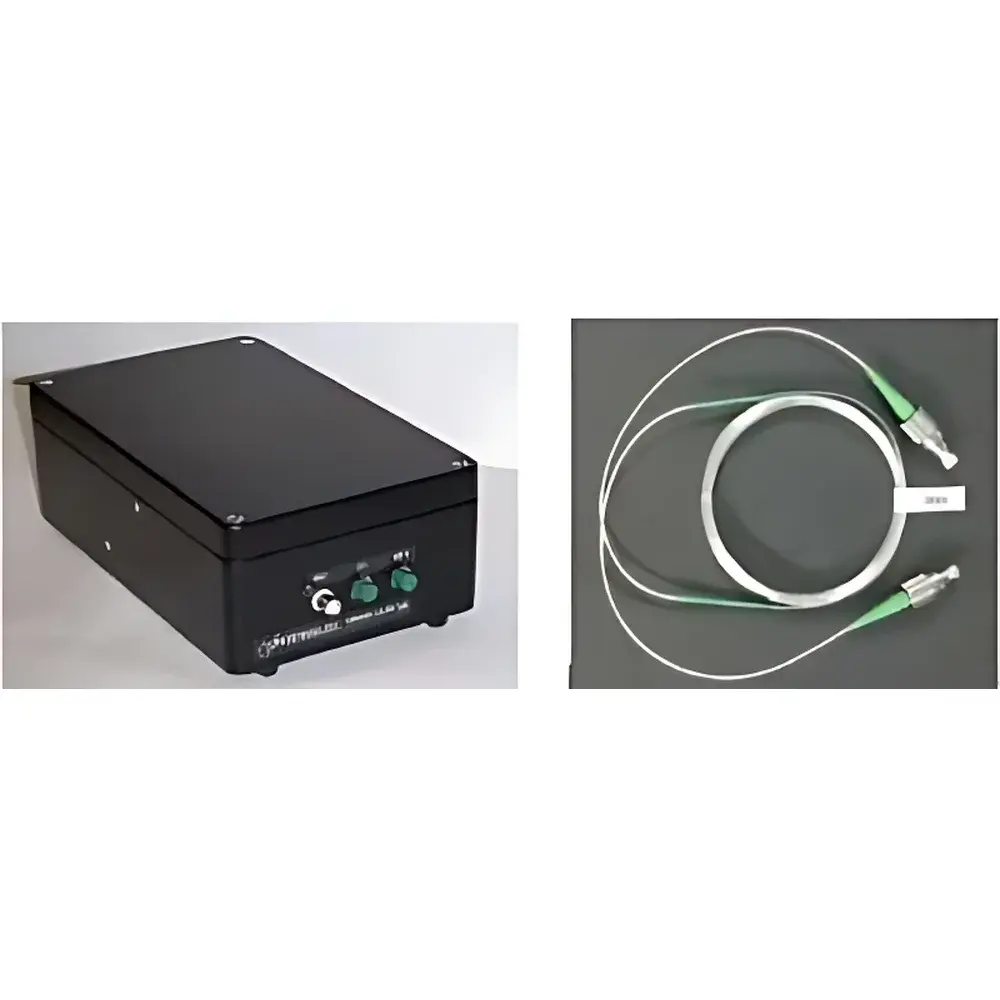
Optiphase MFI/MZI Fiber-Optic Interferometer
| Brand | Optiphase |
|---|---|
| Origin | USA |
| Model | MFI/MZI |
| Wavelength Range | 1064–1550 nm |
| Drive Interface | Front-panel BNC for PZ1 Piezoelectric Fiber Stretcher |
| Application Focus | Laser Phase Noise Measurement, Frequency Noise Characterization, and Fiber-Optic Sensor Interrogation |
| Compliance Context | Designed for laboratory-grade metrology in alignment with ISO/IEC 17025 traceable optical measurement practices |
Overview
The Optiphase MFI/MZI Fiber-Optic Interferometer is a precision passive interferometric device engineered for high-sensitivity phase-resolved optical measurements in research and industrial metrology environments. Based on the Mach–Zehnder (MZI) or Michelson (MFI) interferometric configuration—user-selectable via optical path design—it operates within the near-infrared spectral window of 1064 nm to 1550 nm, making it fully compatible with standard telecom-band lasers, fiber amplifiers, and low-noise diode sources. Unlike active integrated photonic sensors, this interferometer functions as a calibrated, all-fiber, free-space-coupled reference platform where optical path difference (OPD) is modulated externally via piezoelectric actuation. Its core function is to convert minute laser phase fluctuations—on the order of micro-radians—into measurable intensity variations at the output port, enabling quantitative analysis of intrinsic laser linewidth, residual frequency noise, and dynamic strain or temperature perturbations in fiber-optic sensing configurations.
Key Features
- Fully polarization-maintaining (PM) fiber construction with FC/APC connectors ensures stable interference fringe visibility under varying environmental conditions.
- Modular mechanical housing with kinematic mounting options supports integration into vibration-isolated optical tables and vacuum-compatible enclosures.
- Front-panel BNC interface enables direct analog voltage control of optical path length using the industry-standard PZ1 piezoelectric fiber stretcher, supporting closed-loop phase modulation up to 10 kHz bandwidth.
- Low insertion loss (25 dB) across the operational wavelength band ensure signal fidelity and dynamic range preservation.
- No internal electronics or power supply required—operates as a passive, inherently linear transduction element compliant with electromagnetic compatibility (EMC) Class B standards.
Sample Compatibility & Compliance
The MFI/MZI interferometer is designed for use with single-mode fiber (SMF-28 or equivalent), polarization-maintaining fiber (PANDA or bow-tie), and specialty fibers such as photosensitive or radiation-hardened variants. It accommodates input powers from −20 dBm to +10 dBm without nonlinear distortion or thermal drift-induced baseline shift. As a metrological reference instrument, it conforms to foundational requirements of ISO/IEC 17025 for calibration laboratories, including documented stability testing (≤0.05 rad RMS phase drift over 8 hours at 23 ± 1 °C), traceable alignment verification, and mechanical shock resistance per MIL-STD-810G Method 516.6. While not a certified medical or safety device, its passive architecture renders it suitable for use in Class 1 laser environments under IEC 60825-1:2014 guidelines.
Software & Data Management
The interferometer itself requires no embedded firmware or driver software; it serves as a hardware-level transducer in conjunction with external data acquisition systems. Users typically interface it with high-resolution digitizers (e.g., Keysight U5303A, Spectrum M4i.4450-x8) sampling at ≥100 MS/s and 14-bit vertical resolution. Phase demodulation is performed offline using standard algorithms—including Hilbert transform, arctangent demodulation, or digital lock-in techniques—implemented in MATLAB, Python (SciPy/NumPy), or LabVIEW. When deployed in regulated environments (e.g., pharmaceutical laser source qualification or aerospace component testing), the full measurement chain—including interferometer alignment logs, PZ1 drive voltage calibration records, and raw time-series acquisitions—can be archived with audit-trail metadata to satisfy FDA 21 CFR Part 11 electronic record requirements when paired with validated DAQ software platforms.
Applications
- Laser phase noise spectroscopy: Quantifying residual frequency jitter in narrow-linewidth lasers (e.g., DFB, ECDL, or fiber lasers) for coherent communications and atomic physics experiments.
- Dynamic fiber-optic sensor interrogation: Resolving sub-nanometer strain or sub-millikelvin temperature shifts in FBG, interferometric hydrophones, or distributed acoustic sensing (DAS) backends.
- Optical coherence tomography (OCT) reference arm stabilization: Providing real-time OPD feedback to compensate for mechanical drift in swept-source or spectral-domain OCT systems.
- Gravitational wave detector prototype development: Serving as a low-noise testbed for displacement metrology and feedback loop characterization in tabletop interferometric gravitational sensors.
- Calibration transfer standard: Acting as a secondary reference for verifying the phase linearity and dynamic range of commercial phase-modulated interferometers or electro-optic modulators.
FAQ
Is the MFI/MZI interferometer polarization-sensitive?
Yes—the device is constructed with polarization-maintaining fiber and requires aligned linear input polarization for optimal fringe contrast. A manual or motorized polarization controller is recommended upstream for maximum visibility.
Can it be used with femtosecond pulsed lasers?
It is compatible with transform-limited pulses ≥1 ps duration; however, dispersion mismatch between arms may broaden interference fringes. For ultrafast applications, dispersion-compensated versions (custom-order) are available.
What is the typical coherence length requirement?
To sustain stable interference, the source coherence length must exceed the differential arm length (standard models: 2–5 cm). Broadband SLEDs or ASE sources require careful path balancing and may necessitate active stabilization.
Does Optiphase provide calibration certificates?
Yes—NIST-traceable phase response calibration (at 1310 nm and 1550 nm) and OPD vs. PZ1 drive voltage characterization are available upon request as optional deliverables.
Is vacuum operation supported?
The standard aluminum housing is vacuum-compatible to 10⁻⁶ Torr when fitted with vacuum-rated fiber feedthroughs and sealed BNC bulkhead connectors (custom configuration required).