
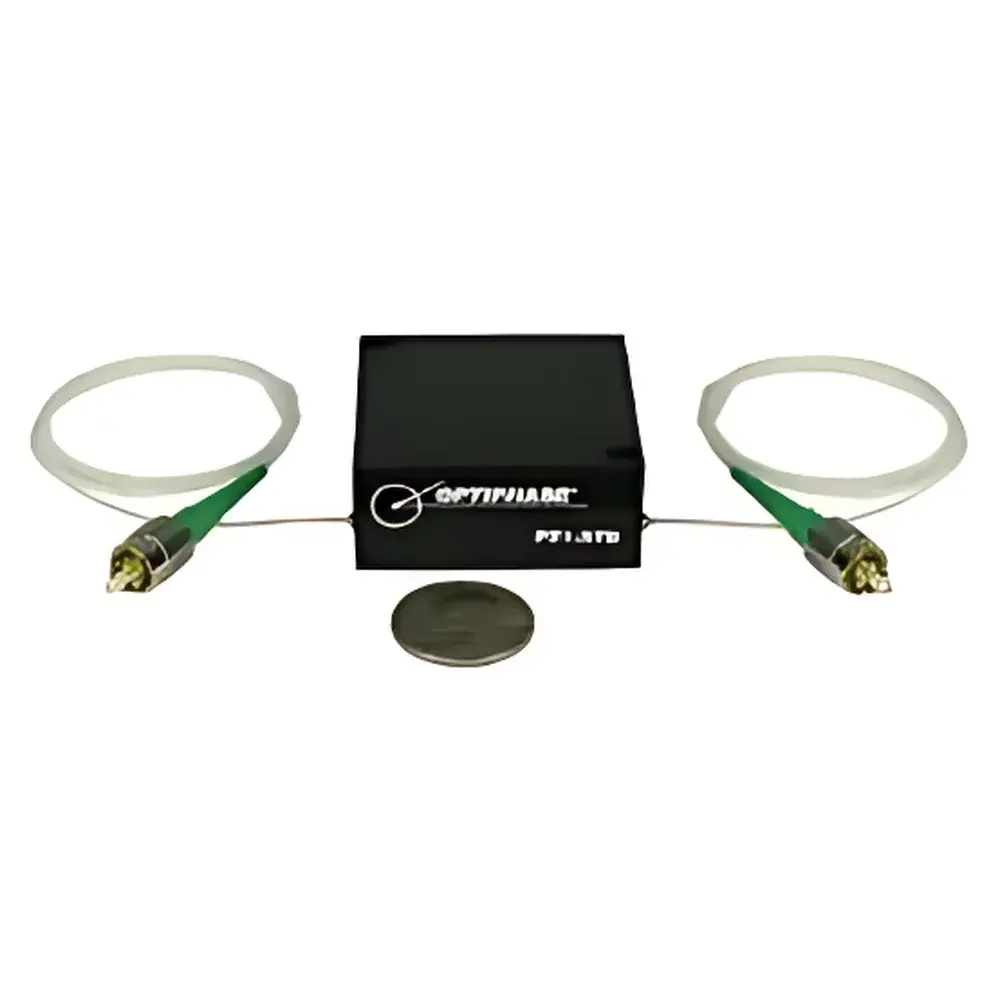
Optiphase PZ1/PZ2 Fiber Optic Stretchers
| Brand | Optiphase |
|---|---|
| Origin | USA |
| Model | PZ1 / PZ2 |
| Operating Wavelength | 1260–1625 nm (SMF-28), 1550 nm (PM fiber) |
| Modulation Coefficient | 1 rad/V @ 1300 nm (PZ1), 27 rad/V @ 1300 nm (PZ2) |
| Frequency Range | DC–80 kHz & 120–160 kHz |
| Optical Loss | ≤0.5 dB (typ. 0.2 dB) |
| Extinction Ratio | ≥24 dB (bare fiber), ≥22 dB (with connector) |
| Max Drive Voltage | ±500 V (PZ1), ±400 V (PZ2) |
| Fiber Length | 12.3 m (PZ1), 40 m (PZ2) |
| Dimensions | 2.0″ × 2.0″ × 0.85″ (PZ1) |
| Weight | 162 g (PZ1), 454 g (PZ2 enclosed) |
| Connector Options | Bare fiber, FC/PC, FC/APC |
Overview
The Optiphase PZ1 and PZ2 Fiber Optic Stretchers are precision electro-optic transduction devices engineered for controlled, voltage-dependent optical path length modulation in single-mode and polarization-maintaining (PM) fiber systems. Based on the piezoelectric longitudinal strain effect, these stretchers apply calibrated mechanical elongation to a defined segment of optical fiber—inducing a linear, repeatable phase shift proportional to the applied drive voltage. Unlike thermal or interferometric phase modulators, the PZ-series leverages direct mechanical displacement of the fiber core, ensuring high linearity, low hysteresis, and sub-picosecond timing resolution. Designed for integration into fiber-optic sensing, coherent detection, laser cavity stabilization, and ultrafast pulse shaping architectures, both models operate across the full C- and L-band telecom spectrum (1260–1625 nm) with minimal insertion loss and polarization-dependent loss (PDL). The PZ1 serves as a compact, general-purpose stretcher optimized for laboratory prototyping and OEM integration; the PZ2 delivers enhanced modulation efficiency (27 rad/V at 1300 nm) and extended fiber length (40 m), supporting high-fidelity optical delay tuning and dynamic dispersion compensation in advanced photonic testbeds.
Key Features
- Two platform variants: PZ1 (compact, cost-optimized) and PZ2 (high-efficiency, extended-length)
- Validated compatibility with SMF-28e (ITU-T G.652.D) and Corning PM15-U25A polarization-maintaining fiber
- Modulation coefficients up to 27 rad/V at 1300 nm (PZ2), enabling sub-radian phase control with millivolt-level resolution
- Dual-frequency response: broadband DC–80 kHz operation plus resonant enhancement in 120–160 kHz band for narrowband applications
- Optical insertion loss ≤0.5 dB (typical 0.2 dB), with extinction ratio ≥24 dB on bare PM fiber terminations
- Robust mechanical architecture: stainless-steel housing, hermetically sealed piezoceramic actuator, and strain-relieved fiber routing
- Thermally stable design operating from 0 °C to +70 °C without active temperature control
- Flexible termination options: bare fiber (900 µm loose tube), FC/PC, or FC/APC connectors
Sample Compatibility & Compliance
The PZ1 and PZ2 stretchers are qualified for use with standard telecommunication-grade fibers, including ITU-T G.652.D (SMF-28e) and G.657.A1/B2 (bend-insensitive) single-mode fibers, as well as Corning PM15-U25A and Fujikura PANDA-type PM fibers. Each unit undergoes factory calibration using traceable interferometric phase measurement per IEC 61290-10-1 (optical amplifier—phase modulation test method). While not certified to specific regulatory frameworks (e.g., FDA, CE), the devices comply with RoHS 2011/65/EU and REACH (EC 1907/2006) material restrictions. Mechanical construction adheres to IPC-A-610 Class 2 standards for industrial electronics. For GLP/GMP environments requiring auditability, optional firmware-enabled timestamped calibration logs and user-accessible diagnostic registers are available upon request.
Software & Data Management
Optiphase provides a vendor-agnostic analog interface: DC-coupled BNC input accepts ±500 V (PZ1) or ±400 V (PZ2) drive signals, compatible with arbitrary waveform generators (AWGs), lock-in amplifiers, and PID controllers. No proprietary software or drivers are required for basic operation. For automated test systems, Optiphase supplies SCPI-compatible ASCII command sets via optional USB-to-serial adapter (model OPT-USB-IF), enabling integration with LabVIEW, Python (PyVISA), MATLAB, or Keysight PathWave. All units support real-time monitoring of internal temperature and piezo impedance via auxiliary analog monitor outputs (0–5 V scaling). Calibration certificates include NIST-traceable phase-vs-voltage transfer functions, delivered as CSV and PDF files with uncertainty budgets per ISO/IEC 17025:2017 Annex A.2.
Applications
- Fiber-optic interferometry: active path-length stabilization in Michelson, Mach–Zehnder, and Sagnac configurations
- Coherent optical communications: dynamic dispersion compensation and carrier-phase recovery in QPSK/QAM receivers
- Laser frequency stabilization: Pound–Drever–Hall locking of external cavity diode lasers (ECDLs) and fiber lasers
- Ultrafast optics: programmable optical delay lines for pump–probe spectroscopy and THz time-domain systems
- Fiber sensor interrogation: demodulation of phase-encoded signals in distributed acoustic sensing (DAS) and fiber Bragg grating (FBG) arrays
- Quantum photonics: path-length tuning in integrated photonic circuits and entangled photon source synchronization
FAQ
What is the difference between PZ1 and PZ2 in terms of optical delay per volt?
The PZ2 provides 3.8 µm/V (0.028 ps/V) optical path length change, whereas the PZ1 offers lower displacement sensitivity—suitable for coarse adjustment or low-noise biasing applications.
Can the PZ2 be used with non-Corning PM fiber?
Yes—provided the fiber’s coating geometry, numerical aperture, and polarization extinction ratio meet minimum specifications (≥20 dB over 1 m), custom calibration is recommended for optimal extinction ratio retention.
Is thermal drift compensated in these devices?
No active thermal compensation is built-in; however, the low thermal expansion coefficient of the ceramic–fiber composite assembly limits drift to <±0.05 rad/°C over 0–70 °C when operated within specified ambient conditions.
Do these stretchers require optical isolation or Faraday rotation?
No—unlike free-space modulators, fiber-integrated stretchers inherently suppress back-reflection; however, an inline isolator is advised when driving high-power (>500 mW) sources to prevent destabilization of upstream lasers.
Can I integrate the PZ1 into a vacuum environment?
The standard PZ1 is not vacuum-rated due to outgassing from epoxy adhesives and polymer strain relief; vacuum-compatible variants (PZ1-VAC) with metal-sealed housings and dry-lubricated actuators are available under custom order.




