
Rayscience DMD Digital Micromirror Device Array
| Brand | Rayscience |
|---|---|
| Origin | Shanghai, China |
| Manufacturer Type | Authorized Distributor |
| Domestic Product | Yes |
| Model | DMD |
| Price | USD 1 (Reference Only) |
Overview
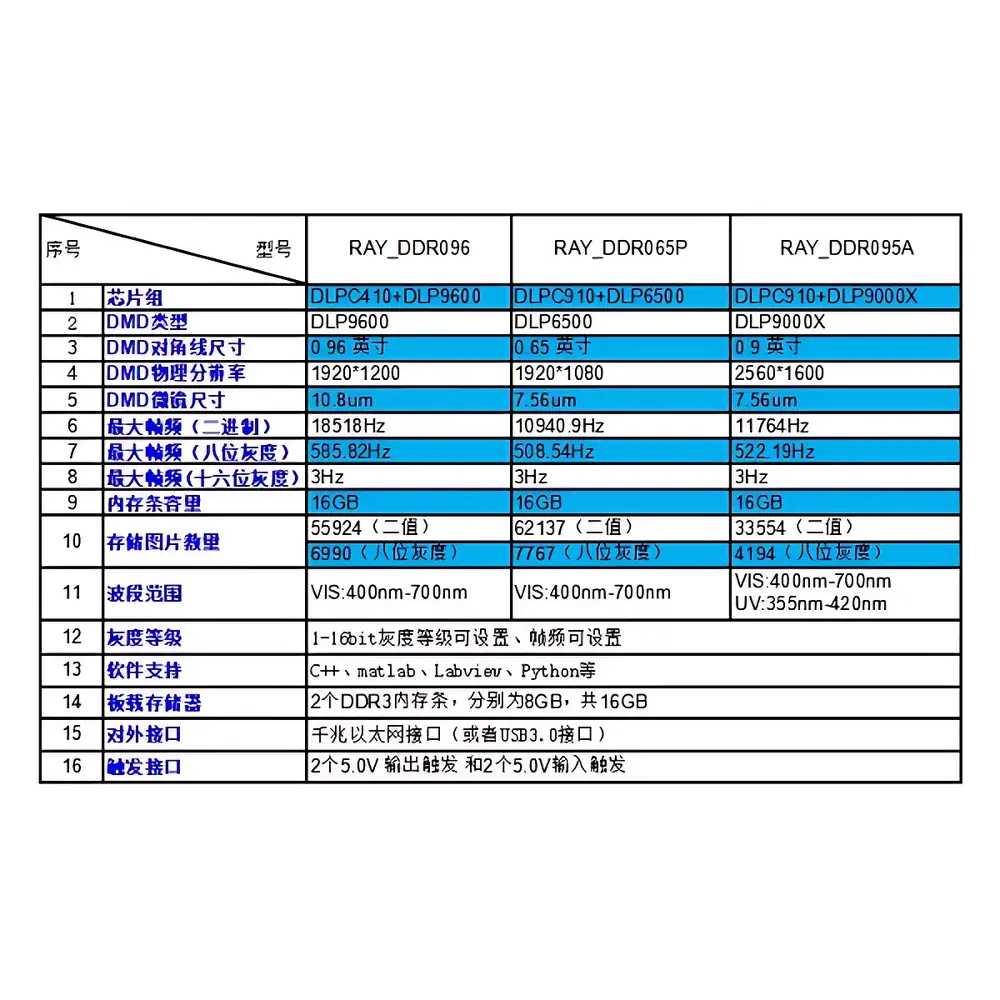
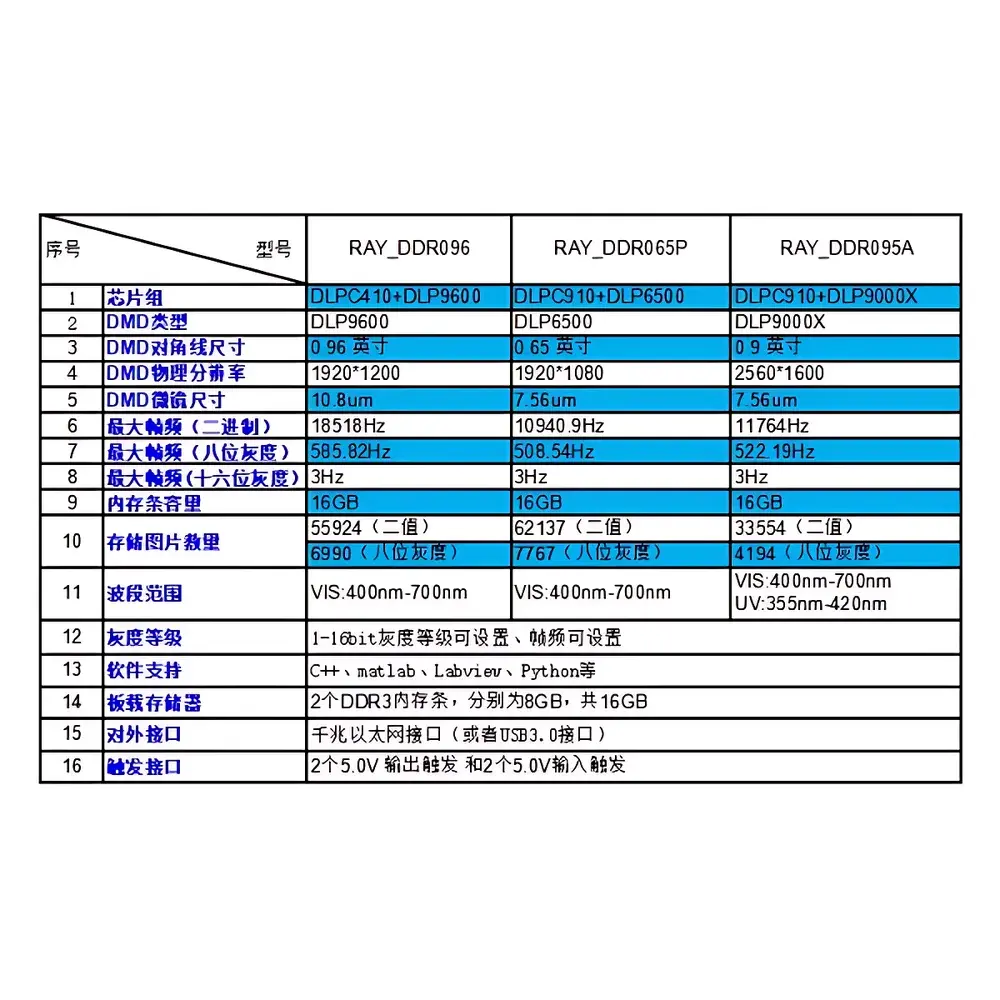
The Rayscience DMD Digital Micromirror Device Array is a high-performance optical semiconductor module engineered for precision spatial light modulation (SLM) in advanced photonics research and industrial applications. At its core lies the Texas Instruments DLP Discovery 4100 chipset—a 1080p-resolution micromirror array comprising over 2 million individually addressable aluminum micro-mirrors, each measuring 13.68 µm × 13.68 µm with a 17-µm pitch. The device operates on electrostatic actuation principles: each mirror tilts ±12° between two stable states (“on” and “off”), enabling binary amplitude or phase modulation of incident light via pulse-width modulation (PWM) timing control. Unlike liquid-crystal-based SLMs, the DMD’s solid-state mechanical architecture delivers nanosecond-scale switching speeds (< 10 µs full tilt), zero pixel crosstalk, and exceptional long-term stability—making it ideal for high-dynamic-range optical systems requiring deterministic, repeatable light shaping.
Key Features
- Ultra-Broad Spectral Compatibility: Optimized optical path design supports continuous operation from deep ultraviolet (350 nm) to short-wave infrared (2500 nm), accommodating laser sources across Ti:sapphire, Nd:YAG, quantum cascade, and supercontinuum regimes.
- High Optical Power Handling: A-type hermetic packaging with fused silica window and thermally optimized substrate enables continuous-wave (CW) power loading up to 60 W without thermal distortion or mirror stiction—validated under ISO 10110-7 surface quality and MIL-STD-883H reliability testing.
- Native 1080p Resolution & High Fill Factor: 1920 × 1080 mirror array with >92% active fill factor ensures minimal diffraction artifacts and high optical throughput; compatible with standard DLP controller interfaces (e.g., DLPC900/910).
- Robust Mechanical Architecture: Aluminum mirrors deposited on silicon CMOS backplane; no organic alignment layers or birefringent materials—ensuring immunity to UV degradation, vacuum outgassing, and humidity-induced drift.
- Low Latency & Deterministic Timing: Sub-microsecond mirror settling time and hardware-synchronized trigger I/O support real-time adaptive optics, structured illumination microscopy, and laser beam steering with frame-to-frame reproducibility < ±0.5% intensity deviation (measured per ASTM E275–22).
Sample Compatibility & Compliance
The DMD array is designed for integration into OEM optical benches, custom interferometers, spectral imaging platforms, and laser processing tools. It accepts collimated input beams with diameters up to 12 mm (dependent on projection optics). Mounting follows TI-recommended mechanical interface specifications (M2.5 threaded holes, 1.2-mm clearance tolerance). The device complies with RoHS 2015/863/EU and CE marking directives for electromagnetic compatibility (EN 61326-1:2013) and low-voltage safety (EN 61010-1:2010). For regulated environments—including GLP/GMP-compliant analytical labs—the DMD supports audit-ready firmware logging when paired with Rayscience’s optional USB3.0 control module (model R-DMD-CTRL-USB3), which implements timestamped command history and user-access-level authentication per FDA 21 CFR Part 11 requirements.
Software & Data Management
Rayscience provides open-source SDKs for Windows, Linux, and LabVIEW (NI VISA-compatible), including C/C++, Python (PyDMD), and MATLAB bindings. All drivers expose low-level register access for bit-plane sequencing, gamma correction, and pattern preloading—enabling implementation of holographic multiplexing, compressive sensing, or wavefront encoding algorithms. Pattern sequences can be streamed at up to 22,000 frames/sec (8-bit grayscale equivalent) using onboard 1 GB DDR3 frame buffer. Data export supports HDF5, TIFF stack, and CSV metadata formats, with embedded EXIF tags for wavelength, exposure duration, and mirror state calibration coefficients. Firmware updates are performed via secure signed binaries with SHA-256 verification.
Applications
- Laser direct writing and maskless lithography (UV to NIR)
- Single-pixel compressive imaging and computational ghost imaging
- Adaptive optics wavefront correction in astronomy and ophthalmology
- Structured illumination fluorescence microscopy (SIM) and optical sectioning
- Spectral encoding in Fourier-transform spectroscopy and hyperspectral snapshot systems
- Dynamic optical filtering and programmable monochromators
- Industrial laser material processing with real-time beam shaping
FAQ
Is this DMD compatible with third-party DLP controller boards?
Yes—hardware pinout and timing protocols fully conform to TI’s DLP4100 datasheet Rev. F. Reference schematics and FPGA constraint files are provided in the SDK.
What is the maximum safe irradiance for CW lasers at 1064 nm?
At 1064 nm, the maximum permissible irradiance is 2.5 kW/cm² for a 12-mm-diameter collimated beam, assuming ≤1% absorption and adequate heat sinking per TI Application Report DLPA028.
Does the device include factory calibration data for reflectivity and tilt angle uniformity?
Yes—each unit ships with NIST-traceable calibration report covering mirror-to-mirror reflectivity variation (±1.8%), static tilt angle deviation (±0.3°), and dynamic response consistency across all quadrants.
Can the DMD be operated in vacuum or inert-gas environments?
The A-type package is rated for operation in dry nitrogen or argon atmospheres down to 10⁻³ mbar; vacuum bake-out is not recommended due to potential outgassing from internal adhesives.
Is there support for synchronized external triggering with camera acquisition?
Yes—dedicated TTL-compatible trigger-in and trigger-out ports enable sub-100-ns jitter synchronization with scientific CMOS cameras and pulsed laser sources.



