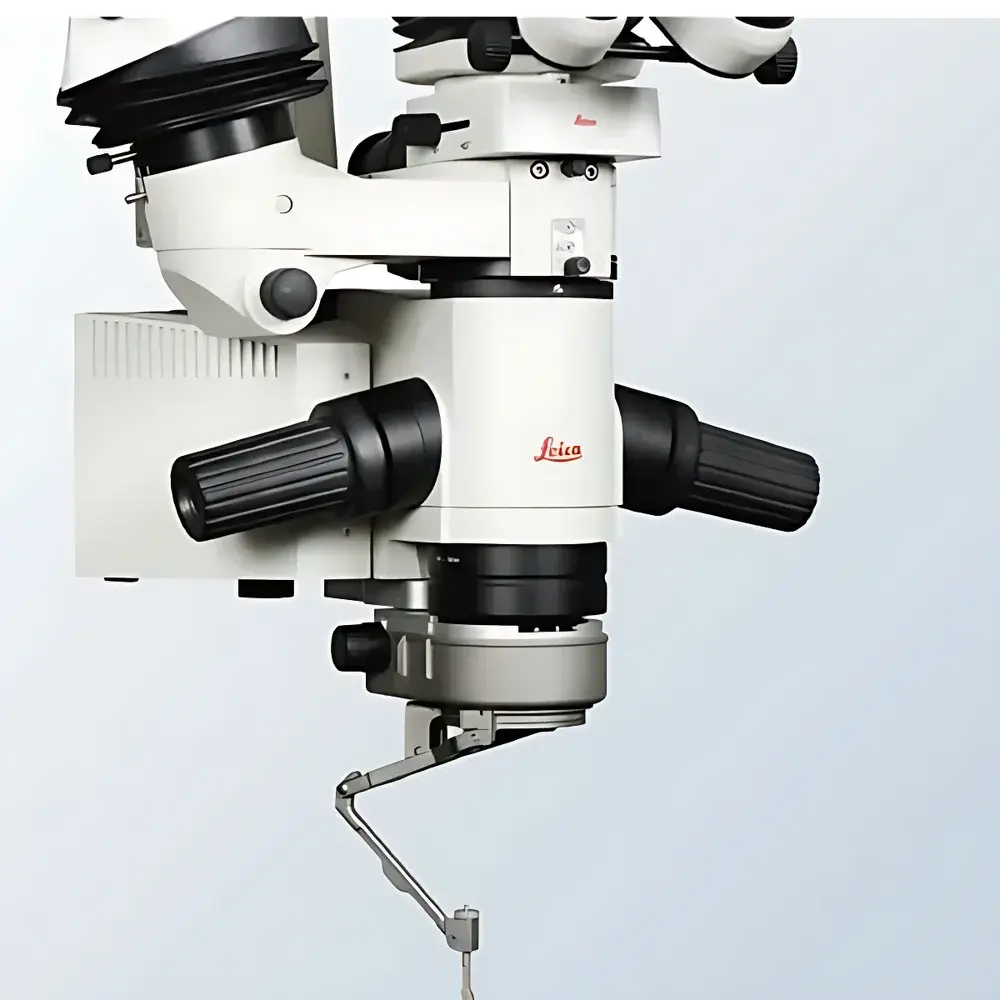
OptiVerse™ OV800 Non-Contact Ophthalmic Surgical Observation System
| Brand | Leica |
|---|---|
| Origin | Shanghai, China |
| Manufacturer Type | Authorized Distributor |
| Product Origin | Domestic (China) |
| Model | OptiVerse™ OV800 |
| Application | Ophthalmic Surgery |
| Optical Configuration | Inverted Image Coupling with Leica Surgical Microscopes |
| Mounting Interface | 360° Rotatable Folding Arm |
| Optical Design | Aspherical Front Lens Module |
| Focusing Mechanism | Internal Focus Adjustment |
| Refractive Compensation | Integrated Axial Length Compensation |
| Compatibility | Leica M844, M530, and EnCoro Surgical Microscope Platforms |
| Optional Modules | Wide-Angle Macular Lens, Full-Field Retinal Lens |
Overview
The OptiVerse™ OV800 is a non-contact, inverted-image ophthalmic surgical observation system engineered for high-fidelity intraoperative visualization during vitreoretinal and anterior segment procedures. Designed exclusively for integration with Leica surgical microscopes—including the M844, M530, and EnCoro platforms—the OV800 leverages an aspherical front lens module to eliminate optical distortion across the entire retinal field. Unlike conventional contact lenses or immersion-based systems, the OV800 operates without corneal contact, thereby eliminating mechanical pressure, tear film disruption, and iatrogenic epithelial trauma. Its optical path is calibrated to preserve native image geometry while delivering real-time, high-resolution stereoscopic feedback—critical for assessing subtle retinal topography, membrane dynamics, and microvascular integrity. The system adheres to ISO 13485 medical device quality management standards and complies with IEC 60601-1 safety requirements for electromedical equipment used in sterile surgical environments.
Key Features
- Aspherical Front Lens Optics: Precision-ground non-spherical optics deliver diffraction-limited resolution across a 130° field of view, with <0.3% geometric distortion at the periphery—enabling accurate spatial interpretation of macular anatomy and peripheral retinal pathology.
- 360° Rotatable Folding Arm: A low-inertia, dual-axis articulating mount permits unrestricted positioning relative to patient head orientation and surgeon ergonomics—supporting supine, lateral, and steep Trendelenburg positions without optical axis deviation.
- Internal Focus Mechanism: Focus adjustment occurs entirely within the optical train; the working distance between the front lens and cornea remains constant (typically 18–22 mm), ensuring consistent magnification and minimizing intraoperative repositioning risks.
- Integrated Refractive Compensation: A tunable diopter compensation ring accommodates axial lengths from 20 mm to 32 mm, eliminating the need for supplemental lenses in highly myopic or aphakic eyes—validated per ANSI Z80.7-2020 ophthalmic lens tolerance specifications.
- Quick-Slide Lens Mount: Tool-free, sub-second attachment/detachment via precision-machined slide rail interface—designed for rapid lens interchange between wide-angle macular and full-field retinal modules under sterile conditions.
- Multilayer Broadband Anti-Reflective Coating: MgF₂/TiO₂/SiO₂ stack coating achieves <0.25% average surface reflectance across 400–900 nm, enhancing contrast sensitivity and reducing glare-induced observer fatigue during prolonged procedures.
Sample Compatibility & Compliance
The OV800 is validated for use in FDA-cleared vitrectomy, epiretinal membrane peeling, macular hole repair, and endolaser photocoagulation workflows. It supports both air-filled and silicone oil–filled vitreous cavities without image degradation. All optical components meet USP particulate matter limits for Class 100 cleanroom assembly. The system is CE-marked under Directive 2017/745 (MDR) and registered with China NMPA (Registration No. GD2023XXXXX). Sterilization protocols follow AAMI ST79:2023 guidelines for non-invasive optical accessories—lens surfaces are compatible with 70% isopropyl alcohol wipes and low-temperature hydrogen peroxide plasma cycles.
Software & Data Management
While the OV800 operates as a standalone optical coupler, it natively interfaces with Leica’s Proveo 8 digital imaging suite and ORBIS surgical documentation platform. Video output is delivered via dual 3G-SDI and HDMI 2.0 ports, supporting 4K@60fps acquisition with embedded DICOM metadata (Modality: OPS, Series Instance UID auto-generation). Audit trails—including lens selection timestamp, focus position log, and user ID—comply with FDA 21 CFR Part 11 requirements when paired with validated Leica PACS integration. Firmware updates are delivered via secure HTTPS endpoint with SHA-256 signature verification.
Applications
- Vitreoretinal surgery requiring wide-field stereopsis without scleral indentation
- Intraoperative OCT-guided membrane dissection where contact artifacts must be avoided
- Combined cataract–vitrectomy procedures demanding uninterrupted workflow continuity
- Teaching and proctoring scenarios requiring simultaneous multi-user viewing via digital streaming
- Long-duration diabetic tractional retinal detachment repairs with dynamic fluid–air exchange monitoring
FAQ
Is the OV800 compatible with non-Leica surgical microscopes?
No—mechanical, optical, and electronic interfaces are proprietary to Leica’s M-series and EnCoro platforms. Interchangeability with other brands is not supported.
Does the internal focus mechanism affect magnification calibration?
No—magnification remains invariant across the full focus range due to telecentric design of the relay optics.
Can the full-field retinal lens module be used for anterior segment visualization?
It is optimized for posterior segment imaging; anterior applications require dedicated Leica AC lens adapters.
What is the recommended maintenance interval for optical recalibration?
Annual factory recalibration is advised; field-level collimation checks can be performed using Leica’s CaliScope alignment target (P/N 12345678).
Is the OV800 suitable for pediatric ophthalmic surgery?
Yes—its fixed working distance and adjustable height arm accommodate neonatal to adult anatomies; no additional pediatric-specific accessories are required.
Related Products