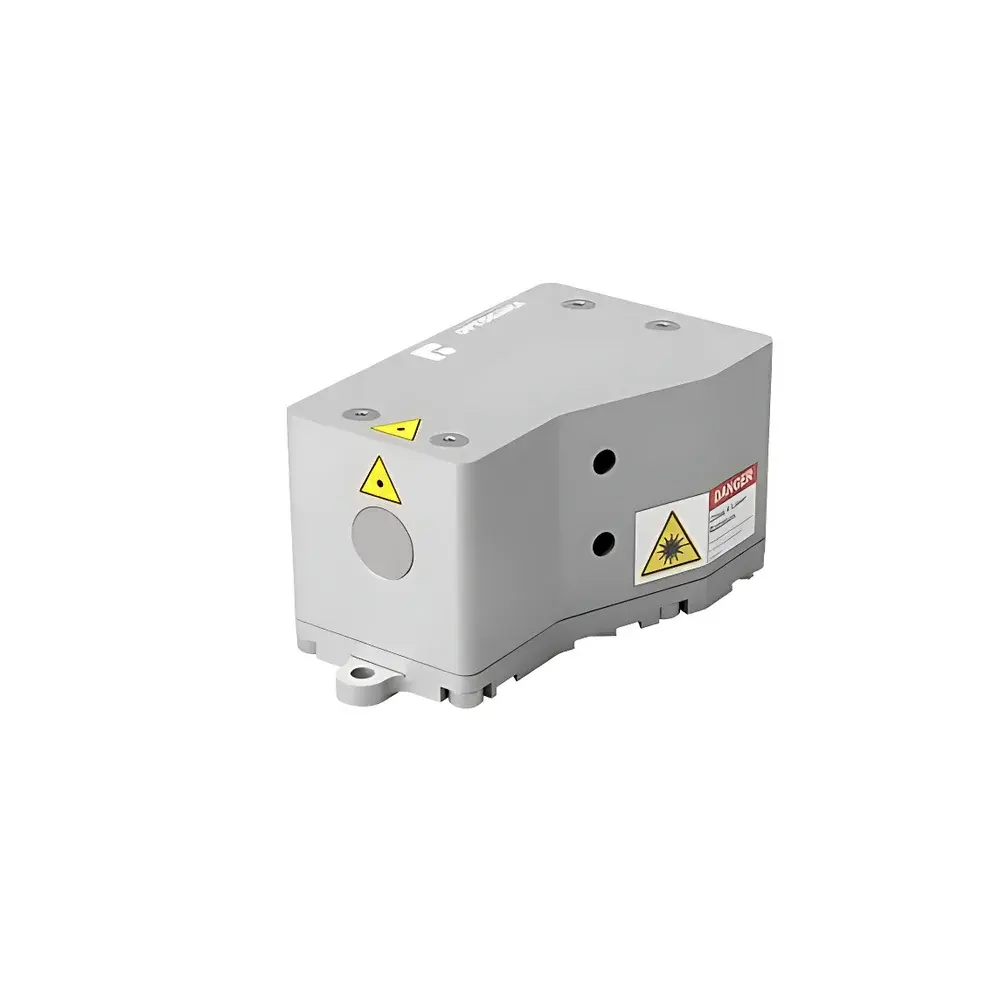
Optogama Kaukas 4 Eye-Safe 1540 nm Nanosecond Pulsed Laser
| Brand | Optogama |
|---|---|
| Origin | Lithuania |
| Manufacturer Type | OEM Laser Systems Developer |
| Product Category | Imported |
| Model | Kaukas 4 |
| Core Technology | Diode-Pumped Solid-State (DPSS) Q-Switched Laser |
| Wavelength | 1540 nm |
| Pulse Energy | Up to 3 mJ per pulse |
| Repetition Rate | Up to 5 Hz |
| Pulse Duration | <10 ns (FWHM) |
| Beam Quality (M²) | <1.3 |
| Output Polarization | Linear, >100:1 |
| Cooling | Air-cooled |
| Dimensions (L×W×H) | 220 × 120 × 85 mm |
| Weight | <2.5 kg |
| Compliance | EN 60825-1:2014 Class 1M (Eye-Safe under specified conditions) |
Overview
The Optogama Kaukas 4 is a diode-pumped, passively Q-switched solid-state laser engineered for reliable, field-deployable operation at the eye-safe wavelength of 1540 nm. Operating in the short-wave infrared (SWIR) spectral region, this laser leverages thulium-holmium-doped crystalline gain media and a saturable absorber to generate nanosecond-duration pulses with high peak power and excellent beam quality (M² < 1.3). Its classification as EN 60825-1:2014 Class 1M ensures compliance with international laser safety standards for open-beam use without mandatory protective eyewear—provided nominal ocular hazard distance (NOHD) guidelines are observed. Designed for integration into portable or embedded systems, the Kaukas 4 delivers up to 3 mJ pulse energy at repetition rates up to 5 Hz, making it suitable for applications demanding robust single-pulse performance in thermally constrained environments.
Key Features
- Eye-safe 1540 nm output compliant with EN 60825-1:2014 Class 1M requirements
- High pulse energy: ≥3 mJ per shot at 5 Hz, scalable via external trigger synchronization
- Nanosecond pulse width (<10 ns FWHM) optimized for time-resolved spectroscopy and LIDAR ranging
- Air-cooled, compact housing (220 × 120 × 85 mm) with integrated thermal management for stable long-term operation
- Linear polarization ratio >100:1, enabling precise control in interferometric and polarimetric configurations
- OEM-ready architecture with TTL-compatible trigger input, analog pulse energy monitor output, and RS-232/USB interface for remote parameter control
- No consumables or gas fill; solid-state design ensures >10⁷ shot lifetime under recommended operating conditions
Sample Compatibility & Compliance
The Kaukas 4 is compatible with standard optical mounts (e.g., SM1-threaded lens tubes), fiber-coupling adapters (with optional collimation optics), and common spectrometer and detector interfaces (e.g., SMA-905, FC/PC). It meets electromagnetic compatibility (EMC) requirements per EN 55032:2015 and EN 55035:2017. For regulated environments—including ISO/IEC 17025-accredited laboratories and GLP-compliant analytical workflows—the laser supports audit-trail-capable firmware logging (via USB serial) and configurable pulse timing jitter <100 ps RMS. While not intrinsically rated for hazardous locations, its low-power electronics and absence of high-voltage discharge circuits simplify integration into ATEX-zone-adjacent instrumentation.
Software & Data Management
Optogama provides the Kaukas Control Suite—a cross-platform application (Windows/macOS/Linux) supporting real-time monitoring of pulse energy, internal temperature, and trigger status. The software enables scripting via Python API (PySerial-based), facilitating automated calibration routines and synchronization with gated detectors or data acquisition systems (e.g., National Instruments DAQmx, Keysight U1001A). All operational parameters—including repetition rate, delay settings, and interlock states—are logged with timestamped UTC metadata, ensuring traceability for FDA 21 CFR Part 11–aligned workflows when paired with validated electronic lab notebook (ELN) platforms. Firmware updates retain backward compatibility and support signed binary verification.
Applications
- Laser-Induced Breakdown Spectroscopy (LIBS): High single-pulse energy enables efficient plasma generation on metallic, ceramic, and geological samples—even through atmospheric moisture—without requiring vacuum chambers.
- Time-of-Flight LIDAR & Ranging: Sub-10 ns pulse width supports centimeter-level range resolution in airborne, terrestrial, and industrial proximity sensing systems.
- Calibration & Metrology: Used as a stable reference source for SWIR photodetector linearity testing, optical encoder verification, and absolute distance interferometry traceable to NIST SRM standards.
- Nonlinear Optics Pumping: Serves as a fundamental pump source for optical parametric oscillators (OPOs) generating tunable mid-IR output (3–5 µm) in research-grade spectroscopic setups.
- Defense & Security: Integrated into counter-drone identification systems and covert illumination modules where eye safety and low probability of intercept (LPI) are critical design constraints.
FAQ
Is the Kaukas 4 certified for use in medical devices?
No—it is not CE-marked as a medical device (MDR 2017/745) nor FDA 510(k)-cleared. Integration into Class IIa or higher medical systems requires additional risk analysis and system-level validation.
Can pulse energy be adjusted without changing repetition rate?
Yes—pulse energy is digitally adjustable from 0.5 mJ to 3.0 mJ in 0.1 mJ increments via software or analog voltage input (0–5 V), independent of repetition rate selection.
What is the typical warm-up time to achieve energy stability?
Less than 15 minutes from cold start to <±1.5% pulse energy drift over 1 hour, verified per ISO 11554 Annex B protocols.
Does the laser include beam delivery optics?
Standard configuration includes a collimated free-space output (1.2 mm diameter, divergence <1.5 mrad); optional fiber coupling (FC/APC, 400 µm core) and focusing attachments are available as accessories.
Is remote firmware update supported over USB?
Yes—field-upgradable firmware with SHA-256 signature verification ensures secure, version-controlled maintenance without hardware modification.