
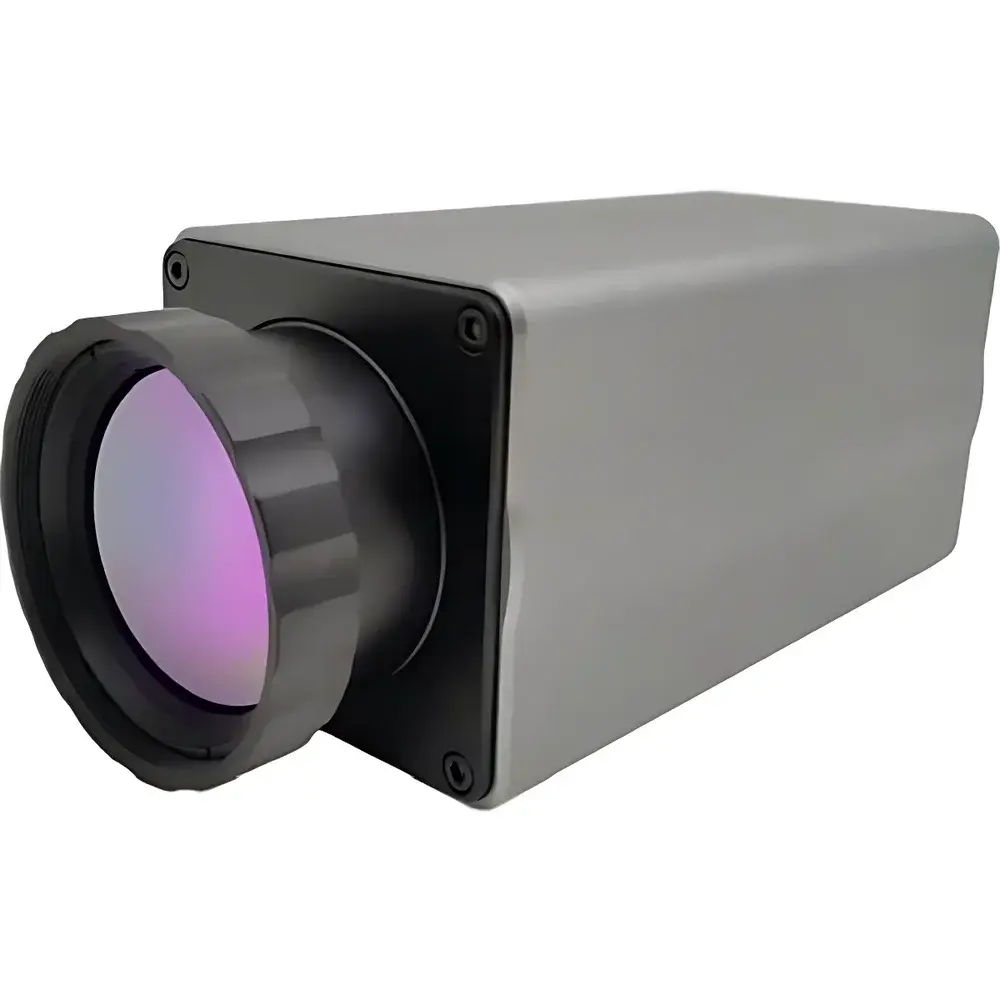
Optop GW-ZXS Series Infrared Thermal Imaging Camera
| Brand | Optop |
|---|---|
| Origin | Beijing, China |
| Model | GW-ZXS Series |
| Detector Type | Uncooled Vanadium Oxide (VOx) Microbolometer |
| Resolution Options | 384 × 288, 640 × 512, or 1280 × 1024 pixels |
| Pixel Pitch | 17 µm (for 384×288), 12 µm (for 640×512 and 1280×1024) |
| Spectral Range | 7.5–14 µm |
| NETD | < 50 mK |
| Frame Rate | Up to 50 Hz (full-frame, dependent on resolution) |
| Temperature Range | −20 °C to +550 °C (extendable to +1000 °C or +1500 °C with calibration) |
| Accuracy | ±2 °C or ±2% of reading |
| Focus | Manual or motorized (auto-focus optional) |
| Lens Interface | Standard C-mount |
| Video Output | GigE Vision compliant (IEEE 1588 time synchronization supported) |
| Power Supply | DC 12 V ±2 V |
| Operating Temperature | −40 °C to +70 °C |
| Enclosure Rating | IP54 equivalent (industrial-grade sealed housing) |
| Dimensions (with standard lens) | ≤175 × 74 × 74 mm |
| Weight (with standard lens) | ≤0.8 kg |
| Compliance | RoHS, CE, FCC, GigE Vision 2.0, GenICam3 |
Overview
The Optop GW-ZXS Series Infrared Thermal Imaging Camera is an industrial-grade, uncooled thermal imaging platform engineered for continuous online temperature monitoring and thermographic analysis in demanding environments. Based on vanadium oxide (VOx) microbolometer detector technology, the system operates within the long-wave infrared (LWIR) spectral band (7.5–14 µm), enabling passive, non-contact surface temperature measurement without external illumination. Its core architecture integrates low-noise analog front-end electronics, high-fidelity optics, and real-time digital signal processing optimized for thermal stability and radiometric accuracy. Designed for integration into automated inspection lines, predictive maintenance systems, and R&D test benches, the GW-ZXS series supports both OEM embedding and standalone deployment—offering scalable spatial resolution (384 × 288 to 1280 × 1024 pixels), configurable frame rates (up to 50 Hz), and deterministic GigE Vision-compliant data streaming. All variants comply with GenICam3 standards, ensuring interoperability with third-party machine vision software and hardware ecosystems.
Key Features
- Uncooled VOx microbolometer detectors with pixel pitches of 17 µm (384×288) or 12 µm (640×512 / 1280×1024), delivering high thermal sensitivity (NETD < 50 mK) and stable responsivity across wide ambient ranges.
- GigE Vision 2.0 interface with IEEE 1588 precision time stamping—enabling synchronized multi-camera acquisition, deterministic latency (< 10 ms end-to-end), and plug-and-play compatibility with HALCON, OpenCV, and Common Vision Blox (CVB) toolkits.
- Modular optical design supporting C-mount lenses from 4 mm to 100 mm focal length, with field-of-view (FOV) options ranging from 91.4° × 78.6° (ultra-wide) to 8.8° × 7.0° (telephoto), and spatial resolutions down to 0.12 mrad (at 100 mm).
- Radiometric calibration traceable to NIST-traceable blackbody sources; supports dual-point auto-calibration using two reference blackbodies for drift compensation over extended operational cycles.
- Embedded real-time image processing pipeline including non-uniformity correction (NUC), adaptive digital noise reduction, dynamic contrast enhancement, and electronic zoom (1.0×–3.0× continuous).
- Industrial-hardened mechanical design: aluminum alloy housing rated to IP54-equivalent ingress protection, shock resistance up to 40 g (11 ms half-sine), and random vibration tolerance of 4.3 g RMS across all axes.
Sample Compatibility & Compliance
The GW-ZXS series is suitable for non-destructive temperature mapping of metallic, ceramic, polymer, and composite surfaces under static or dynamic conditions. It accommodates emissivity correction (0.10–1.00 adjustable), reflected apparent temperature compensation, and atmospheric transmission modeling for measurements at distances up to 30 m (dependent on lens selection and target size). The camera meets electromagnetic compatibility requirements per EN 61000-6-2/6-4 and carries CE marking under the EU Machinery Directive 2006/42/EC and Low Voltage Directive 2014/35/EU. It is RoHS 3 and REACH compliant. While not certified for Class I Div 1 hazardous locations, its low-power design (<3.7 W) and absence of moving cryogenic components make it appropriate for Zone 2/22 classified areas when installed per IEC 60079-14 guidelines. Firmware and SDK support audit trails aligned with GLP/GMP documentation requirements.
Software & Data Management
IR-SVision R2.0 is a native Windows application built on Qt and leveraging DirectShow/GigE Vision drivers for zero-copy frame acquisition. It provides full radiometric data access—including raw 16-bit linear temperature arrays—and supports export in HDF5, CSV, and TIFF formats with embedded metadata (time stamp, lens ID, calibration coefficients, emissivity settings). The GUI features tabbed workflow panels for live imaging, region-of-interest (ROI) analysis, alarm configuration, and report generation. Measurement tools include point/line/area statistics (min/max/mean/std dev), isotherm overlays, thermal gradient profiling, and auto-tracking of hottest spot within user-defined windows. The open-source SDK (C/C++, Python, .NET bindings) exposes low-level control of exposure, gain, NUC scheduling, and GPIO-triggered capture—facilitating integration into SCADA, MES, and LabVIEW-based QA/QC platforms. All session logs and calibration events are timestamped and stored in SQLite databases compliant with FDA 21 CFR Part 11 audit trail requirements.
Applications
- Electrical infrastructure monitoring: detection of loose connections, overloaded breakers, and failing insulators in substations and switchgear cabinets.
- Industrial process control: real-time thermal profiling of rolling mills, extrusion dies, welding seams, and composite curing ovens.
- Building diagnostics: identification of insulation defects, moisture intrusion, and HVAC duct leakage per ASTM C1060 and ISO 6781-3 protocols.
- R&D thermal analysis: transient heat dissipation studies in PCBs, battery modules, and power electronics under load cycling.
- Maritime and border surveillance: long-range personnel and vessel detection under low-visibility conditions, compatible with radar fusion architectures.
- Automotive validation: brake rotor thermal distribution, exhaust manifold hot-spot analysis, and cabin climate uniformity assessment.
FAQ
What detector technologies are used in the GW-ZXS series?
The series employs uncooled vanadium oxide (VOx) microbolometers fabricated on silicon readout integrated circuits (ROICs), offering superior stability and lower power consumption compared to amorphous silicon alternatives.
Can the camera be calibrated for temperatures above 550 °C?
Yes—optional high-temperature calibration kits enable extension to 1000 °C or 1500 °C using specialized blackbodies and emissivity-compensated algorithms; documentation and uncertainty budgets are provided per ISO/IEC 17025.
Is motorized focus standard or optional?
Motorized focus is available as a factory-configurable option on GW-ZXS-6400EM and GW-ZXS-1280 models; all variants support manual focus via precision-threaded lens mounts.
Does IR-SVision support batch processing of archived thermal sequences?
Yes—the Batch Analysis module enables scripted ROI extraction, statistical aggregation, and trend chart generation across thousands of .tiff/.hdf5 files, with output exportable to Excel-compatible templates.
How is radiometric accuracy maintained during prolonged operation?
Automatic shutter-based NUC cycles occur every 5–30 minutes (user-adjustable); combined with dual-point blackbody referencing, this ensures thermal drift remains below ±0.5 °C over 8-hour shifts.




