
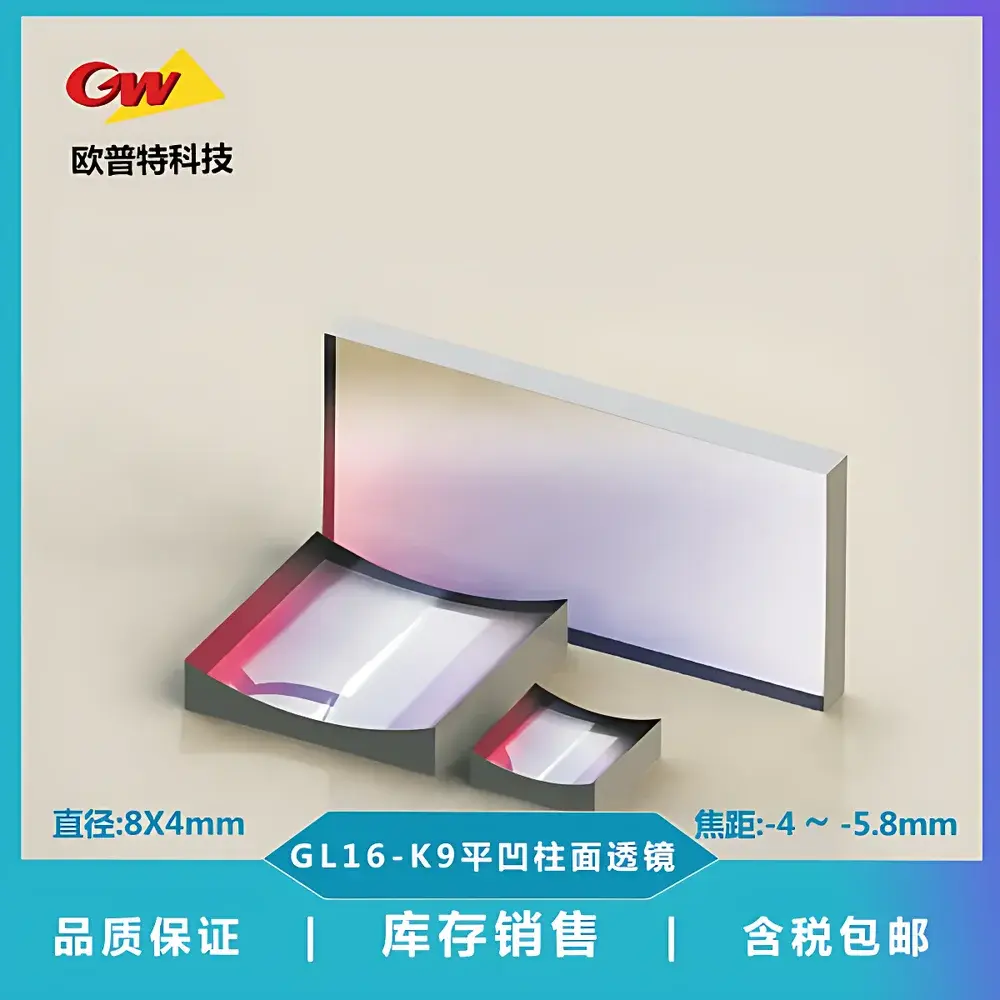
Optoprecision GL16 K9 Plano-Concave Cylindrical Lens – Broadband AR-Coated for VIS, NIR & SWIR
| Origin | Beijing, China |
|---|---|
| Manufacturer Type | Authorized Distributor |
| Regional Origin | Domestic (China) |
| Model | GL16 |
| Price Range | USD 0.50–299.00 |
| Component Category | Optical Element |
Overview
The Optoprecision GL16 K9 Plano-Concave Cylindrical Lens is a precision optical component engineered for controlled one-dimensional beam shaping and anamorphic manipulation in laboratory, industrial, and OEM laser systems. Unlike spherical lenses, cylindrical optics possess curvature along only one axis—here, the concave surface—enabling focused line generation or astigmatic correction. The GL16 series utilizes optically homogeneous, fine-annealed K9 borosilicate crown glass (Schott BK7 equivalent), with a design wavelength of 587.6 nm (d-line), ensuring minimal internal stress birefringence and high wavefront fidelity. Its negative effective focal length (EFL) makes it ideal for diverging collimated light into a line focus or for compensating cylindrical aberration in imaging paths. Each lens is fabricated to ISO 10110-1 standards for dimensional tolerances and surface quality, supporting demanding applications in spectroscopy, interferometry, laser diode collimation, and optical metrology.
Key Features
- High-purity, stress-relieved K9 optical glass substrate with refractive index nd = 1.5163 and Abbe number νd = 64.2
- Precision-ground and polished plano-concave geometry with single-axis curvature; plano surface parallelism ≤ 1 arcmin
- Tight dimensional control: clear aperture tolerance ±0.1 mm; center thickness tolerance ±0.2 mm; EFL tolerance ±2% (as specified per ISO 10110-2)
- Surface quality rated at 3–4 scratch-dig per MIL-PRF-13830B; surface flatness λ/4 @ 633 nm on plano side
- Edge treatment: 0.2 mm × 45° chamfer applied to all peripheries to mitigate chipping and coating delamination
- Multiple broadband anti-reflection (AR) coating options optimized for spectral bands: VIS (400–700 nm), NIR (650–1050 nm), and SWIR (1000–1650 nm), each delivering <0.5% average reflectance per surface
Sample Compatibility & Compliance
The GL16 lens family is compatible with standard optomechanical mounts including kinematic lens holders, SM-threaded lens tubes (e.g., Thorlabs SM05/SM1), and custom-designed lens cells. All uncoated and AR-coated variants meet RoHS Directive 2011/65/EU and REACH Regulation (EC) No. 1907/2006 for hazardous substance restrictions. Coating adhesion is verified per MIL-C-48497A, with humidity and tape peel testing confirming Class 1 durability. While not certified to ISO 9001 as a finished system, manufacturing processes adhere to ISO 9001-aligned quality management protocols. For regulated environments—such as medical device R&D or defense-related optical subsystems—the lenses support traceable calibration documentation and can be supplied with individual test reports including interferometric surface verification and spectral reflectance curves.
Software & Data Management
As a passive optical component, the GL16 lens requires no embedded firmware or driver software. However, comprehensive optical design integration is supported via industry-standard file formats: Zemax (.ZAR), Code V (.SEQ), and Synopsys LightTools (.LTD) prescription files are available upon request for all standard configurations. Each product variant includes a unique GL16-XXXX-YYYY-ZZZ catalog identifier enabling unambiguous BOM referencing and ERP/MRP system synchronization. Traceability data—including batch number, annealing date, coating run ID, and interferometric validation timestamp—is retained for ≥10 years and accessible under NDA for qualified customers engaged in GxP-aligned development workflows.
Applications
- Laser diode fast-axis collimation in fiber coupling and pump combiner assemblies
- Anamorphic beam expansion or compression in ultrafast Ti:sapphire and Yb-doped amplifier chains
- Line illumination generation for structured light 3D scanning and machine vision inspection
- Cylindrical aberration correction in multi-element objectives and telecentric lenses
- Spectral dispersion compensation in grating-based monochromators and pulse compressors
- Thermal imaging optics alignment in SWIR camera calibration stations (e.g., InGaAs sensor characterization)
FAQ
What is the maximum power density this lens can withstand in continuous-wave (CW) laser applications?
For uncoated K9, the damage threshold is approximately 500 MW/cm² for nanosecond pulses at 1064 nm. For CW operation at 532 nm or 633 nm, thermal lensing becomes limiting above ~10 W/mm²—consult application-specific derating based on beam uniformity and cooling conditions.
Can I specify custom focal lengths or non-standard dimensions?
Yes. Optoprecision offers OEM customization including non-standard EFLs, asymmetric clear apertures, alternate substrates (e.g., fused silica for UV or high-power use), and hybrid coatings (e.g., dual-band VIS+NIR). Minimum order quantities apply.
Is there polarization-dependent performance variation with the cylindrical geometry?
No intrinsic polarization sensitivity arises from the geometry itself; however, AR coating performance may vary by ±0.1% reflectance between s- and p-polarized states at large angles of incidence (>30°). Normal-incidence use ensures negligible polarization dependence.
Do you provide mounting solutions or alignment fixtures for these lenses?
Standard SM-threaded lens mounts and kinematic tip/tilt platforms are recommended and widely available from third-party suppliers. Custom machined lens cells with integrated fiducials or kinematic reference surfaces can be co-engineered upon request.
How is coating durability validated for harsh environmental use?
All AR coatings undergo MIL-C-48497A-compliant abrasion, humidity (95% RH, 40°C, 240 h), and thermal cycling (−40°C to +85°C, 100 cycles) testing. Results are documented in the Certificate of Conformance accompanying each shipment.




