
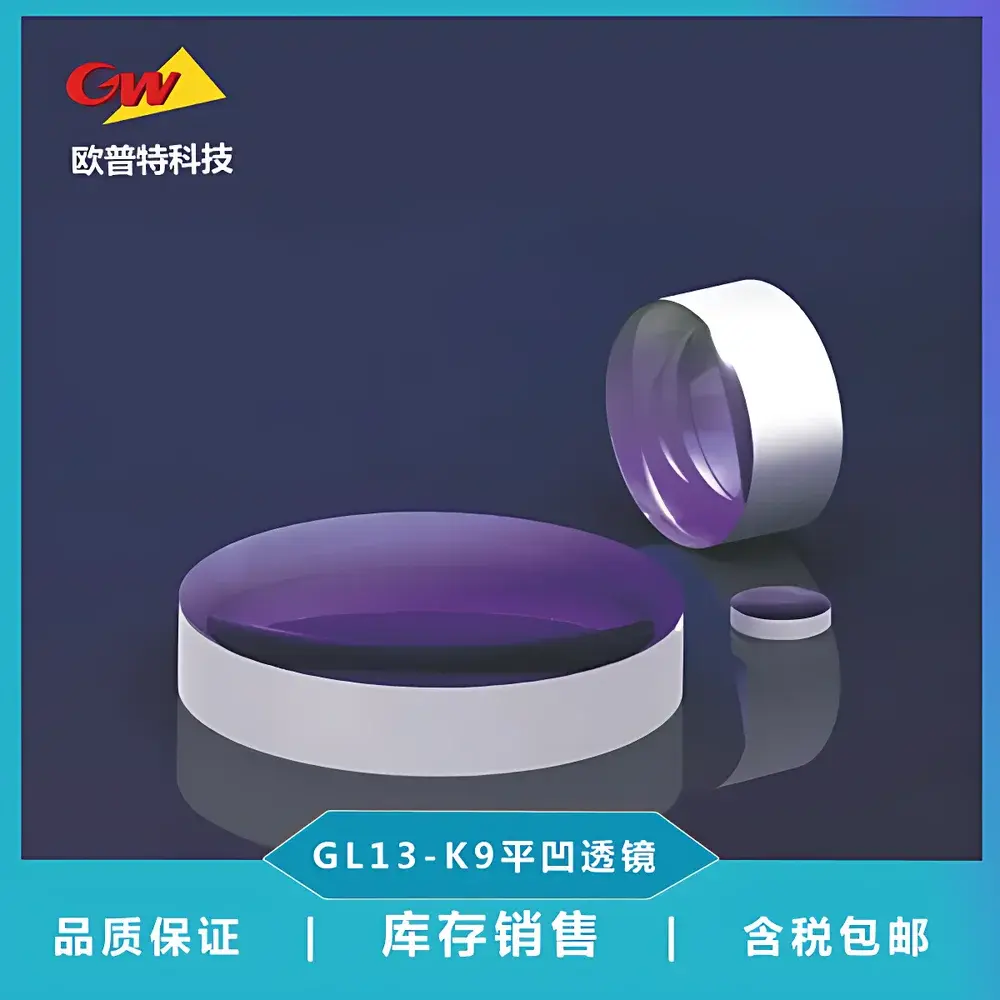
OptoTech GL13 K9 Plano-Concave Lens with Broadband Anti-Reflection Coating for Visible, NIR, and SWIR Spectral Ranges
| Material | Precision-Annealed K9 Optical Glass |
|---|---|
| Design Wavelength | 587.6 nm |
| Diameter Tolerance | +0.0 / −0.1 mm |
| Center Thickness Tolerance | ±0.2 mm |
| Surface Irregularity | λ/4 @ 632.8 nm |
| EFL Tolerance | ±2% |
| Centration Error | ≤3 arcmin |
| Surface Quality | 3–4 scratch-dig |
| Edge Treatment | 0.2 mm × 45° chamfer |
| Coating Options | VIS AR (400–700 nm), NIR AR (650–1050 nm), SWIR AR (1000–1650 nm) |
Overview
The OptoTech GL13 K9 Plano-Concave Lens is a precision optical component engineered for beam expansion, focal length extension, and divergent wavefront correction in demanding laboratory and industrial optical systems. As a plano-concave lens—featuring one flat surface and one spherical concave surface—it introduces negative optical power and is commonly employed in laser cavity design, collimation reversal, spatial filtering, and imaging system telecentricity adjustment. Fabricated from high-homogeneity, precision-annealed K9 borosilicate crown glass (Schott BK7 equivalent), the GL13 series exhibits excellent transmission across the visible spectrum (350–700 nm), extended near-infrared (NIR), and short-wave infrared (SWIR) bands when paired with appropriate broadband anti-reflection (AR) coatings. Each lens is manufactured to ISO 10110-1 and ISO 10110-2 standards for dimensional accuracy, surface figure, and surface quality, ensuring compatibility with alignment-critical applications such as interferometry, spectroscopy, and fiber coupling.
Key Features
- Precision-annealed K9 optical glass substrate with low bubble/inclusion content and refractive index uniformity of Δn ≤ 5 × 10⁻⁶
- Surface figure accuracy of λ/4 RMS @ 632.8 nm (HeNe wavelength), verified via phase-shifting interferometry
- Strict centration control: ≤3 arcminutes residual wedge, enabling minimal beam deviation in multi-element mounts
- Consistent edge geometry: 0.2 mm × 45° protective chamfer applied to all diameters to mitigate chipping during handling and mounting
- Three standardized AR coating variants optimized for distinct spectral bands: VIS (400–700 nm, Ravg < 0.5%), NIR (650–1050 nm, Ravg < 0.4%), and SWIR (1000–1650 nm, Ravg < 0.6%)
- Comprehensive dimensional traceability: every lens batch includes certified metrology reports covering diameter, center thickness, edge thickness, radius of curvature (R₁), effective focal length (EFL), and back focal length (BFL)
Sample Compatibility & Compliance
The GL13 series is compatible with standard kinematic lens mounts (e.g., Thorlabs SM-series, Newport LM-series) and custom machined retaining rings referenced in the OptoTech Mounting Handbook (Pg. 100). All lenses meet RoHS Directive 2011/65/EU and REACH Regulation (EC) No. 1907/2006 requirements for restricted substances. Coating adhesion is validated per MIL-C-48497A and ISO 9211-3:2021 for environmental durability, including tape peel, humidity cycling (95% RH, 40°C, 240 h), and thermal shock (−40°C ↔ +70°C, 10 cycles). Uncoated variants are available for UV or custom coating integration; coated versions support laser-induced damage threshold (LIDT) testing per ISO 21254-1 at 1064 nm (CW, 1 kW/cm²) and 532 nm (10 ns, 5 J/cm²) upon request.
Software & Data Management
While the GL13 is a passive optical element, its specifications are fully integrated into OptoTech’s Optical Component Database (OCDB v3.2), accessible via secure API for automated bill-of-materials (BOM) generation and optical design software interoperability. Each product code (e.g., GL13-025-100-NIR) maps directly to a calibrated Zemax OpticStudio .ZMX file containing measured surface data, coating dispersion curves (from ellipsometric characterization), and thermal expansion coefficients (α = 7.1 × 10⁻⁶ /K). Traceable metrology records—including interferometric surface maps and spectrophotometric transmittance curves—are archived for ≥10 years and available on demand for GMP/GLP audit compliance.
Applications
- Laser beam expansion in ultrafast Ti:sapphire and Yb:fiber oscillator-amplifier chains
- Divergence compensation in free-space quantum optics setups (e.g., entangled photon source collimation)
- NIR/SWIR spectral imaging systems for agricultural monitoring and semiconductor wafer inspection
- FTIR spectrometer fore-optics requiring low wavefront distortion over broad bandwidths
- Industrial machine vision illumination optics where chromatic aberration minimization is critical
- Custom telescope secondary elements in compact folded-path optical designs
FAQ
What is the typical surface quality specification for GL13 lenses?
All GL13 lenses meet ISO 10110-7 scratch-dig grade 3–4 (i.e., maximum 3 scratches ≥0.01 mm width, dig diameter ≤0.04 mm), verified under controlled illumination per ANSI/OEOSC OP1.002.
Can GL13 lenses be used in vacuum environments?
Yes—K9 glass has negligible outgassing (water vapor desorption rate < 1×10⁻⁹ g/cm²/s at 25°C per ASTM E595), and AR coatings are ion-assisted deposited for mechanical stability under low-pressure conditions. Vacuum-compatible mounting hardware is available separately.
Is there a tolerance stack-up guide for multi-lens assemblies using GL13 components?
OptoTech provides a downloadable tolerance analysis toolkit (TAT-GL13 v2.1) that models cumulative centration, thickness, and radius errors across up to 12-element sequences, supporting Monte Carlo-based yield prediction for high-precision optomechanical integration.
Do you offer custom focal lengths or non-standard diameters?
Yes—custom geometries (diameters 2–100 mm, EFL from −3 mm to −2000 mm) are available with lead times of 4–6 weeks; minimum order quantity applies. Custom coating designs (e.g., dual-band, angle-tuned, or polarization-selective AR) are supported through our Thin Film Engineering Group.
How is coating performance validated across the specified bandwidth?
Each coated lens batch undergoes spectrophotometric verification (PerkinElmer Lambda 1050+ with integrating sphere) from 350 nm to 1700 nm, with transmittance data reported at 5 nm intervals and certified against NIST-traceable reference standards.





