
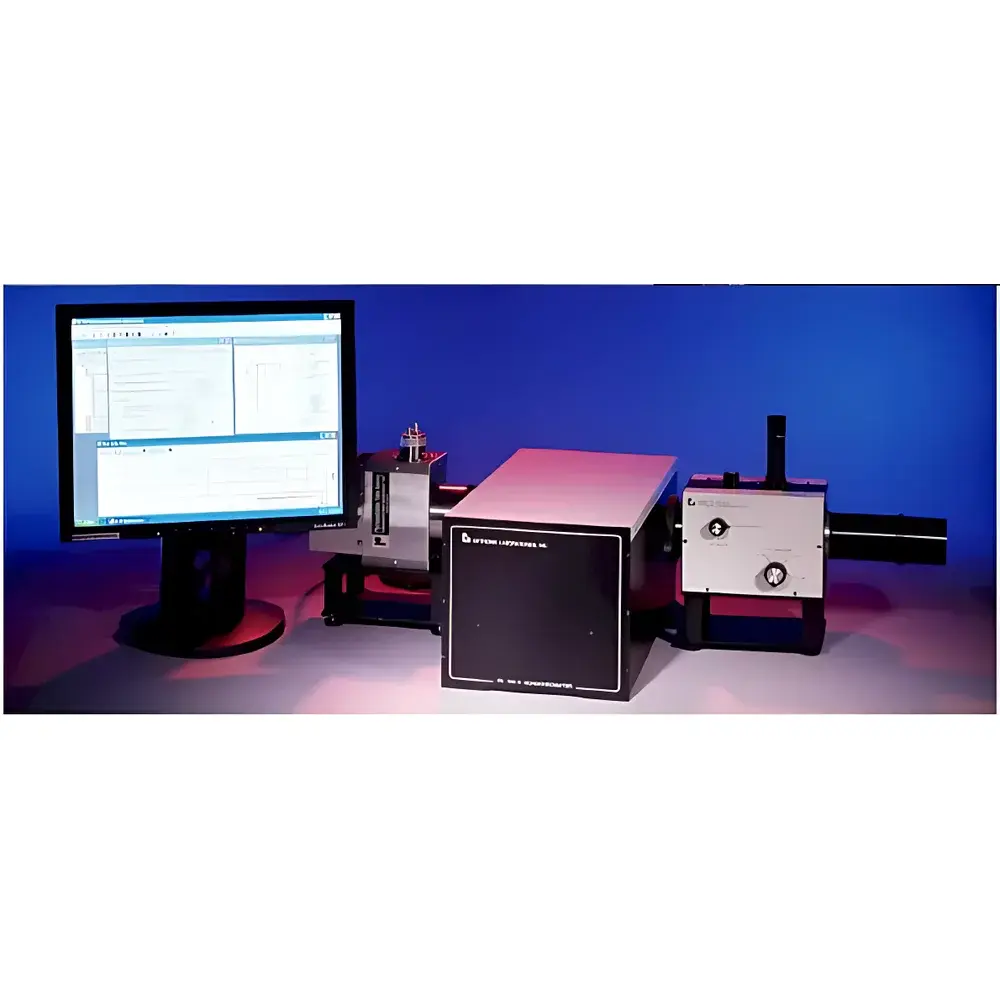
Optronic Laboratories OL750D Spectral Response Measurement System
| Brand | Optronic Laboratories |
|---|---|
| Origin | USA |
| Manufacturer Type | Authorized Distributor |
| Product Origin | Imported |
| Model | OL750D |
| Price Range | USD 110,000 – 135,000 |
| Grating Spectral Range | 200 nm – 30 µm |
| Wavelength Accuracy | ±0.05% |
| Wavelength Repeatability | ±0.01% |
| Reciprocal Linear Dispersion | 2 nm/mm |
| Bandwidth (FWHM) | 0.25–10 nm |
| Stray Light Level | ≤1×10⁻⁸ |
| Grating Size | 68 mm × 68 mm |
| Focal Length | 254 mm (f/4) |
| Chopper Frequency Range | 10–500 Hz |
| Control Interface | RS-422 |
| Nonlinearity Error | <0.1% |
| Silicon Detector (Spectral Range | 200–1100 nm |
| Lead Sulfide (PbS) Detector (Spectral Range | 1000–3200 nm |
Overview
The Optronic Laboratories OL750D Spectral Response Measurement System is a high-precision, double-monochromator-based instrumentation platform engineered for absolute spectral responsivity calibration of photodetectors across the ultraviolet, visible, and near-to-mid infrared spectrum (200 nm – 30 µm). It operates on the substitution method—comparing the photocurrent generated by a device under test (DUT) against that of a NIST-traceable reference detector under identical monochromatic irradiance conditions. This methodology eliminates systematic errors associated with source instability and optical alignment drift, ensuring traceable, reproducible results compliant with ISO/IEC 17025 requirements for calibration laboratories. The system’s core architecture integrates a dual-grating monochromator with motorized grating turret, precision slit drives, synchronized chopper modulation, and multi-detector support—enabling rigorous characterization of quantum efficiency, spectral responsivity (A/W), and linearity over decades of optical power.
Key Features
- Double-monochromator design with two independently controlled 68 mm × 68 mm ruled gratings, delivering exceptional stray light suppression (≤1×10⁻⁸) and enabling high-fidelity measurements in low-signal regimes such as deep UV or weak IR emission.
- Motorized three-position grating turret allowing seamless switching between optimized gratings—each selected for specific spectral bands—to maintain consistent resolution and throughput across the full 200 nm – 30 µm range.
- Computer-controlled entrance and exit slits (adjustable from 10 µm to 2 mm), supporting variable bandwidth selection (0.25–10 nm FWHM) while preserving optical throughput and signal-to-noise ratio.
- Integrated optical chopper (10–500 Hz, adjustable frequency and phase lock capability) for AC-coupled detection, effectively rejecting DC drift and 1/f noise in low-light measurements.
- 11-position filter wheel with interference and order-sorting filters, enabling harmonic rejection and out-of-band suppression critical for accurate IR detector calibration.
- RS-422 digital interface for deterministic, low-jitter synchronization of all subsystems—including grating rotation, slit positioning, chopper timing, and filter selection—ensuring sub-pixel wavelength registration repeatability (±0.01%).
Sample Compatibility & Compliance
The OL750D supports planar, packaged, and bare-die photodetectors up to Ø25 mm in diameter, including silicon photodiodes (200–1100 nm), PbS photoconductors (1–3.2 µm), InGaAs detectors (900–1700 nm), and thermopiles (up to 30 µm). Mounting fixtures accommodate standard TO-can, surface-mount, and custom probe configurations with electrical feedthroughs for bias voltage and current measurement. All calibration procedures follow ASTM E275, ISO 11627, and CIE Publication 69 guidelines. Data acquisition and reporting modules are designed to meet GLP/GMP documentation standards, including full audit trail logging, user access control, and electronic signature support per FDA 21 CFR Part 11 when integrated with compliant LIMS environments.
Software & Data Management
The system ships with OL-SpecCal v5.x—a Windows-based application built on .NET Framework with real-time instrument control, automated scan sequencing, and NIST-traceable uncertainty propagation. It supports batch calibration of multiple DUTs using customizable protocols, auto-generation of spectral responsivity curves (A/W vs. λ), and export to CSV, XML, or CIE-format files. Raw data includes timestamped wavelength positions, measured photocurrents, reference detector correction factors, and environmental metadata (ambient temperature, humidity). All calibration coefficients and detector-specific parameters are stored in encrypted SQLite databases with versioned backups and SHA-256 integrity verification. Remote monitoring via Ethernet-enabled RS-422 bridge is supported for integration into centralized metrology networks.
Applications
- Primary calibration of transfer standard detectors used in national metrology institutes (NMIs) and accredited calibration labs.
- Verification of spectral responsivity specifications for aerospace-grade UV sensors, solar cell QE testers, and industrial flame monitors.
- R&D characterization of novel photodetector materials—including perovskite, graphene, and quantum dot photodiodes—under controlled monochromatic excitation.
- Validation of spectroradiometer and hyperspectral imager spectral fidelity per ISO 12232 and EN 13032-4.
- Linearity assessment over 8+ decades of irradiance (10⁻¹² to 10⁴ W/m²) using calibrated neutral density filter sets.
FAQ
What standards does the OL750D comply with for spectral calibration?
The system adheres to ASTM E275, ISO 11627, CIE 69, and NIST SP 250-85 for spectral responsivity measurement. Its uncertainty budget conforms to GUM (JCGM 100:2008) and is validated annually using NIST SRM 2065 and 2066.
Can the OL750D calibrate cryogenically cooled detectors?
Yes—via optional vacuum-compatible cold-stage interface (not included), supporting operation down to 77 K with electrical feedthroughs rated for ±10 V and 100 mA.
Is remote operation supported for unattended overnight scans?
Yes—the RS-422 interface enables full command-line control via Python or LabVIEW APIs, with automatic error recovery, email alerts on completion/failure, and scheduled job queuing.
How is stray light quantified and corrected during calibration?
Stray light contribution is measured using the “dark scan” method at off-peak wavelengths, then subtracted from raw signals using a polynomial correction model embedded in OL-SpecCal’s post-processing engine.
Does the system include NIST-traceable reference detectors?
Reference detectors (e.g., OL-2000 series Si and PbS) are available as optional accessories with full NIST calibration certificates (including spectral responsivity, linearity, and temperature coefficient data).



