
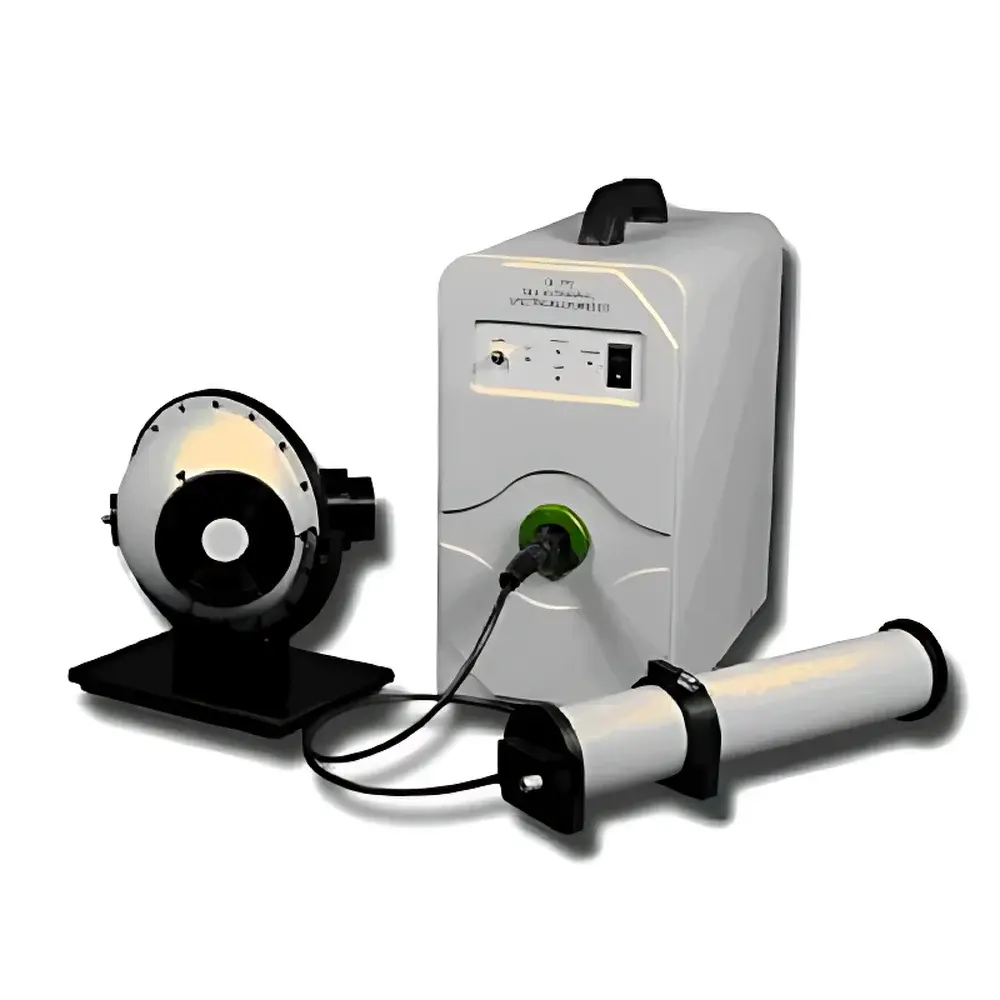
Optronic Laboratories OL770 Fast Spectral Radiometry System
| Brand | Optronic Laboratories |
|---|---|
| Origin | USA |
| Manufacturer Type | Authorized Distributor |
| Origin Category | Imported |
| Model | OL770 |
| Pricing | Available Upon Request |
Overview
The Optronic Laboratories OL770 Fast Spectral Radiometry System is a research-grade, NIST-traceable instrumentation platform engineered for high-accuracy spectral radiometric and photometric characterization of light sources—particularly LEDs, laser diodes, OLEDs, and other solid-state emitters. Built upon a double-grating Czerny–Turner monochromator architecture with thermally stabilized optics and a back-thinned CCD detector, the OL770 implements calibrated spectral scanning via absolute radiance transfer standards traceable to NIST. Its core measurement principle relies on sequential wavelength dispersion followed by photon flux quantification across 380–1100 nm, enabling simultaneous derivation of radiometric (W, W/sr, W/cm²·nm), photometric (lm, cd, lm/W), and colorimetric (CCT, CRI, x,y, u′,v′, dominant/peak wavelength) quantities. Designed explicitly to satisfy CIE 127:2007 (Conditions A and B for average luminous intensity) and CIE 127.2:2021 (for total and partial luminous flux), the system supports full compliance with ISO/CIE lighting metrology frameworks and is routinely deployed in GLP-compliant R&D labs, LED manufacturing QA/QC environments, and national metrology institutes.
Key Features
- Real-time spectral acquisition at ≥25 scans per second—enabling dynamic thermal and transient optical characterization
- 0.5 nm wavelength accuracy certified against NIST-traceable line sources (e.g., Hg, Cd, Zn lamps)
- Stray light rejection < 1×10⁻⁵ (typical), achieved via optimized grating blaze, order-sorting filters, and internal baffling
- Dynamic range > 10⁶:1 (linear response), supported by dual-gain amplifier architecture and auto-ranging integration control
- High spectral resolution: ≤1.0 nm FWHM at 546.1 nm (configurable via slit width adjustment)
- Integrated reference lamp module for in-situ radiometric calibration—eliminating need for off-site recalibration
- USB 2.0 interface with deterministic timing and low-latency data streaming; compatible with Windows-based host systems
- Compact, shock-isolated aluminum enclosure (32 × 24 × 14 cm; <8 kg) suitable for laboratory, cleanroom, and field-deployable use
- Ruggedized fiber-optic coupling with self-centering strain-relief adapter for repeatable alignment and long-term mechanical stability
- Research-grade uncertainty budget documented per ISO/IEC 17025 requirements—including contributions from detector nonlinearity, grating thermal drift, and spectral responsivity calibration uncertainty
Sample Compatibility & Compliance
The OL770 is fully interoperable with a modular suite of CIE-compliant accessories designed for comprehensive source and material optical testing. All integrated spheres—including the OL IS-670-LED (6″, PTFE-coated, >99% reflectance from 300–1700 nm) and OL 1272-LED (9.75″, dual-mode total/partial flux configuration)—are validated against CIE 127.2 Annex A test geometries. The OL 700-30 goniophotometric attachment enables automated angular scans from −90° to +90° with 0.001° angular repeatability and 0.01° resolution, supporting IES LM-79 and EN 13032-4 compliant intensity distribution mapping. Optional temperature-controlled fixtures (OL 700-88TC, liquid-circulated) allow thermal derating studies per JEDEC JESD51-1. All hardware and firmware comply with FDA 21 CFR Part 11 requirements for electronic records and signatures when operated with validated software configurations. System documentation includes full traceability statements, calibration certificates (NIST SRM 2030, 2031, 2032), and uncertainty budgets aligned with GUM (JCGM 100:2008).
Software & Data Management
The OL770 operates with OL’s proprietary SpectraWin™ v5.x software—a 64-bit Windows application developed under ISO 13485-aligned design controls. It provides full audit trail logging (user actions, parameter changes, calibration events), electronic signature capability, and configurable role-based access (Administrator, Operator, Reviewer). Raw spectral data are stored in HDF5 format with embedded metadata (wavelength array, integration time, slit width, calibration date, instrument ID), ensuring FAIR (Findable, Accessible, Interoperable, Reusable) principles. Export options include CSV, XML, CIE 15:2018-compliant .cie files, and direct import into MATLAB, Python (via h5py), or LabVIEW. The SDK supports COM and DLL interfaces for custom automation, including integration with programmable power supplies (e.g., Keithley 2400 series) and environmental chambers. Software validation packages—including IQ/OQ documentation, test protocols, and summary reports—are available for regulated environments.
Applications
- LED package qualification per IES LM-80 and TM-21 lifetime projection models
- Color binning and chromaticity shift analysis under thermal stress (junction temperature mapping)
- Optical safety classification per IEC 62471 (photobiological hazard assessment)
- Development and verification of spectrally tunable light sources for horticulture and circadian lighting
- Calibration transfer between primary standards (e.g., cryogenic radiometers) and secondary field instruments
- Material transmittance/reflectance measurements using OL 610 non-contact lens and OL 750 integrating sphere accessories
- Validation of display backlight uniformity, micro-LED pixel emission profiles, and AR/VR waveguide spectral throughput
- Support for DOE SSL Program metrics including efficacy (lm/W), color fidelity (Rf, Rg), and gamut area (GAMUT)
FAQ
Does the OL770 meet CIE 127:2007 Condition A and Condition B for average luminous intensity?
Yes—the system achieves full compliance through traceable geometric alignment and spatial response validation using the OL 15AB fixture, which satisfies both near-field measurement conditions simultaneously.
Can the OL770 perform absolute radiometric calibration without external reference standards?
Yes—its integrated tungsten-halogen reference lamp (NIST-traceable spectral irradiance) enables user-performed in-situ calibration at any time, eliminating dependency on third-party recalibration services.
Is the software compliant with 21 CFR Part 11 for pharmaceutical or medical device applications?
When deployed with enabled audit trail, electronic signatures, and validated configuration, SpectraWin™ meets all technical and procedural requirements for Part 11 compliance.
What is the minimum measurable radiant flux for a 380–780 nm broadband LED?
At 100 ms integration time and optimal slit settings, the system achieves a noise floor of <5×10⁻⁸ W/nm, corresponding to ~0.1 mcd for typical white LEDs under Condition B geometry.
Are calibration certificates provided with each instrument shipment?
Yes—each OL770 ships with a full calibration certificate referencing NIST Standard Reference Materials, including spectral responsivity, wavelength scale, linearity, and stray light performance data.
Related Products



