
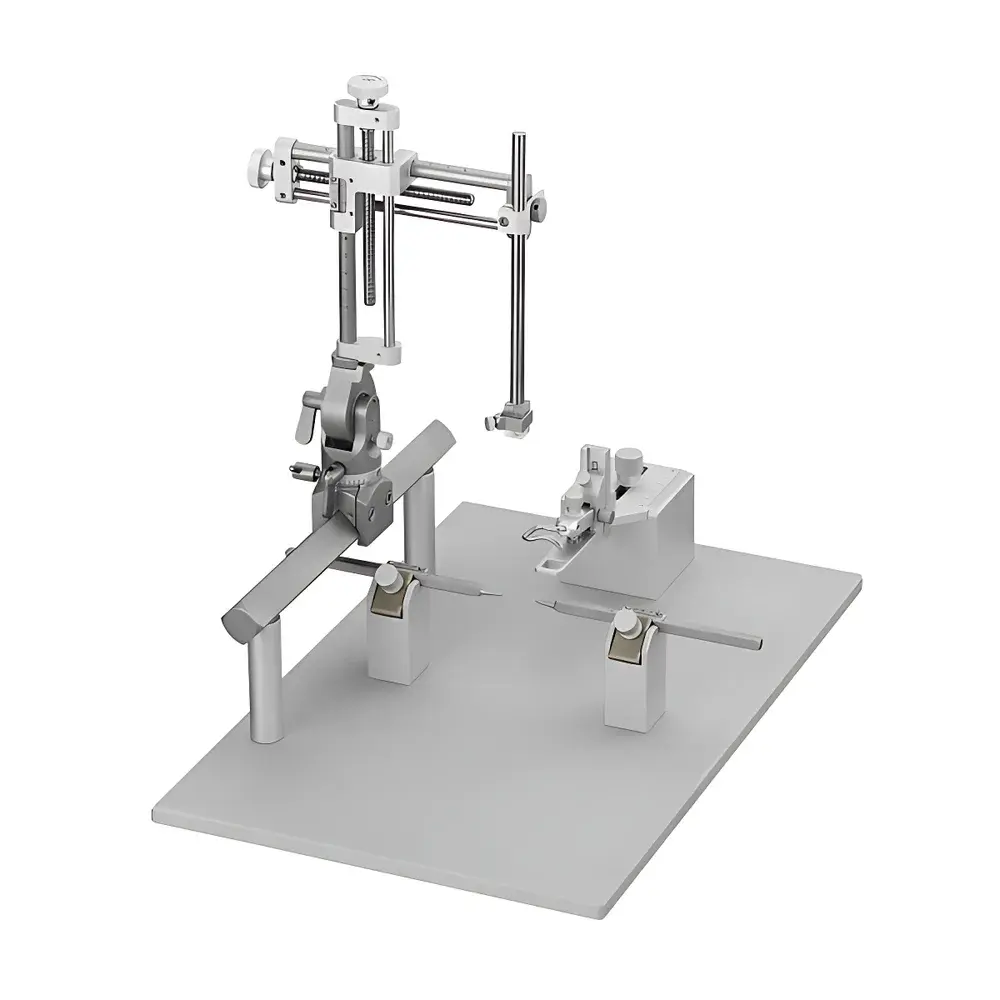
OrionTrack R-400 Rat Brain Stereotaxic Instrument
| Origin | Guangdong, China |
|---|---|
| Manufacturer Type | Authorized Distributor |
| Origin Category | Domestic (PRC) |
| Model | Rail-Mounted |
| Pricing | Available Upon Request |
| Base Plate Dimensions | 400 mm × 255 mm |
| Ear Bar Height from Base | 55.5 mm |
| Ear Bar Groove Scale Resolution | 0.1 mm |
| Ear Bar Linear Adjustment Range | 35 mm (1 mm graduation) |
| Rail Length | 255 mm |
| Zero Alignment | Rail zero line coincident with ear bar centerline |
| Rail Bidirectional Scale Range | ±100 mm (1 mm graduation) |
| Adapter Anterior–Posterior Travel | 43.5 mm |
| Adapter Dorsal–Ventral Adjustment Range | 30 mm (−20 mm to +10 mm |
| Optional AP Micro-Drive (Model 68102) | ±25 mm travel, 10 µm step resolution |
Overview
The OrionTrack R-400 is a rail-mounted stereotaxic instrument engineered for high-precision neurosurgical and intracranial intervention procedures in adult Sprague-Dawley and Wistar rats (250–500 g). Designed around the principles of mechanical rigidity, repeatable coordinate alignment, and ergonomic operator control, it implements a fixed-base, dual-rail architecture that minimizes parasitic motion during electrode, cannula, or microinjection needle positioning. Its coordinate system conforms to the Paxinos & Watson rat brain atlas (7th ed.), enabling reproducible targeting of subcortical structures—including the hippocampus (CA1), nucleus accumbens, ventral tegmental area, and medial prefrontal cortex—with sub-millimeter spatial fidelity. The instrument operates without electronic actuation; all movements are manually controlled via calibrated micrometers and vernier scales, ensuring deterministic mechanical feedback and eliminating latency or drift associated with motorized systems.
Key Features
- Reinforced aluminum alloy base plate (400 mm × 255 mm) provides stable platform mounting on standard vibration-dampened surgical tables or custom lab benches.
- Ear bar assembly mounted at precisely 55.5 mm above base plane ensures consistent skull leveling across animal cohorts; integrated groove scale (0.1 mm resolution) enables rapid bilateral symmetry verification prior to fixation.
- Linear rail system (255 mm total length) features zero-reference line aligned with the geometric centerline of the ear bars—critical for eliminating angular offset in anterior–posterior (AP) axis calibration.
- Bidirectional rail scale (±100 mm, 1 mm graduations) supports full-range targeting from olfactory bulb to cerebellum while maintaining traceable positional reference relative to bregma or lambda landmarks.
- Vertically adjustable adapter stage offers −20 mm to +10 mm dorsal–ventral (DV) travel (0.1 mm resolution via fine-thread micrometer), accommodating variable skull thickness and craniotomy depth requirements.
- Optional AP Micro-Drive (Cat. No. 68102) integrates seamlessly into the rail interface, delivering 10 µm incremental advancement for electrophysiology or optogenetic fiber placement where thermal or mechanical creep must be excluded.
Sample Compatibility & Compliance
The OrionTrack R-400 is validated for use with adult laboratory rats (Rattus norvegicus) under IACUC-approved protocols requiring precise intracerebral coordinate registration. It complies with ISO 13485-aligned manufacturing controls for Class I medical device accessories and meets mechanical safety requirements per EN 61000-6-2 (EMC immunity) and EN 61000-6-3 (EMC emission) when used with compatible ancillary equipment (e.g., microinjectors, electrophysiology amplifiers). All metallic components are anodized 6061-T6 aluminum or stainless steel (AISI 304), ensuring corrosion resistance during repeated ethanol/bleach decontamination cycles. Calibration documentation includes NIST-traceable dimensional verification reports for critical axes (AP, ML, DV) and is supplied with each unit.
Software & Data Management
As a purely mechanical positioning platform, the OrionTrack R-400 does not incorporate embedded firmware or proprietary software. Coordinate acquisition and experimental metadata logging are performed externally using laboratory information management systems (LIMS) or ELN platforms compliant with 21 CFR Part 11 (e.g., LabArchives, Benchling). Users may export annotated coordinate logs (CSV/Excel) from atlas-based planning tools such as QuickNII or BrainMaker for audit trail generation. The instrument’s physical scale markings support direct transcription into standardized reporting templates required for GLP-compliant toxicology studies or NIH-funded behavioral neuroscience grants.
Applications
- Stereotactic implantation of chronic EEG/ECoG electrodes or depth probes for longitudinal seizure monitoring.
- Targeted intracerebroventricular (ICV) or intraparenchymal microinjection of viral vectors, siRNA, or pharmacological agents.
- Guided insertion of optical fibers for fiber photometry or optogenetic stimulation experiments.
- Craniotomy-guided placement of guide cannulas for repeated drug delivery or microdialysis probe insertion.
- Validation of functional MRI (fMRI) activation loci via post-hoc histological reconstruction of injection sites.
FAQ
Is the OrionTrack R-400 compatible with mouse models?
No—this instrument is specifically dimensioned and calibrated for adult rats (250–500 g). For murine applications, refer to the OrionTrack M-200 series with scaled ear bar spacing and reduced DV travel range.
Does the rail system support third-party manipulators?
Yes—the 255 mm rail features standardized M4 threaded mounting holes (pitch = 25 mm) compatible with major manipulator brands including Narishige, Kopf, and Stoelting.
Can the base plate be sterilized in an autoclave?
No—autoclaving is not recommended due to thermal expansion mismatch between aluminum and stainless components. Surface decontamination with 70% ethanol, 0.5% sodium hypochlorite, or hydrogen peroxide vapor is validated.
What documentation is provided for regulatory submissions?
Each unit ships with a Certificate of Conformance, dimensional calibration report, and IACUC installation checklist template suitable for inclusion in AAALAC accreditation files or FDA IND applications.




