
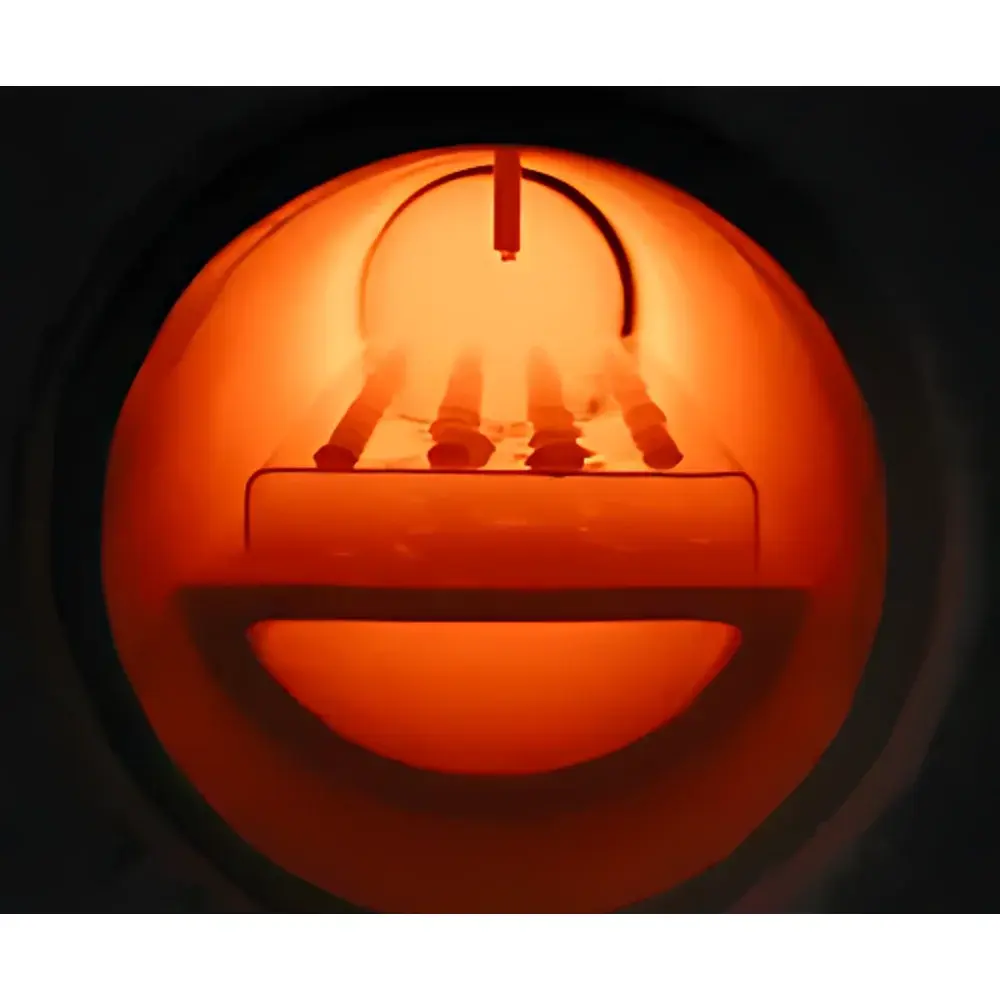
Orton GTF-MD Series Gradient Tube Furnace (Crystallization & Liquation Furnace)
| Brand | Orton |
|---|---|
| Origin | USA |
| Equipment Type | Horizontal Tube Furnace |
| Model | GTF-MD Series |
| Maximum Temperature | 1600 °C |
| Gradient Zone Length | 12 in (300 mm) or 16 in (405 mm) |
| Gradient Options | 10 °C/in or 20 °C/in |
| Corresponding ΔT Across Gradient Zone | 120 °C, 160 °C, 240 °C, or 320 °C |
| Compliance | ASTM C829A & C829B |
Overview
The Orton GTF-MD Series Gradient Tube Furnace is a precision-engineered horizontal tube furnace designed specifically for controlled thermal gradient analysis of inorganic glasses, ceramics, and refractory materials. Operating on the principle of steady-state linear temperature distribution along a defined axial zone, it enables reproducible spatial mapping of phase transitions—including glass-to-liquid transition (liquation), crystallization onset, and devitrification kinetics—within a single heating cycle. Unlike conventional muffle or box furnaces, the GTF-MD maintains a highly stable, user-selectable thermal gradient across its calibrated hot zone, allowing simultaneous exposure of a sample to a continuous range of temperatures. This architecture eliminates sequential thermal cycling and supports direct correlation between microstructural evolution (e.g., crystal nucleation, boundary formation) and local temperature—critical for determining critical thermal thresholds such as the liquidus point, maximum crystallization temperature (Tx,max), and the lower limit of the “crystallization-inhibiting” temperature window.
Key Features
- Horizontally oriented high-purity alumina or silicon carbide tube assembly with optimized insulation design to sustain stable axial gradients over 12-inch (300 mm) or 16-inch (405 mm) zones
- Dual-gradient capability: selectable 10 °C/in or 20 °C/in slope, yielding total ΔT values of 120 °C, 160 °C, 240 °C, or 320 °C across the monitored length
- Maximum operating temperature of 1600 °C, achieved via low-thermal-mass resistance heating elements with independent thermocouple feedback loops
- Integrated platinum sample carrier tray enabling rapid quenching—sample removal under inert atmosphere or ambient air freezes transient microstructures at precise axial positions
- Modular system architecture comprising four core subsystems: gradient furnace chamber, programmable temperature controller (PID-based), step-down power transformer, and digital temperature display with position-calibrated readout
- Designed and validated for compliance with ASTM C829A (“Standard Test Method for Determining the Liquation Temperature of Glass”) and ASTM C829B (“Standard Test Method for Determining the Crystallization Temperature of Glass”)
Sample Compatibility & Compliance
The GTF-MD accommodates standard cylindrical or slab-shaped glass and ceramic specimens up to 12 mm in diameter and 50 mm in length. Its horizontal configuration ensures uniform heat transfer and minimizes gravitational distortion during softening or partial melting. The furnace’s thermal profile stability (< ±1 °C/h drift under gradient mode) meets GLP-aligned requirements for method validation in materials certification labs. All electrical and thermal safety systems conform to UL 61010-1 and IEC 61000-6-3 standards. Data traceability—including setpoint history, actual gradient verification logs, and quench timestamps—supports 21 CFR Part 11–compliant documentation when paired with Orton’s optional data acquisition interface.
Software & Data Management
While the base GTF-MD operates via analog/digital front-panel controls, optional integration with Orton’s ThermData™ software enables real-time gradient profiling, automated position–temperature calibration mapping, and export of time-synchronized thermal datasets in CSV or XML format. The software includes built-in ASTM C829A/B workflow templates, automatic calculation of liquation temperature from observed boundary position using pre-loaded gradient coefficients, and audit-trail generation for QA/QC reporting. All firmware updates and calibration certificates are accessible through Orton’s secure customer portal, requiring no third-party licensing.
Applications
- Determination of glass liquation temperature (Tliq) via optical identification of the liquid-phase boundary after quenching
- Mapping of crystallization onset temperature (Tc) and peak crystallization temperature (Tx) in oxide and chalcogenide glasses
- Thermal stability assessment of bioactive glasses and nuclear waste forms under controlled devitrification conditions
- Development and validation of heat-treatment schedules for transparent ceramics and sintered phosphors
- Interlaboratory round-robin testing per ISO 17025-accredited protocols for refractory classification
- Teaching laboratories: visual demonstration of solid–liquid coexistence, eutectic behavior, and kinetic vs. thermodynamic phase boundaries
FAQ
What distinguishes the GTF-MD from standard tube furnaces?
Unlike general-purpose tube furnaces, the GTF-MD is engineered exclusively for reproducible linear thermal gradients—not uniform temperature zones—enabling spatially resolved phase transition analysis in a single run.
Can the gradient be verified independently?
Yes. Orton provides NIST-traceable calibration procedures using dual-point thermocouples inserted at defined axial locations; full gradient verification reports are issued with each unit shipment.
Is inert gas purging supported?
The furnace tube features standard VCR-compatible inlet/outlet ports for continuous argon, nitrogen, or forming gas flow, with optional mass flow controller integration.
How is temperature–position correlation established?
Each GTF-MD unit undergoes factory calibration to generate a position–temperature polynomial (R² > 0.9998); users receive a certified gradient map referencing axial distance (in inches or mm) to temperature (°C).
Does the system support automated quenching?
Manual platinum tray extraction is standard; robotic sample handling and pneumatically actuated quench stages are available as custom OEM options.



