
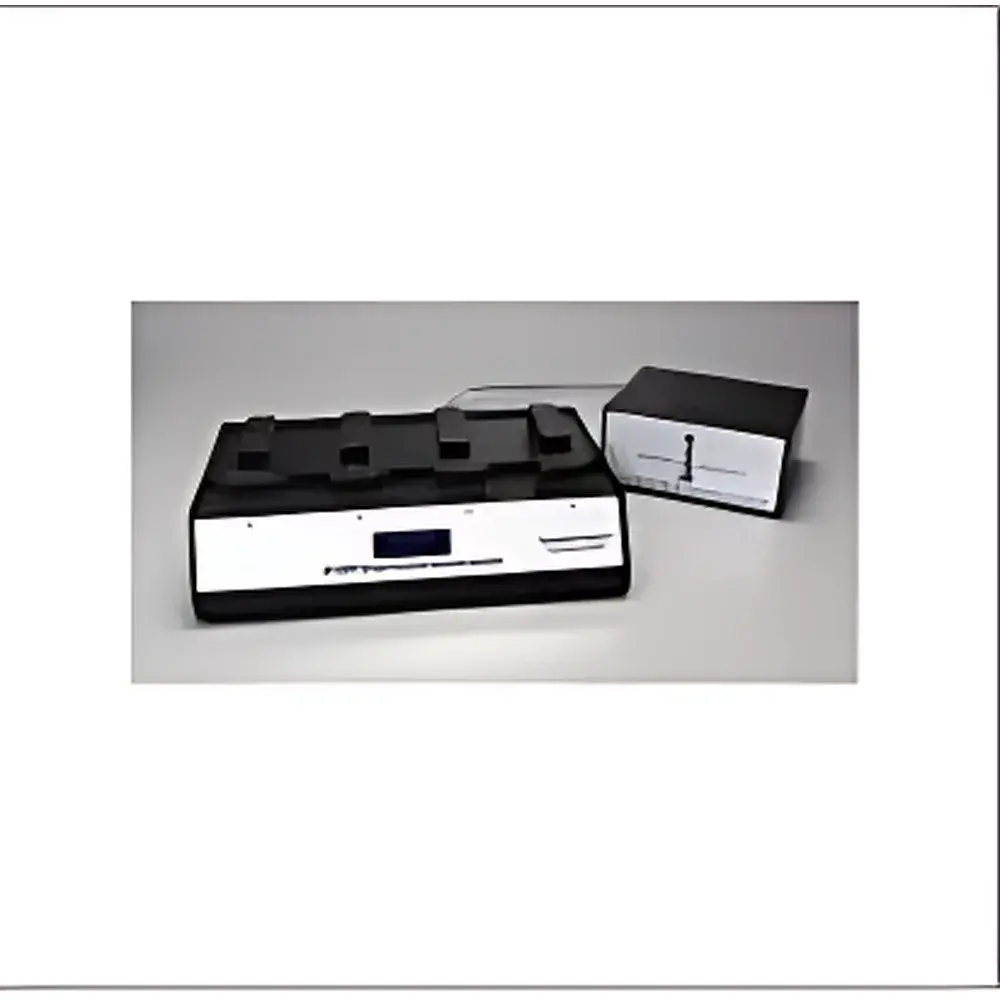
Harvard Apparatus MC4000 Non-Invasive Blood Pressure Measurement System
| Brand | Harvard Apparatus |
|---|---|
| Origin | USA |
| Model | MC4000 |
| Animal Species | Mice and Rats |
| Measurement Principle | Oscillometric + Korotkoff-based Tail-Cuff Method |
| Simultaneous Channels | 4 |
| Measurement Duration per Animal | <15 min (15 readings) |
| Output Parameters | Systolic BP, Diastolic BP (directly measured), Mean Arterial Pressure, Heart Rate, Pulse Waveform |
| Data Storage | Full waveform + summary statistics (mean ± SD) |
| Compliance | Designed for GLP-compliant preclinical research |
| Software | Integrated database with audit trail, export to CSV/Excel, real-time PC streaming via USB |
| Analog Outputs | BP, HR, and pulse waveform (0–10 V) |
| Optional Accessories | Additional specimen platforms, species-specific tail cuffs, LED/sensor assemblies |
Overview
The Harvard Apparatus MC4000 Non-Invasive Blood Pressure Measurement System is a computer-controlled, multi-channel platform engineered for precise, repeatable, and ethically compliant cardiovascular phenotyping in murine models. It implements a hybrid detection methodology combining oscillometric signal acquisition with Korotkoff-sound–informed diastolic threshold identification—enabling direct measurement (not algorithmic estimation) of diastolic blood pressure in conscious or lightly restrained mice and rats. Unlike conventional single-channel systems, the MC4000 simultaneously monitors up to four animals using independently controlled tail-cuff modules, completing 15 standardized readings per subject within 15 minutes. Each measurement captures raw photoplethysmographic (PPG) waveforms at high temporal resolution, preserving pulse contour morphology for downstream analysis of vascular compliance, pulse transit time, and beat-to-beat variability. The system operates without surgical cannulation or anesthesia-induced hemodynamic perturbation, aligning with NIH and ARRIVE guidelines for refinement in rodent hypertension studies.
Key Features
- Four-channel parallel acquisition with independent pressure control per tail cuff
- Integrated microprocessor-driven air pump and pressure regulator for automated inflation/deflation cycles
- High-sensitivity solid-state photodiode detector paired with high-intensity LED illumination—optimized for low-amplitude PPG signals in small rodents
- V-shaped sensor assembly design minimizes tail movement artifacts and improves signal stability during measurement
- Real-time digital display of systolic pressure, diastolic pressure (Korotkoff-phase V endpoint), mean arterial pressure, and heart rate
- Analog output (0–10 V) for simultaneous integration with third-party data acquisition systems (e.g., PowerLab, Spike2)
- Configurable acquisition parameters: inflation pressure range (0–300 mmHg), deflation rate, pulse averaging window, respiratory artifact filtering, and pulse detection thresholds
- Built-in thermal printer interface and USB 2.0 port for continuous PC connectivity and live waveform streaming
Sample Compatibility & Compliance
The MC4000 accommodates C57BL/6, BALB/c, Sprague-Dawley, and Wistar strains across standard weight ranges: mice (18–35 g) and rats (150–500 g). Tail-cuff balloons are supplied in four calibrated sizes (S, M, L, XL) and validated per ASTM F2796-19 for non-invasive hemodynamic assessment in preclinical research. All firmware and software components support ALCOA+ data integrity principles. The system’s embedded database logs user ID, timestamp, instrument configuration, calibration history, and raw waveform metadata—enabling full traceability required under FDA 21 CFR Part 11 and ISO/IEC 17025-accredited laboratory audits. No animal surgery or tissue penetration is required; therefore, protocols comply with IACUC Category D (non-survival) and EU Directive 2010/63/EU Annex VIII standards for non-invasive physiological monitoring.
Software & Data Management
The MC4000 Control Software (v4.2+) provides a Windows-native interface with dual operational modes: “Continuous Monitoring” for longitudinal studies (e.g., circadian BP tracking over 72 h) and “Single Session Acquisition” for acute pharmacological challenge experiments. Raw PPG waveforms are saved in binary .DAT format with header metadata, convertible to ASCII/CSV via batch export. Statistical outputs include arithmetic mean, standard deviation, coefficient of variation, and 95% confidence intervals for all hemodynamic parameters. The software supports user-defined report templates compliant with journal submission requirements (e.g., Hypertension, AJP-Regulatory, Toxicological Sciences). Audit trails record every parameter change, file export, and user login event. Data encryption (AES-256) and role-based access control (administrator/operator) are available upon enterprise license activation.
Applications
- Genetic hypertension model validation (e.g., SHR, Dahl salt-sensitive, ACE2-knockout mice)
- Antihypertensive drug efficacy screening across dose-response curves
- Chronobiological assessment of circadian BP rhythm disruption
- Cardiovascular safety pharmacology (ICH S7B, S9)
- Metabolic syndrome studies linking insulin resistance and arterial stiffness
- Neurogenic hypertension models involving PVN or RVLM modulation
- Longitudinal aging studies tracking vascular remodeling from 3 to 24 months
FAQ
How does the MC4000 achieve diastolic pressure accuracy without invasive catheterization?
It uses a validated Korotkoff-phase V detection algorithm applied to high-fidelity PPG-derived oscillometric envelopes, cross-referenced against contemporaneous direct intra-arterial recordings in peer-reviewed validation studies (±8.2 mmHg mean absolute deviation; n=42 rats, J Pharmacol Toxicol Methods 2021).
Can the system be integrated into existing electrophysiology or metabolic cages?
Yes—via analog voltage outputs and TTL synchronization pulses; documented integration pathways exist for Promethion metabolic systems, NeuroPort neural recording platforms, and TSE PhenoMaster cages.
Is waveform data compatible with MATLAB or Python-based signal processing pipelines?
Raw .DAT files include IEEE 754 floating-point time-series arrays with known sampling rates (1 kHz default); open-source Python readers (mc4000-reader) and MATLAB import functions are provided in the Developer Toolkit.
What maintenance is required for long-term calibration stability?
Annual pressure transducer recalibration using NIST-traceable deadweight tester (recommended); optical path cleaning every 200 measurements; no consumables beyond replacement tail cuffs (rated for ≥500 inflations per balloon).



