
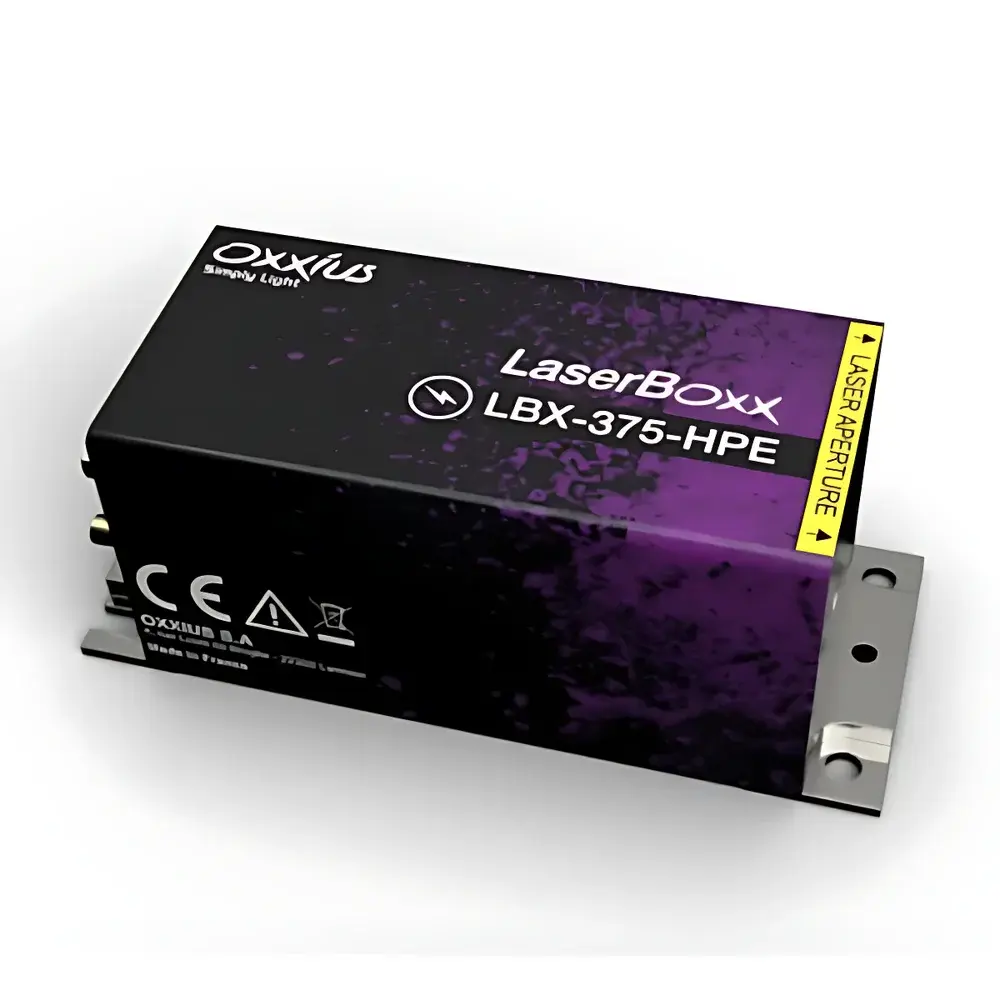
Oxxius LBX Series High-Power Semiconductor Laser Modules (375 nm / 405 nm / 488 nm / 638 nm)
| Brand | Oxxius |
|---|---|
| Origin | France |
| Laser Type | Diode-Based Continuous-Wave (CW) |
| Wavelengths | 375 nm, 405 nm, 488 nm, 638 nm |
| Output | Free-Space Multimode Elliptical Beam |
| Optional Fiber Coupling | Removable Multimode Fiber Pigtail |
| Packaging | Compact OEM-Ready Laser Head with Integrated Driver (Standard 32 mm × 115 mm Cylindrical Form Factor) |
| Control Interface | Analog Modulation (0–5 V), TTL Modulation, USB 2.0, RS-232 |
| Compliance | FDA 21 CFR Part 1040.10/1040.11 (Class 3B/4), CE, RoHS, IEC 60825-1 |
| Smart Features | Embedded EEPROM for calibration data, real-time operational logging, remote diagnostics, firmware-upgradable controller |
Overview
The Oxxius LBX Series comprises a family of high-power, continuous-wave (CW) semiconductor laser modules engineered for demanding scientific and industrial applications requiring stable, spectrally pure visible-light output. Operating at four precisely defined wavelengths—375 nm (UV-A), 405 nm (violet), 488 nm (blue), and 638 nm (red)—these diode-based lasers deliver exceptional power stability (<±0.5% RMS over 8 hours), low noise (<0.3% RMS intensity noise, 10 Hz–10 MHz), and narrow spectral bandwidth (25% typical), minimal thermal load, and intrinsic compatibility with digital modulation protocols. Designed for integration into analytical instrumentation—including confocal microscopes, flow cytometers, Raman spectrometers, and photolithography tools—the LBX series meets rigorous requirements for long-term repeatability, environmental robustness, and regulatory traceability.
Key Features
- Four standardized wavelengths optimized for fluorescence excitation, photochemical activation, and optical alignment: 375 nm (DNA crosslinking, UV curing), 405 nm (DAPI/CFP excitation), 488 nm (FITC/GFP excitation, flow cytometry standard), and 638 nm (Cy5/AF647 excitation, deep-tissue imaging).
- Compact monolithic architecture integrating laser diode, thermoelectric cooler (TEC), collimation optics, and intelligent driver in a single 32 mm diameter × 115 mm length housing—conforming to industry-standard OEM packaging dimensions.
- Factory-calibrated output power ranging from 50 mW to 500 mW per wavelength (model-dependent), with optional active power stabilization via internal photodiode feedback loop.
- Native support for multiple control interfaces: analog voltage (0–5 V), TTL (LVTTL-compatible), USB 2.0 (CDC-class virtual COM port), and RS-232—all enabling precise external triggering, intensity ramping, and synchronized pulsing.
- Embedded smart controller with non-volatile EEPROM storing factory calibration coefficients, lifetime operational logs (including temperature, current, and cumulative on-time), and error-code history—enabling GLP-compliant audit trails.
- FDA-compliant Class 3B/4 configurations available with integrated interlock circuitry, emission indicator LED, and key-switch safety lock—fully documented per 21 CFR Part 1040.10/1040.11.
Sample Compatibility & Compliance
The LBX series is compatible with a broad range of sample types and experimental configurations. Its free-space elliptical beam (typical M² < 30) supports direct coupling into scanning galvanometers, acousto-optic deflectors (AODs), or spatial light modulators (SLMs); optional detachable multimode fiber pigtails (e.g., 105 µm core, NA 0.22) enable seamless integration into fiber-fed systems such as endomicroscopy probes or multi-channel spectrographs. All units comply with ISO 13406-2 for optical safety classification, IEC 61000-6-3 (EMC emissions), and IEC 61000-6-2 (immunity). For regulated environments—including clinical diagnostics (IVD), pharmaceutical QC, and GMP manufacturing—the laser’s embedded logging capability satisfies FDA 21 CFR Part 11 requirements for electronic records and signatures when used with validated software (e.g., Oxxius Lasea™ or third-party LabVIEW/Python drivers).
Software & Data Management
Oxxius provides native software development kits (SDKs) for Windows, Linux, and macOS supporting C/C++, Python, MATLAB, and LabVIEW APIs. The Lasea™ GUI enables full parameter configuration—including setpoint power, modulation depth, TEC target temperature, and fault threshold adjustment—as well as real-time monitoring of diode current, heatsink temperature, and photodiode signal. Operational logs are stored in timestamped CSV format with millisecond resolution, supporting retrospective analysis of thermal drift, aging effects, or environmental perturbations. Firmware updates are performed over USB without hardware modification, ensuring long-term maintainability and compliance with evolving regulatory expectations.
Applications
- Confocal and super-resolution microscopy (STED, SIM): Precise 488 nm and 638 nm excitation with sub-millisecond modulation for gated detection.
- Next-generation sequencing (NGS) platforms: High-duty-cycle 405 nm and 488 nm sources for fluorescent base calling with >99.9% pulse-to-pulse consistency.
- Photopolymerization and additive manufacturing: 375 nm and 405 nm modules drive rapid resin curing with controlled depth penetration and minimal thermal distortion.
- Flow cytometry and cell sorting: Multi-wavelength excitation capability enables simultaneous detection of ≥4 fluorophores in compact benchtop instruments.
- Optogenetics and neurophotonics: 473–488 nm variants support ChR2 activation; 638 nm enables red-shifted opsins (e.g., ChrimsonR) with reduced phototoxicity.
- Industrial metrology and machine vision: Stable 638 nm output serves as alignment reference in semiconductor wafer inspection and precision laser triangulation sensors.
FAQ
What safety certifications do LBX lasers carry?
All LBX models are certified to IEC 60825-1:2014 (Edition 3), CE-marked under the EU Machinery Directive 2006/42/EC, and compliant with FDA 21 CFR Part 1040.10/1040.11 for Class 3B and Class 4 laser products.
Can I operate multiple LBX lasers synchronously?
Yes—via USB or RS-232 daisy-chaining and shared trigger signals, up to eight LBX units can be phase-locked and intensity-synchronized with <100 ns jitter using the Oxxius Master-Slave protocol.
Is fiber coupling included by default?
No—free-space output is standard; multimode fiber pigtails (with FC/PC or SMA-905 connectors) are optional accessories ordered separately with specified core diameter and NA.
How is laser lifetime monitored?
The embedded controller continuously records operating hours, average drive current, and peak junction temperature; degradation trends are quantified using built-in accelerated life modeling per Telcordia GR-468-CORE.
Do LBX lasers support analog modulation above 1 MHz?
Yes—bandwidth exceeds 5 MHz for small-signal modulation (≤10% power swing); for full-range on/off switching, TTL response time is <50 ns (10%–90%).





