
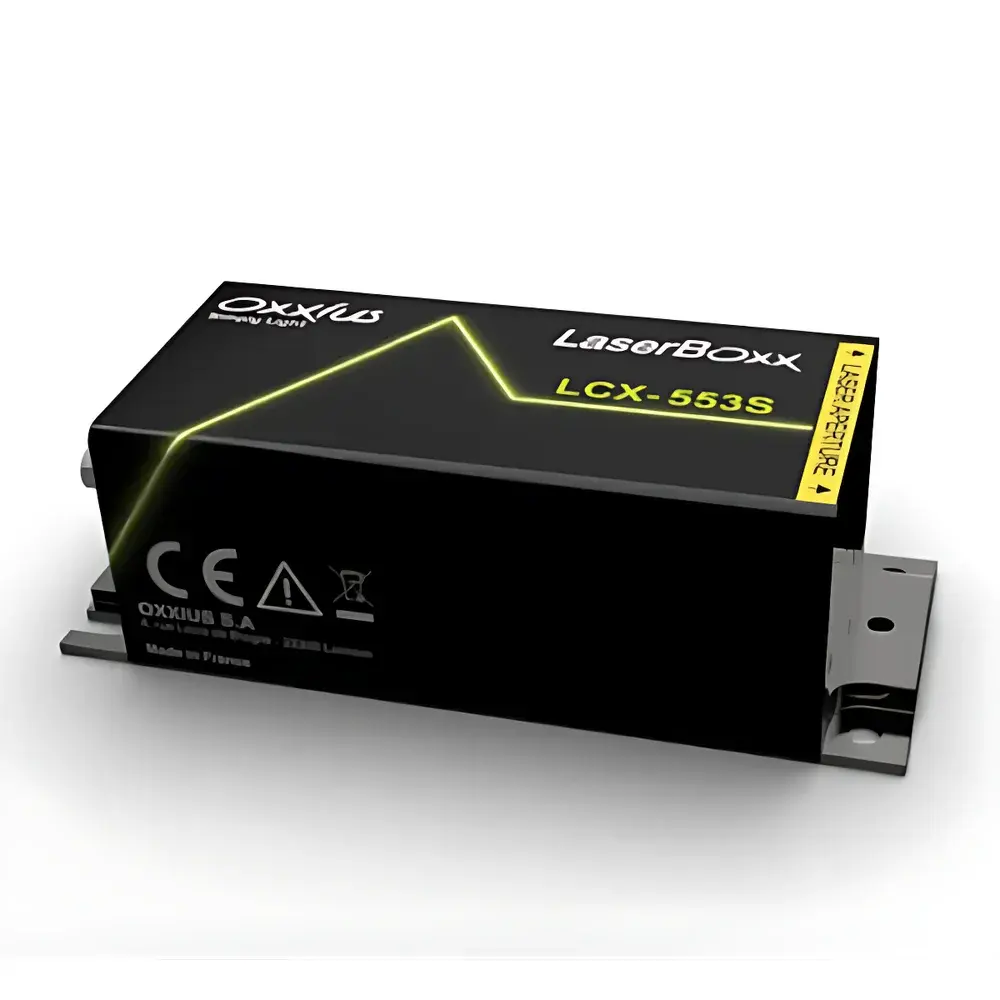
Oxxius LCX/LBX Series Single-Longitudinal-Mode Narrow-Linewidth Lasers
| Brand | Oxxius |
|---|---|
| Origin | France |
| Laser Type | Solid-State DPSS or Semiconductor |
| Wavelengths | 553 nm, 633 nm, 785 nm, 830 nm, 946 nm, 1064 nm |
| Linewidth | <1 MHz (typical) |
| Output Power | Up to 500 mW (model-dependent) |
| Beam Quality | M² < 1.1 |
| Power Stability | <±0.5% RMS over 8 h |
| Frequency Stability | <±20 MHz/h (with SLM lock) |
| Noise | <0.3% RMS (10 Hz–10 MHz) |
| Control Interface | USB, RS-232, Analog TTL |
| Compliance | CDRH Class 3B/4, CE, RoHS |
| Form Factor | OEM module or benchtop with integrated driver and thermal management |
Overview
The Oxxius LCX and LBX Series single-longitudinal-mode (SLM) narrow-linewidth lasers are engineered for high-fidelity coherent light generation in precision optical metrology, spectroscopy, and interferometric applications. Based on either diode-pumped solid-state (DPSS) or distributed-feedback (DFB) semiconductor architectures, these lasers operate in fundamental transverse (TEM₀₀) and longitudinal (single axial mode) regimes—ensuring diffraction-limited beam propagation and minimal phase noise. The SLM condition is actively maintained via internal cavity-length stabilization and electronic feedback loops, enabling sub-MHz spectral linewidths and long coherence lengths (>100 m). Unlike multimode or free-running sources, these lasers eliminate mode-hopping and intensity fluctuations, making them suitable for demanding applications where temporal coherence, frequency agility, and amplitude stability are non-negotiable—such as heterodyne detection, Brillouin scattering spectroscopy, and quantum optics experiments requiring well-defined photon statistics.
Key Features
- Active single-longitudinal-mode (SLM) locking with real-time cavity resonance tracking
- Narrow spectral linewidth: <1 MHz (FWHM), verified by delayed self-heterodyne interferometry
- Exceptional amplitude stability: <±0.5% RMS over 8 hours at constant ambient temperature
- Low relative intensity noise (RIN): <−145 dB/Hz at 1 MHz offset (typical)
- Integrated intelligent controller with embedded microprocessor and EEPROM-based calibration data
- Multi-interface control: USB 2.0, RS-232, and analog/digital I/O for TTL modulation and status monitoring
- OEM-ready mechanical design with industry-standard mounting flanges and thermal interface pads
- Compliance with CDRH 21 CFR Part 1040.10/1040.11 and IEC 60825-1:2014 for Class 3B/4 operation
Sample Compatibility & Compliance
These lasers are compatible with standard optical breadboards, kinematic mounts, and fiber-coupled collimation packages (e.g., FC/APC or SMA905 interfaces). All models support polarization-maintaining (PM) fiber coupling upon request and meet ISO 10110 surface quality specifications for internal optics. From a regulatory standpoint, each unit carries full CE marking under the EU Machinery Directive and Electromagnetic Compatibility (EMC) Directive. For laboratory environments operating under GLP or GMP frameworks, the built-in event logging system records operational parameters—including runtime, temperature setpoints, output power history, and fault codes—with timestamped entries stored in non-volatile memory. Audit trails comply with FDA 21 CFR Part 11 requirements when used with validated third-party software platforms.
Software & Data Management
Oxxius provides the Lasea™ control suite—a cross-platform application (Windows/macOS/Linux) supporting remote configuration, real-time parameter monitoring, and scriptable automation via Python SDK. The embedded firmware implements secure command parsing with password-protected access levels for service diagnostics. Operational logs are exportable in CSV format with UTC timestamps, facilitating traceability during instrument qualification (IQ/OQ/PQ). Firmware updates are performed over USB without external hardware programmers; version history and checksum validation ensure integrity. Optional integration with LabVIEW™, MATLAB®, and EPICS IOC environments is supported through documented API libraries and shared memory buffers.
Applications
- Raman and Brillouin spectroscopy—where narrow linewidth minimizes spectral broadening and enables high-resolution phonon mode discrimination
- Interferometric sensing—including fiber-optic gyroscopes, displacement metrology, and gravitational wave detector prototype systems
- Coherent anti-Stokes Raman scattering (CARS) and stimulated Raman scattering (SRS) microscopy
- Laser Doppler velocimetry (LDV) and particle image velocimetry (PIV) requiring stable beat-note generation
- Atomic physics setups involving laser cooling, magneto-optical traps (MOTs), and optical lattice clocks
- Dynamic light scattering (DLS) and electrophoretic light scattering (ELS) instrumentation demanding low-coherence-noise illumination
- Multiplexed excitation in fluorescence correlation spectroscopy (FCS) and Förster resonance energy transfer (FRET) assays
FAQ
What distinguishes an SLM laser from a standard CW laser?
An SLM laser emits light in only one longitudinal cavity mode, resulting in a near-Fourier-transform-limited linewidth and coherence length exceeding 100 meters. Standard CW lasers often operate in multiple longitudinal modes, leading to broader spectra and reduced temporal coherence.
Can these lasers be integrated into multi-wavelength combiner systems?
Yes—LCX/LBX series lasers are fully compatible with Oxxius L4Cc and L6Cc multi-channel beam combiners, supporting polarization-maintained alignment and active power balancing across up to six wavelengths.
Is remote diagnostics supported out-of-the-box?
Each laser includes an embedded diagnostic port accessible via USB or RS-232. Field engineers can perform firmware-level health checks, thermal map analysis, and PID loop tuning remotely—without physical access to the unit.
Are custom wavelengths or power levels available?
Oxxius offers tailored configurations including non-standard wavelengths (e.g., 532 nm, 730 nm) and higher-power variants (up to 1 W) under NRE agreements, subject to optical damage threshold and thermal management constraints.
What thermal management options exist for OEM integration?
Standard models include thermoelectric coolers (TECs) with PID-controlled temperature regulation (±0.02 °C stability). Conduction-cooled variants with cold-plate interfaces are available for high-density rack-mounted systems.



