
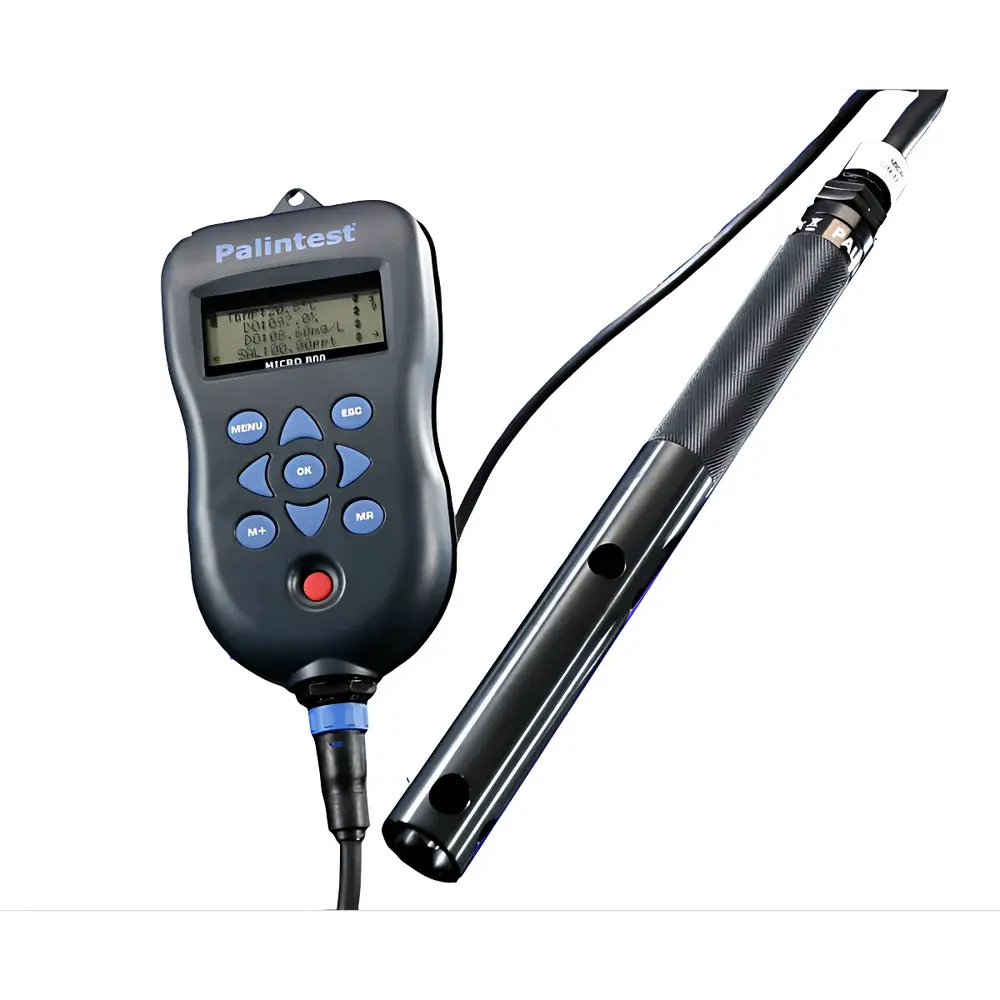
Palintest Micro 800 Fluorescence-Based Dissolved Oxygen Meter
| Brand | Palintest |
|---|---|
| Origin | United Kingdom |
| Model | Micro 800 |
| Instrument Type | Portable |
| Measurement Principle | Fluorescence Quenching |
| DO Range | 0.00–50.00 mg/L |
| DO Resolution | 0.01 mg/L / 0.1% saturation |
| DO Accuracy | ±1% of reading (≤20 mg/L or ≤200% sat) / ±10% of reading (>20 mg/L or >200% sat) |
| Conductivity Range | 0–200 mS/cm |
| TDS Range | 0–100,000 mg/L |
| Salinity Range | 0–70 PSU |
| Temperature Range | −5 to +50 °C |
| IP Rating | IP67 (instrument), IP68 (probe) |
| Battery Life | >20 h (alkaline), >40 h (NiMH) |
| Data Storage | 3,000 full-parameter records with GPS and barometric metadata |
| GPS | 12-channel internal antenna, ±10 m 3D accuracy |
| Operating Temperature | −20 to +70 °C |
| Probe Submersion Depth | Up to 30 m |
| Dimensions (main unit) | 90 × 180 × 39 mm |
| Weight (with batteries) | 450 g |
| Probe Dimensions | 250 × 24 mm (L × Ø) |
| Cable Length | 3 m (extendable) |
Overview
The Palintest Micro 800 is a field-deployable, multi-parameter water quality analyzer engineered for high-accuracy dissolved oxygen (DO) measurement using optical fluorescence quenching technology. Unlike electrochemical Clark-type sensors, the Micro 800 employs a solid-state luminescent sensor coated with a ruthenium-based fluorophore, where DO concentration is determined by measuring the phase shift or intensity decay of emitted light following pulsed excitation — a method inherently free from oxygen consumption, flow dependence, or electrolyte depletion. This principle delivers stable, maintenance-light operation across diverse aquatic environments, including estuarine, freshwater, wastewater effluent, aquaculture systems, and groundwater monitoring wells. The instrument simultaneously acquires DO, conductivity, total dissolved solids (TDS), salinity (PSU), temperature, barometric pressure, and geotagged location data — enabling real-time compensation of DO readings for temperature, salinity, and atmospheric pressure per ISO 5814:2012 and ASTM D888–22 standards.
Key Features
- Fluorescence-based DO sensing with zero drift and no membrane replacement or polarization time required
- Integrated multi-parameter capability: simultaneous DO, conductivity (0–200 mS/cm), TDS (0–100,000 mg/L), salinity (0–70 PSU), and temperature (−5 to +50 °C)
- Automatic salinity and barometric compensation applied in real time to DO calculations per Winkler-equivalent reporting conventions
- Ruggedized housing rated IP67 (submersible to 1 m for 30 min); probe rated IP68 for continuous operation up to 30 m depth
- Backlit 80-character LCD display optimized for outdoor readability under variable lighting conditions
- Onboard GPS (12-channel) with ±10 m horizontal/vertical accuracy and automatic timestamping for spatially referenced data logging
- 3,000-point internal memory storing full parameter sets, including GPS coordinates, barometric pressure, and operator-defined site IDs
- USB interface for direct data export; compatible with Palintest DataLink software for audit-trail-enabled report generation
Sample Compatibility & Compliance
The Micro 800 is validated for use in natural waters (rivers, lakes, reservoirs), marine and brackish systems, treated and raw wastewater, cooling tower fluids, and process streams in food & beverage and pharmaceutical manufacturing. Its fluorescence sensor exhibits minimal interference from hydrogen sulfide, chlorine residuals, or heavy metals—unlike amperometric probes—and remains stable in low-oxygen (200% air saturation) conditions. The device complies with ISO 5814:2012 (water quality — determination of dissolved oxygen — optical sensor method), meets the performance criteria outlined in US EPA Method 360.1 (for field DO screening), and supports GLP-compliant workflows through encrypted, time-stamped, and GPS-tagged data records. All calibration and measurement logs adhere to traceable documentation requirements aligned with ISO/IEC 17025 and FDA 21 CFR Part 11 when used with validated software protocols.
Software & Data Management
Data retrieval and reporting are supported via Palintest DataLink desktop software (Windows), which enables secure import of .csv or proprietary binary files. The software provides automated DO correction using user-selectable altitude or manually entered barometric pressure, generates compliance-ready summary reports with embedded metadata (GPS, operator ID, calibration history), and supports export to LIMS-compatible formats. Audit trails include calibration timestamps, sensor diagnostics, firmware version, and any manual overrides—ensuring full traceability for regulatory submissions. DataLink also facilitates batch calibration verification against NIST-traceable standards and supports custom parameter grouping for site-specific QA/QC templates.
Applications
- Regulatory environmental monitoring (EPA, EA, Environment Canada mandated sampling)
- Aquaculture pond management and hypoxia early-warning systems
- Wastewater treatment plant process control (aeration basin optimization, nitrification/denitrification monitoring)
- Drinking water distribution system integrity assessment (residual oxygen mapping)
- Ecological field studies requiring geo-referenced, multi-parameter water column profiling
- Industrial cooling water system corrosion risk evaluation (via DO–temperature–conductivity correlation)
- Educational and research deployments where portability, battery endurance, and sensor robustness are critical
FAQ
Does the Micro 800 require daily calibration?
No. The fluorescence sensor is factory-calibrated and maintains stability for ≥6 months under typical field use. A single-point air-saturation verification is recommended before each deployment.
Can the probe be used in turbid or biofouling-prone waters?
Yes. The optical sensor surface is chemically inert and resistant to organic fouling; optional cleaning kits and anti-fouling caps are available for extended deployments in eutrophic or industrial effluent.
Is GPS data embedded in exported files?
Yes. Each recorded measurement includes latitude, longitude, elevation, UTC timestamp, and HDOP value — all preserved in raw exports and report outputs.
How is barometric pressure measured and applied?
An integrated absolute pressure transducer (150–1150 mbar, ±1 mbar accuracy) continuously monitors ambient pressure and automatically adjusts DO saturation calculations without manual input.
What battery options are supported?
Five AA alkaline cells (≥20 h runtime) or rechargeable NiMH cells (≥40 h); low-battery warning and graceful shutdown prevent data loss during power transition.
Related Products







