
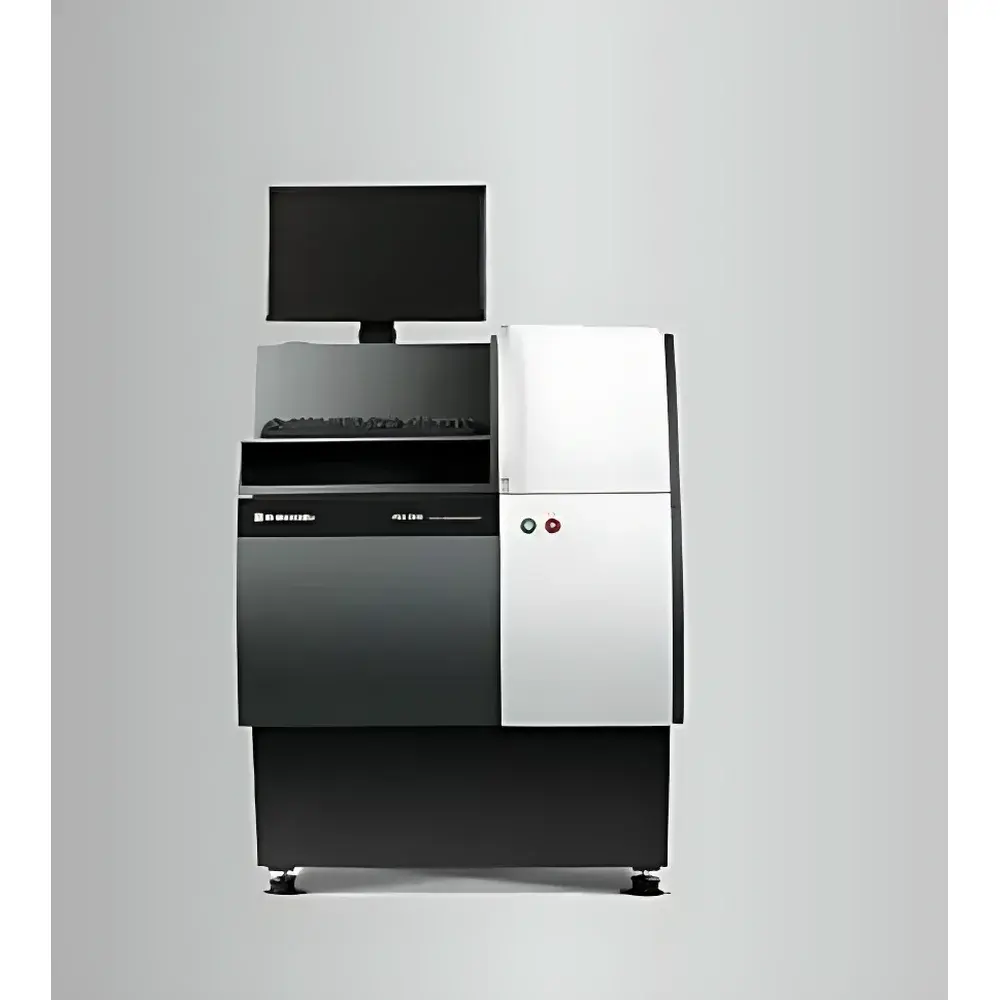
Shimadzu PDA-5000 Direct-Reading Optical Emission Spectrometer
| Brand | Shimadzu |
|---|---|
| Origin | Japan |
| Instrument Type | Floor-Standing |
| Excitation Method | Spark |
| Detector Type | Photomultiplier Tube (PMT) |
| Focal Length | 600 mm |
| Grating Groove Density | 2400 lines/mm |
| Wavelength Range | 120–800 nm |
| Maximum Channel Count | 24 |
Overview
The Shimadzu PDA-5000 is a floor-standing direct-reading optical emission spectrometer (OES) engineered for high-precision elemental analysis of solid metallic samples in industrial laboratory and production-floor environments. Based on the principle of spark-induced atomic emission spectroscopy, the instrument vaporizes and excites sample surfaces using controlled high-energy electrical discharges, generating characteristic line spectra that are dispersed via a high-resolution Czerny–Turner optical system and quantified by an array of photomultiplier tubes (PMTs). With a 600 mm focal length Paschen–Runge mounting configuration and a 2400 lines/mm holographic grating, the PDA-5000 delivers exceptional spectral resolution and long-term optical stability—critical for reproducible quantitative analysis across demanding metallurgical applications.
Key Features
- Robust Paschen–Runge optical bench with thermally stabilized housing, minimizing drift under ambient temperature fluctuations
- Dedicated spark stand with optimized argon purging geometry and electrode alignment mechanism for consistent ablation and reduced matrix effects
- Digital spark source with programmable discharge parameters (pulse width, frequency, energy), enabling tailored excitation for diverse alloys including low-carbon steels, high-chromium cast irons, and nickel-based superalloys
- High-sensitivity PMT detection system with individual high-voltage regulation per channel, supporting simultaneous multi-element measurement with sub-ppm detection limits for key alloying elements (e.g., C, S, P, Mn, Cr, Ni, Mo)
- Modular channel architecture allowing up to 24 pre-aligned PMT positions; additional channels can be installed on-site without optical realignment
- Integrated vacuum-purged optical path (optional) to extend spectral coverage into the vacuum UV region (down to 120 nm), essential for accurate carbon and sulfur determination in low-alloy steels
Sample Compatibility & Compliance
The PDA-5000 is validated for analysis of conductive solid metal samples—including cast iron, carbon and alloy steels, stainless steels, tool steels, bearing steels, and high-Cr/Ni/Mo superalloys—following standardized preparation protocols (flat, polished, contamination-free surfaces ≥ 20 mm diameter). It complies with core international testing standards including ASTM E415 (Standard Test Method for Analysis of Carbon and Low-Alloy Steel by Spark Atomic Emission Spectrometry), ISO 11573 (Metallic materials — Spark emission spectrometric analysis), and JIS G 1253 (Methods of test for steel and iron — Spark emission spectrometry). Its hardware architecture and firmware support audit-ready operation in GLP and GMP-regulated environments, with optional software modules enabling full 21 CFR Part 11 compliance (electronic signatures, audit trails, user access control).
Software & Data Management
The proprietary PDA-5000 analysis software provides a Windows-based interface with intuitive workflow navigation, real-time spectrum visualization, and automated calibration management. Users can perform on-site calibration curve development using certified reference materials (CRMs), with built-in statistical validation (linearity R², residual plots, LOD/LOQ calculation). The software supports customizable report templates compliant with ISO/IEC 17025 documentation requirements, exports data in CSV, XML, and LIMS-compatible formats (ASTM E1382), and integrates seamlessly with enterprise-level quality management systems (QMS) via OPC UA or ODBC. All analytical sessions—including parameter settings, raw intensity values, background corrections, and final concentration outputs—are timestamped and stored with immutable audit logs.
Applications
The PDA-5000 serves as a primary analytical tool in foundries, steel mills, automotive component suppliers, and aerospace material certification labs. Typical use cases include incoming raw material verification (scrap, ingots, billets), melt-process control (ladle analysis pre-casting), finished product release testing (e.g., crankshafts, gears, turbine blades), and failure investigation (inclusion analysis, segregation mapping). Its ability to quantify trace elements such as boron, titanium, and rare earth metals enables advanced grade classification of specialty steels used in high-speed rail bearings and medical-grade stainless components. In fast-paced production environments, cycle times remain consistently below 30 seconds per sample—including spark stabilization, integration, and result output—without compromising precision (RSD < 1.5% for major elements at typical concentrations).
FAQ
What sample preparation is required prior to analysis?
Flat, clean, and dry metallic surfaces must be prepared using standard grinding or milling equipment; minimum diameter: 20 mm; surface roughness Ra ≤ 1.6 µm.
Can the PDA-5000 analyze non-ferrous alloys such as aluminum or copper?
Yes—the instrument supports dedicated calibration packages for Al-, Cu-, Mg-, Zn-, and Ti-based alloys; requires separate spark stand inserts and optimized excitation parameters.
Is vacuum pumping mandatory for routine carbon analysis?
Not mandatory, but strongly recommended for carbon concentrations below 0.03 wt% in low-alloy steels; atmospheric mode suffices for carbon > 0.1 wt% and most other elements in the 120–800 nm range.
How is calibration curve maintenance handled during extended operation?
The software supports drift correction using internal standardization (e.g., Fe I 371.993 nm) and periodic recalibration with control samples; automatic warning triggers when intensity deviation exceeds user-defined thresholds.
Does Shimadzu provide application support for method development?
Yes—Shimadzu’s global Application Support Center offers remote and on-site assistance for CRM selection, curve building, interference correction, and regulatory documentation alignment (ISO 17025, IATF 16949).




