
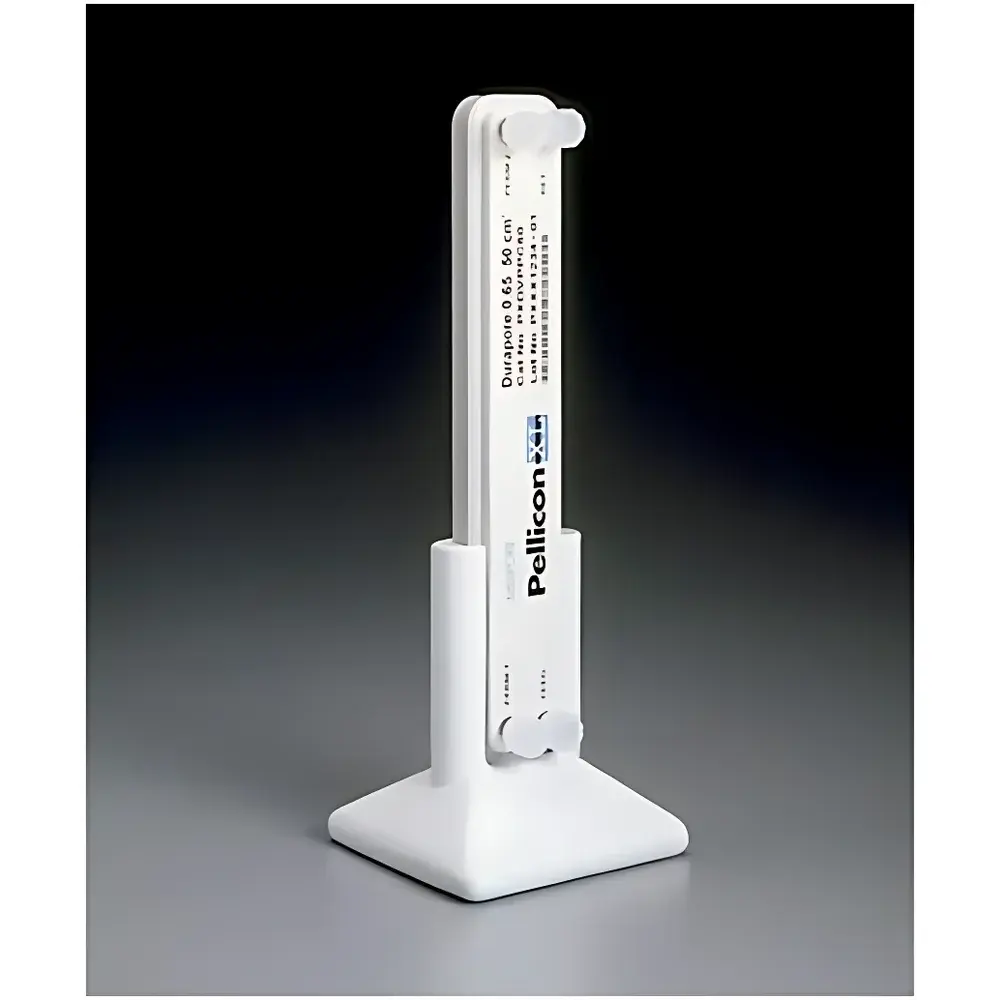
Millipore Pellicon® XL 50 Cassette Ultrafiltration Membrane Module
| Brand | Millipore |
|---|---|
| Origin | USA |
| Product Type | Import |
| Model | Pellicon® XL 50 Ultrafiltration |
| Membrane Area | 50 cm² |
| Membrane Materials | Biomax® (modified polyethersulfone) and Ultracel® (composite regenerated cellulose) |
| pH Stability | 1–14 (Biomax®) |
| Protein Binding | Low (both membranes) |
| MWCO Options | 5–1000 kDa |
| Housing Material | Polypropylene |
| Inlet/Outlet | Standard Luer-lock fittings |
| Configuration | Clamp-free, self-contained cassette module |
| Intended Use | Lab-scale process development and small-volume ultrafiltration/microfiltration |
Overview
The Millipore Pellicon® XL 50 Cassette Ultrafiltration Membrane Module is an engineered single-use ultrafiltration device designed for scalable, reproducible separation of biomolecules in laboratory and pilot-scale bioprocessing workflows. Operating on the principle of tangential flow filtration (TFF), the Pellicon® XL 50 enables efficient concentration, diafiltration, and buffer exchange of proteins, antibodies, plasmids, viruses, and other labile biological macromolecules. Its compact 50 cm² active membrane area balances throughput and sample volume constraints typical of early-stage process development—making it ideal for benchtop optimization prior to scale-up to larger Pellicon® systems (e.g., XL 100, XL 250). The cassette architecture eliminates the need for external clamping mechanisms, reducing setup time and minimizing risk of seal failure or cross-contamination between runs.
Key Features
- Two certified membrane chemistries: Biomax® (modified polyethersulfone) and Ultracel® (composite regenerated cellulose), both manufactured under strict ISO 9001-controlled conditions and qualified per ICH Q5A and Q5B guidelines for biopharmaceutical applications.
- Biomax® membrane offers full pH stability from 1 to 14, enabling compatibility with aggressive cleaning-in-place (CIP) solutions—including 0.1–1.0 M NaOH—and supports extended reuse when validated for multiple cycles.
- Ultracel® membrane provides exceptionally low non-specific protein binding (<0.5 µg/cm² for IgG), high mechanical integrity under shear stress, and resistance to enzymatic degradation—critical for purification of sensitive viral vectors or extracellular vesicles.
- Standardized Luer-lock inlet/outlet ports ensure seamless integration with common peristaltic pumps, syringe drivers, and automated TFF platforms without adapters or custom manifolds.
- Polypropylene housing provides chemical resistance to alcohols, acetone, and aqueous buffers; fully autoclavable at 121°C for up to 20 cycles (validated per ASTM F1632).
- Available in discrete molecular weight cut-off (MWCO) options: 5, 10, 30, 50, 100, and 1000 kDa—each lot tested for retention performance using standardized dextran or PEG challenge solutions per ASTM D5887.
Sample Compatibility & Compliance
The Pellicon® XL 50 is routinely employed in GMP-adjacent environments for pre-clinical process development, supporting protocols aligned with FDA Guidance for Industry: “Process Validation: General Principles and Practices” and EMA CHMP/BWP/3190/00. It accommodates sample volumes from 10 mL to 500 mL and handles feed streams with viscosities up to 25 cP. Both Biomax® and Ultracel® membranes are extractables- and leachables-tested per USP and ISO 10993-12, with full Certificates of Analysis (CoA) and Certificates of Conformance (CoC) supplied with each batch. The device meets ISO 13485:2016 requirements for medical device component suppliers and is compatible with GLP-compliant data recording when used with validated instrumentation.
Software & Data Management
While the Pellicon® XL 50 operates as a standalone passive module, its performance parameters—including transmembrane pressure (TMP), flux decline rate, and rejection coefficient—are fully quantifiable when paired with industry-standard TFF control systems (e.g., Sartorius Vivaflow®, Repligen KrosFlo® Research II, or custom LabVIEW-based acquisition). All relevant test data—including MWCO validation reports, endotoxin levels (<0.25 EU/mL), and bioburden specifications (<1 CFU/device)—are archived in MilliporeSigma’s TraceLink™ digital product passport system, accessible via batch number lookup. Audit trails for CoA issuance comply with 21 CFR Part 11 requirements where integrated with validated electronic lab notebooks (ELNs).
Applications
- Concentration and buffer exchange of monoclonal antibodies (mAbs) during purification process scouting.
- Diafiltration of mRNA-LNP formulations to remove residual ethanol and exchange into cryoprotective storage buffers.
- Clarification and fractionation of cell lysates in recombinant protein expression workflows.
- Downstream processing of lentiviral and AAV vectors—leveraging Ultracel®’s low-binding surface to maximize recovery yield.
- Preparative desalting of oligonucleotides prior to HPLC analysis or lyophilization.
- Process parameter mapping (e.g., TMP vs. flux, shear rate vs. aggregate formation) in Design of Experiments (DoE) studies.
FAQ
Can the Pellicon® XL 50 be sterilized by gamma irradiation?
No—gamma irradiation is not recommended, as it may degrade membrane polymer chains and compromise MWCO integrity. Autoclaving (121°C, 15 psi, 20 min) or 0.1 M NaOH sanitization is the validated sterilization method.
Is the Biomax® membrane compatible with organic solvents such as acetonitrile or DMSO?
Limited compatibility only; prolonged exposure to >10% v/v polar aprotic solvents may cause swelling or loss of hydraulic permeability. Refer to MilliporeSigma Technical Bulletin TB-001 for solvent compatibility matrices.
How many times can the same Pellicon® XL 50 cassette be reused?
Reuse is permissible only after rigorous in-house validation of cleaning efficacy, integrity testing (e.g., bubble point or diffusion test), and performance consistency across ≥3 consecutive runs—per ICH Q5D guidance.
Does the Luer-lock interface support both male and female connections?
Yes—the standard configuration includes one male and one female Luer-lock port, enabling direct connection to syringes, tubing, or manifold assemblies without gender adapters.
Are there application notes available for optimizing flux with viscous feed streams?
Yes—MilliporeSigma Application Note AN-427 details shear rate optimization, feed channel geometry effects, and TMP ramping strategies for feeds up to 15 cP.





