
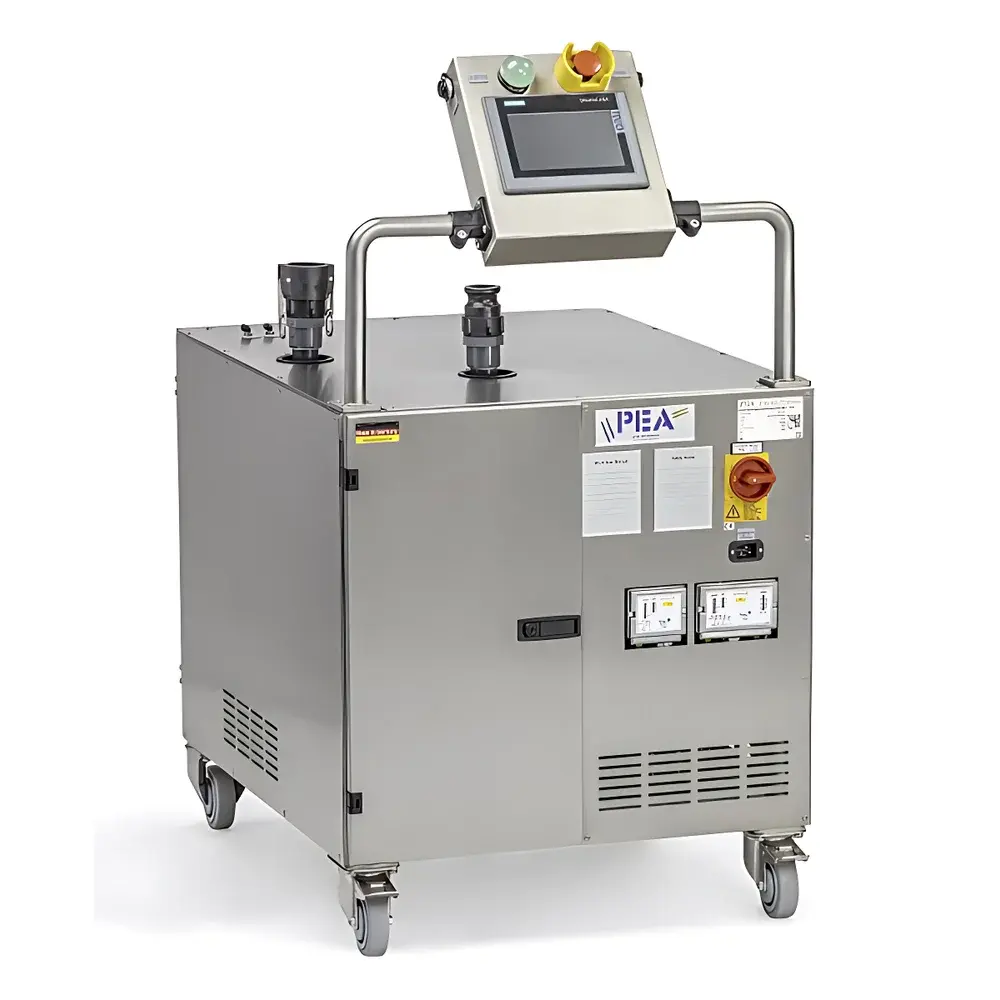
PEA MLT 19ii Vaporized Hydrogen Peroxide (VHP®) Sterilization Generator
| Brand | PEA |
|---|---|
| Origin | Germany |
| Model | MLT 19ii |
| Sterilization Volume | 200 m³ |
| Hydrogen Peroxide Feed Rate | 0.1–12 g/min (customizable) |
| Airflow | 40–120 m³/h (customizable) |
| Vaporization Temperature | up to 160 °C |
| Dehumidification Capability | ≤80% RH |
| Filtration Efficiency | ≥6-log reduction |
| Sterilant | Aqueous Hydrogen Peroxide Solution |
| Microbial Reduction | ≥6-log for Geobacillus stearothermophilus spores |
Overview
The PEA MLT 19ii is a mobile, high-precision vaporized hydrogen peroxide (VHP®) sterilization generator engineered in Germany for controlled-space decontamination in regulated life science environments. It employs PEA’s proprietary third-generation dry-flash vaporization technology — a closed-loop, recirculating injection system that fully converts liquid H₂O₂ into true molecular-phase vapor without condensation. Unlike open-loop or thermal evaporation methods, this process ensures consistent vapor-phase concentration, eliminates surface wetting, and maintains relative humidity below 80% RH throughout the cycle. The MLT 19ii delivers ≥6-log reduction of Geobacillus stearothermophilus spores — the industry-standard biological indicator for sterility assurance — with a validated Sterility Assurance Level (SAL) of ≤10⁻⁶. Its operation conforms to the fundamental principles of low-temperature, oxidative biocidal action: gaseous H₂O₂ generates hydroxyl radicals (•OH) and reactive oxygen species that irreversibly oxidize proteins, lipids, and nucleic acids across all microbial classes, including enveloped/non-enveloped viruses, vegetative bacteria, fungi, and highly resistant bacterial endospores.
Key Features
- Third-generation dry-flash vaporization: Closed-loop recirculating injection ensures complete phase transition, uniform vapor distribution, and minimal material interaction.
- Integrated LiRo™ gas dispersion system: Dynamically optimizes airflow and vapor trajectory to achieve homogeneous concentration profiles across complex geometries (e.g., isolators, BSCs, freeze dryers).
- Siemens S7-1200 PLC-based control interface: Supports up to 500 user-defined sterilization protocols with adjustable parameters including feed rate (0.1–12 g/min), airflow (40–120 m³/h), dwell time, and catalytic decomposition duration.
- Onboard catalyst-driven decomposition unit: Converts residual H₂O₂ vapor into ambient-grade H₂O and O₂ within minutes post-cycle, eliminating ventilation delays and enabling rapid room re-entry.
- Mobile trolley design with casters and integrated leveling feet: Facilitates deployment across multiple zones — laboratories, ABSL-2/3 suites, animal housing facilities, CAR-T cleanrooms, and transfer hatches — without permanent installation.
- Real-time monitoring of critical process variables: Includes inline H₂O₂ concentration sensors (ppm range), RH/T probes, and pressure differential tracking for full cycle traceability.
Sample Compatibility & Compliance
The MLT 19ii is validated for use on stainless steel, anodized aluminum, polycarbonate, silicone, EPDM, and most common cleanroom-compatible polymers. Its dry-vapor profile avoids corrosion of sensitive electronics, optical components, and HEPA/ULPA filter media — making it suitable for decontaminating biosafety cabinets, isolators, lyophilizers, and laminar flow hoods without disassembly. Regulatory alignment includes EU Annex 1 (2022), USP , ISO 14644-3, and FDA 21 CFR Part 11 for electronic records and signatures. All firmware logs include immutable audit trails with user authentication, timestamping, and change history — supporting GLP/GMP compliance and regulatory inspections. Full qualification packages (IQ/OQ/PQ) are available per ASTM E2592 and ISO 14161 standards.
Software & Data Management
The embedded control system supports local operation via a 7-inch touchscreen HMI and remote supervision via tablet or PC using encrypted Ethernet/WiFi communication. Process data — including H₂O₂ concentration curves, RH/T trends, airflow dynamics, and catalyst status — are stored in CSV and PDF formats with SHA-256 hash integrity verification. Optional integration with LIMS or MES platforms is enabled through OPC UA and Modbus TCP protocols. All software modules comply with IEC 62304 for medical device software lifecycle management and undergo annual cybersecurity vulnerability assessments per NIST SP 800-53.
Applications
- Decontamination of Class A/B/C/D cleanrooms and containment suites prior to batch release or facility modification.
- Routine sterilization of isolators used in aseptic filling, cell therapy manufacturing, and sterile API handling.
- Post-experiment decontamination of ABSL-2/3 laboratories, including animal caging systems and necropsy stations.
- Validation-grade sterilization of freeze-dryer chambers, transfer tunnels, and pass-through hatches where steam or ethylene oxide are unsuitable.
- Emergency response disinfection following pathogen release incidents — validated for SARS-CoV-2, influenza A, and other high-consequence viruses per EN 14476.
FAQ
What is the maximum recommended chamber volume for the MLT 19ii?
The MLT 19ii is validated for single-cycle decontamination of up to 200 m³ of enclosed space under standard environmental conditions (20–25 °C, ≤60% RH pre-cycle). Larger volumes require multi-unit coordination or extended cycle times with adjusted feed rates.
Does the MLT 19ii require external humidity control?
Yes — while the system actively dehumidifies during conditioning, optimal performance requires ambient RH ≤60% prior to cycle initiation. Integration with building HVAC or standalone desiccant dryers is recommended for high-humidity environments.
Can chemical and biological indicators be used with this system?
Yes — standardized VHP-compatible CI strips (e.g., 3M™ Attest™ VHP) and BI vials containing ≥10⁶ CFU Geobacillus stearothermophilus spores are fully compatible and required for routine validation per ISO 14644-3 Annex D.
Is the MLT 19ii compliant with FDA 21 CFR Part 11?
Yes — all electronic records include role-based access control, electronic signatures, audit trail logging, and data backup redundancy as defined in Part 11 Subpart B.
What maintenance intervals are recommended?
Catalyst cartridges require replacement every 500 operational hours; vaporizer nozzles and inline filters should be inspected quarterly and replaced annually or after 200 cycles, whichever occurs first. Full preventive maintenance is documented per ISO 13485 requirements.



