
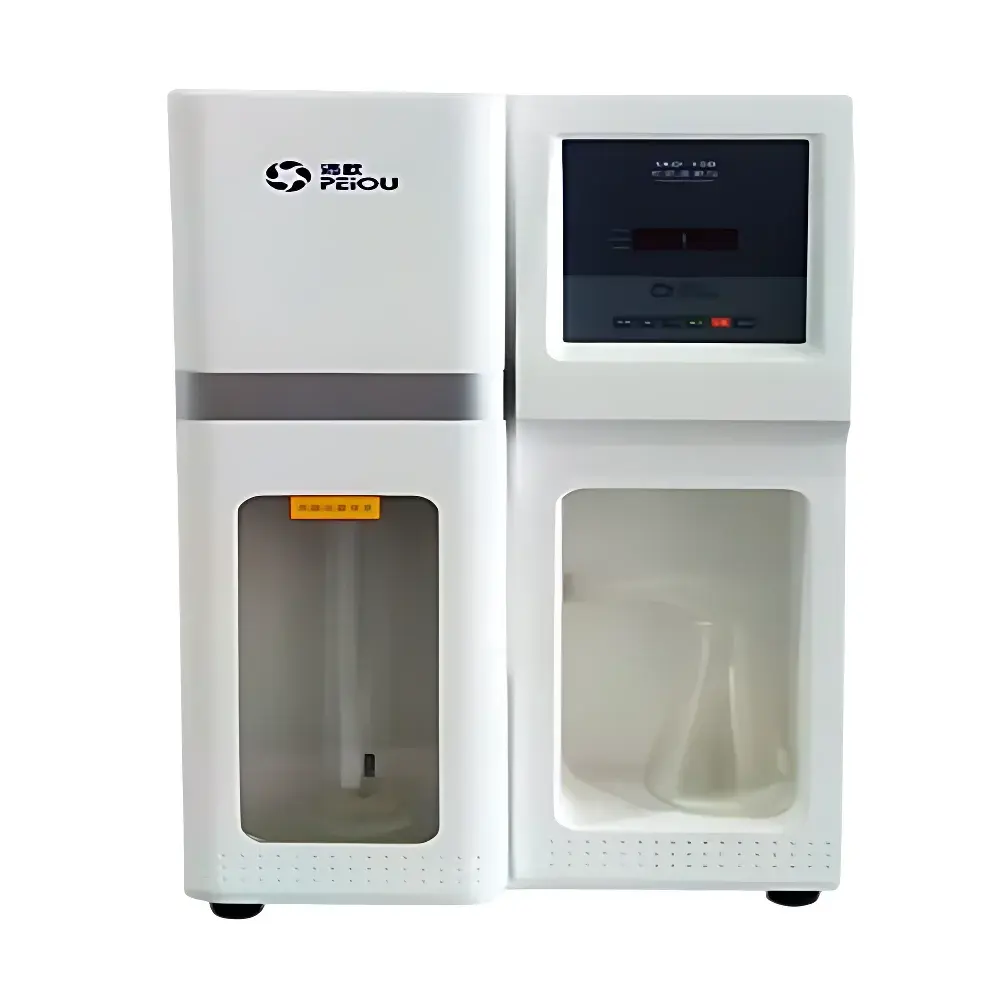
Peiou SKD-180 Semi-Automatic Kjeldahl Nitrogen Determinator
| Brand | Peiou |
|---|---|
| Origin | Shanghai, China |
| Model | SKD-180 |
| Instrument Type | Kjeldahl Nitrogen Determinator |
| Automation Level | Semi-Automatic |
| Nitrogen Measurement Range | 0.1–240 mg N |
| Distillation Time Setting | 0–99 min |
| Repeatability | RSD ≤ 0.5% |
| Sample Capacity | Solid ≤ 20 g/sample |
| Nitrogen Recovery Rate | > 99.5% |
| Adjustable Power Output | 1500 W |
| Dimensions (L×W×H) | 370 × 300 × 680 mm |
Overview
The Peiou SKD-180 Semi-Automatic Kjeldahl Nitrogen Determinator is engineered for precise, reproducible quantification of total nitrogen content in organic samples—particularly animal-derived food matrices—via classical Kjeldahl digestion and steam distillation methodology. It specifically supports the determination of volatile basic nitrogen (TVB-N), a critical freshness indicator in fish, meat, and seafood products. TVB-N comprises low-molecular-weight nitrogenous bases—including ammonia, dimethylamine, and trimethylamine—generated during microbial and enzymatic protein degradation. As such, the SKD-180 serves as a validated analytical tool for quality assurance laboratories conducting routine shelf-life assessment, raw material inspection, and regulatory compliance testing per ISO 8968-1, AOAC 981.10, and GB/T 5009.44–2003. Its semi-automatic architecture balances operational control with process standardization, enabling consistent distillation kinetics, controlled alkali addition, and real-time thermal compensation—key requirements for achieving sub-0.5% RSD performance across heterogeneous biological matrices.
Key Features
- Corrosion-resistant monolithic ABS engineering plastic chassis—molded in one piece to eliminate seams, prevent acid/alkali ingress, and eliminate rust or electrical leakage risks.
- Chemically inert fluidic pathway: All internal tubing is custom-formulated by Peiou for sustained resistance to concentrated H2SO4, NaOH, and ammoniacal vapors—rated for ≥3 years of continuous service without replacement.
- Fail-safe steam management: Integrated overpressure relief valve and balanced steam generator ensure stable vapor flow and eliminate sample back-suction—a common cause of cross-contamination and analytical bias in conventional systems.
- Microprocessor-controlled sequence logic: Fully programmable distillation cycles including automated acid addition (0–99 s), steam generation ramping, and dynamic thermal compensation during condenser pre-heating.
- Intelligent self-cleaning protocol: Dedicated rinse cycles for distillation chamber, acid/alkali delivery lines, and condenser tubing—activated pre- and post-analysis to minimize carryover and extend maintenance intervals.
- Dual-level safety architecture: Real-time liquid level monitoring prevents dry-boiling of the distillation flask; emergency stop button provides immediate power cutoff independent of software state.
Sample Compatibility & Compliance
The SKD-180 accommodates solid samples up to 20 g (e.g., minced fish fillets, ground meat) and liquid samples up to 30 mL (e.g., fish extract, broth, homogenized tissue suspensions). Its 550 mL digestion tube compatibility ensures seamless integration with standard Kjeldahl digestion workflows. The system meets fundamental design criteria outlined in ISO/IEC 17025 for method validation, and its documented recovery (>99.5%) and repeatability (RSD ≤ 0.5%) support GLP-compliant reporting. While not inherently 21 CFR Part 11 compliant due to its semi-automatic data logging (LED display + internal program storage only), it may be deployed within auditable workflows when paired with external electronic lab notebooks (ELNs) that capture timestamped operator inputs, run parameters, and final readings.
Software & Data Management
The SKD-180 employs an embedded single-chip microcontroller—not a PC-based OS—enabling deterministic response timing and immunity to software crashes. It stores up to 10 distinct distillation/acid-addition protocols, each configurable for alkali volume, steam duration, and distillate volume (15–30 mL/min). All settings are retained after power cycling. Data output is limited to LED numeric display; no USB, Ethernet, or RS-232 interface is provided. For traceability, users must manually record run IDs, sample IDs, and results in laboratory notebooks or LIMS-integrated spreadsheets. Optional LCD touch panel upgrade (sold separately) adds on-device parameter editing and run history review—but retains the same non-auditable local storage architecture.
Applications
- Quantitative TVB-N analysis in chilled/frozen fish and seafood for freshness grading (EU Regulation No. 1024/2012 Annex III reference methods).
- Quality control of processed meat products (sausages, cured hams) during production and storage stability studies.
- Validation of enzymatic hydrolysis efficiency in protein isolate manufacturing.
- Monitoring nitrogen loss during thermal processing of dairy powders and infant formula.
- Academic research on spoilage microbiology kinetics and antimicrobial efficacy testing in food models.
FAQ
What is the maximum recommended sample weight for high-fat fish tissue?
For lipid-rich samples (e.g., mackerel, salmon), limit solid loading to ≤15 g to avoid foaming-induced carryover into the condenser.
Does the SKD-180 include a built-in cooling water recirculator?
No. It requires continuous tap water supply at ≥0.15 MPa pressure and ≤20°C inlet temperature. A chiller or recirculating cooler must be added externally for closed-loop operation.
Can the instrument be used for crude protein calculation in feed analysis?
Yes—when paired with prior sulfuric acid digestion, it delivers nitrogen values convertible to crude protein using standard factors (e.g., 6.25 for cereals, 5.70 for fish meal).
Is calibration verification required before each batch?
Per ISO 8968-1, daily system suitability testing with ammonium sulfate standard (N recovery ≥99.5%) is mandatory; full calibration is not performed on the SKD-180 itself but verified via reference material analysis.
What maintenance intervals are recommended for the acid/alkali valves?
Valves require biannual inspection for crystalline residue buildup; cleaning with 10% citric acid solution restores function. No scheduled replacement is specified under normal use conditions.






