
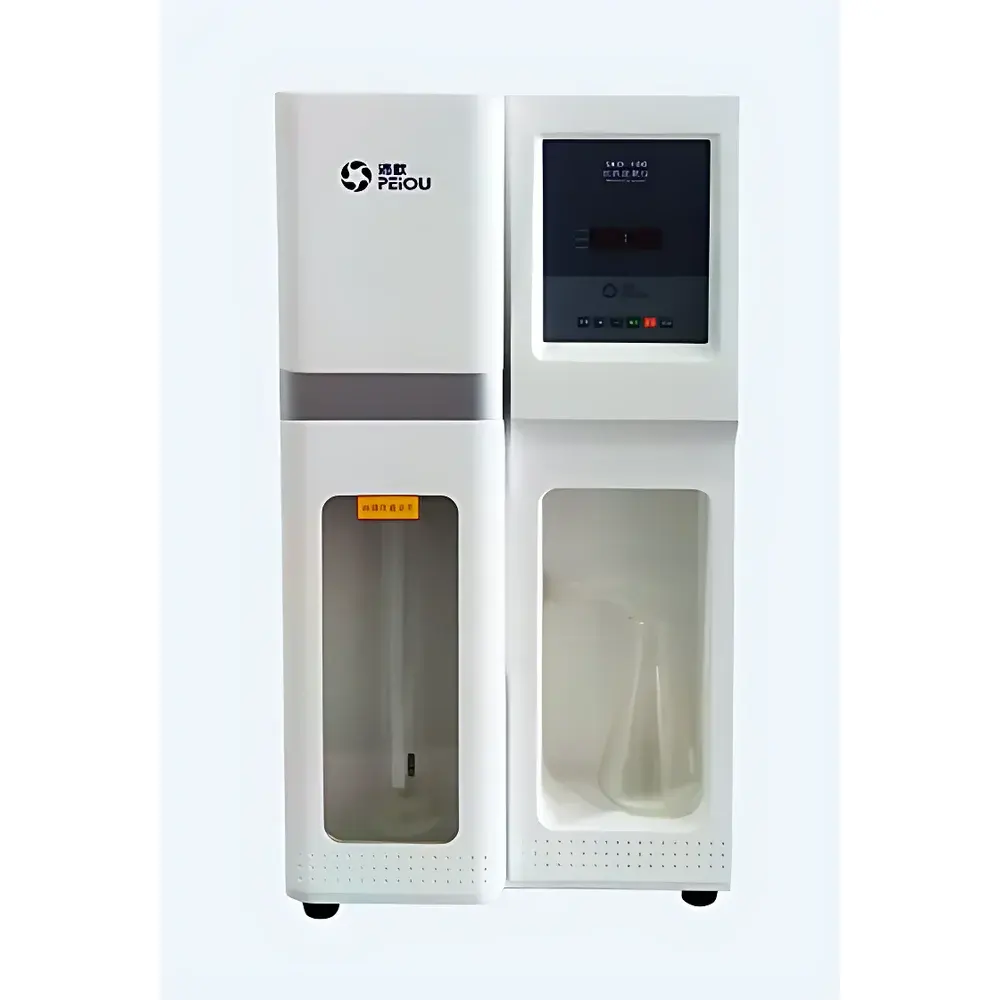
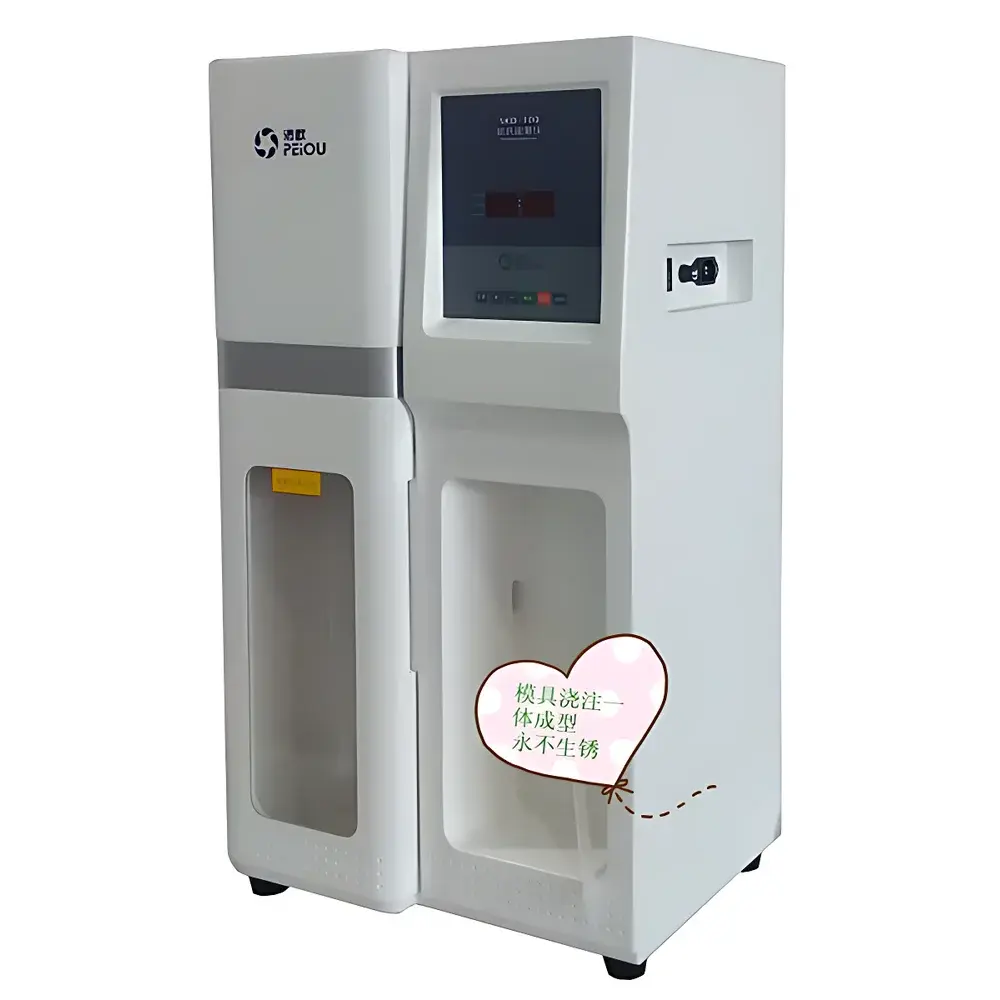
Peiou SKD-200 Kjeldahl Nitrogen/Protein Analyzer
| Brand | Peiou |
|---|---|
| Origin | Shanghai, China |
| Model | SKD-200 |
| Measurement Principle | Kjeldahl Method |
| Nitrogen Range | 0.1–240 mg N |
| Repeatability | ±0.5% RSD |
| Detection Limit | 0.1–240 mg N |
| Recovery Rate | >99.5% |
| Sample Capacity | ≤6 g (solid) or ≤16 mL (liquid) |
| Distillation Time | 3–8 min/sample |
| Distillation Flow Rate | 15–30 mL/min |
| Power Adjustment | 0–1500 W |
| Alkali Addition Time | 0–99 s (stepwise) |
| Acid Addition Time | 0–99 s |
| Distillation Duration Setting | 0–99 min |
| Data Storage | 10 programmable methods |
| Safety Features | Overpressure protection, dry-run prevention via real-time liquid level monitoring, emergency stop |
| Housing Material | Molded ABS engineering plastic (acid/alkali resistant) |
| Tubing | Custom corrosion-resistant polymer tubing (≥3-year service life) |
| Dimensions | 370 × 300 × 680 mm |
| Net Weight | 15 kg |
| Power Supply | AC 220 V ±10%, 50 Hz |
| Cooling Water Requirement | ≥0.15 MPa pressure, ≤20 °C inlet temperature |
Overview
The Peiou SKD-200 Kjeldahl Nitrogen/Protein Analyzer is a fully automated benchtop system engineered for precise, reproducible quantification of total nitrogen and protein content in diverse solid and liquid matrices using the classical Kjeldahl digestion–distillation–titration methodology. Designed to meet the operational rigor of food safety laboratories, agricultural testing centers, feed quality control facilities, and regulatory compliance units, the SKD-200 implements a closed-loop, microprocessor-controlled workflow that eliminates manual intervention during alkaline hydrolysis, steam distillation, and endpoint detection. Its core architecture adheres to the thermodynamic and stoichiometric principles underlying the Kjeldahl method: organic nitrogen is catalytically digested into ammonium sulfate under concentrated sulfuric acid at elevated temperature; the resulting ammonium ions are liberated as ammonia gas under strongly alkaline conditions (pH >12); and the evolved ammonia is quantitatively trapped in boric acid solution prior to titrimetric or colorimetric analysis. This instrument does not replace titration hardware but delivers standardized, operator-independent distillate generation—ensuring traceability, inter-laboratory comparability, and full alignment with internationally recognized reference procedures.
Key Features
- Corrosion-immune housing: One-piece molded ABS engineering plastic enclosure rated for continuous exposure to 98% H₂SO₄ and 40% NaOH without degradation, eliminating rust, galvanic corrosion, or electrical leakage risks.
- Durability-optimized fluidics: All internal peristaltic and pressure-driven tubing is manufactured from proprietary fluoropolymer-reinforced elastomer—resistant to thermal cycling (up to 120 °C), hydrolytic cleavage, and chemical swelling; validated for ≥3 years of uninterrupted operation without replacement.
- Pressure-regulated alkali delivery: A constant-pressure pneumatic system displaces reagent from the alkali reservoir—eliminating peristaltic pump wear, channel occlusion, and volumetric drift associated with roller-based dosing.
- Stable steam generation: Adjustable heating power (0–1500 W) coupled with dynamic vapor pressure regulation ensures consistent steam flow (15–30 mL/min) and prevents sample back-suction or foaming-induced carryover.
- Intelligent thermal compensation: Real-time manual alkali addition override during distillation accommodates variable sample thermal mass—enabling accurate neutralization across heterogeneous matrices (e.g., high-fat dairy vs. low-density cereal flour).
- Embedded procedural memory: Stores up to 10 independent method protocols—including alkali volume, acid volume, distillation duration, and power ramp profiles—for rapid recall and GLP-compliant audit trails.
Sample Compatibility & Compliance
The SKD-200 supports routine nitrogen analysis across regulated food and agricultural sectors, including cereals, oilseeds, animal feed, fertilizers, soil extracts, wastewater, pharmaceutical excipients, and botanical preparations. It complies with multiple national and industry-standard test methods, including GB/T 10511–1989 (feed nitrogen), GB/T 2441.1–2001 (urea nitrogen), GB/T 3595–2000 (fertilizer total nitrogen), and GB/T 10209.1–2001 (phosphate fertilizer). While the SKD-200 itself does not perform titration, its distillate output meets ISO 5983-1:2009 and AOAC 984.13 requirements for ammonia recovery efficiency (>99.5%) and precision (RSD ≤0.5%). The system’s mechanical design facilitates integration into GLP- and GMP-aligned workflows through programmable method locking, electronic log retention, and physical safeguards against dry-run operation and overpressure events.
Software & Data Management
Operation is managed via an embedded single-chip microcontroller with LED-based parameter display and tactile keypad interface—requiring no external PC or proprietary software installation. All method parameters (alkali addition time, acid addition time, distillation duration, power setpoint) are entered directly and stored non-volatilely. Each run logs timestamp, method ID, sample weight (if manually entered), and completion status. Data export is not supported natively; however, the device’s deterministic repeatability and method recall capability ensure full traceability within laboratory information management systems (LIMS) when paired with external titrators or spectrophotometers compliant with FDA 21 CFR Part 11 (via separate validation of connected peripherals). No firmware updates or cloud connectivity are implemented—prioritizing long-term stability and cybersecurity isolation in regulated environments.
Applications
- Food & Beverage QA/QC: Crude protein determination in wheat flour, soybean meal, dairy powders, and infant formula per Codex Alimentarius standards.
- Agricultural Testing: Total nitrogen quantification in compound fertilizers, compost, and soil extracts for nutrient balance modeling.
- Feed Mill Laboratories: Verification of guaranteed analysis claims for poultry, swine, and aquaculture feeds under AAFCO guidelines.
- Environmental Monitoring: Kjeldahl nitrogen measurement in municipal wastewater influent/effluent for TN removal efficiency reporting (EPA Method 351.2 equivalent).
- Pharmaceutical Raw Materials: Nitrogen content verification of excipients such as gelatin, casein, and hydrolyzed collagen used in capsule formulations.
FAQ
Does the SKD-200 include a built-in titrator or colorimeter?
No—the SKD-200 is a dedicated distillation unit. Titration or photometric detection must be performed externally using standard laboratory equipment.
What maintenance intervals are recommended for the SKD-200?
Routine cleaning of the distillation chamber and condenser after each batch is required. The alkaline and acidic reagent lines require no scheduled replacement for ≥3 years under normal use conditions.
Can the SKD-200 be validated for ISO/IEC 17025 accreditation?
Yes—its documented recovery rate (>99.5%), repeatability (RSD ≤0.5%), and adherence to cited national standards support inclusion in method validation packages, provided supporting titration instrumentation is separately qualified.
Is distilled water mandatory for operation?
Deionized or distilled water is strongly recommended to prevent scaling in the steam generator and condenser; tap water with hardness >100 ppm may reduce service life of heating elements.
How is calibration verified on the SKD-200?
Calibration is performed using certified nitrogen reference materials (e.g., ammonium sulfate, glycine) processed through the full Kjeldahl workflow—comparing measured nitrogen recovery against certified values per ISO 8655-6.




