
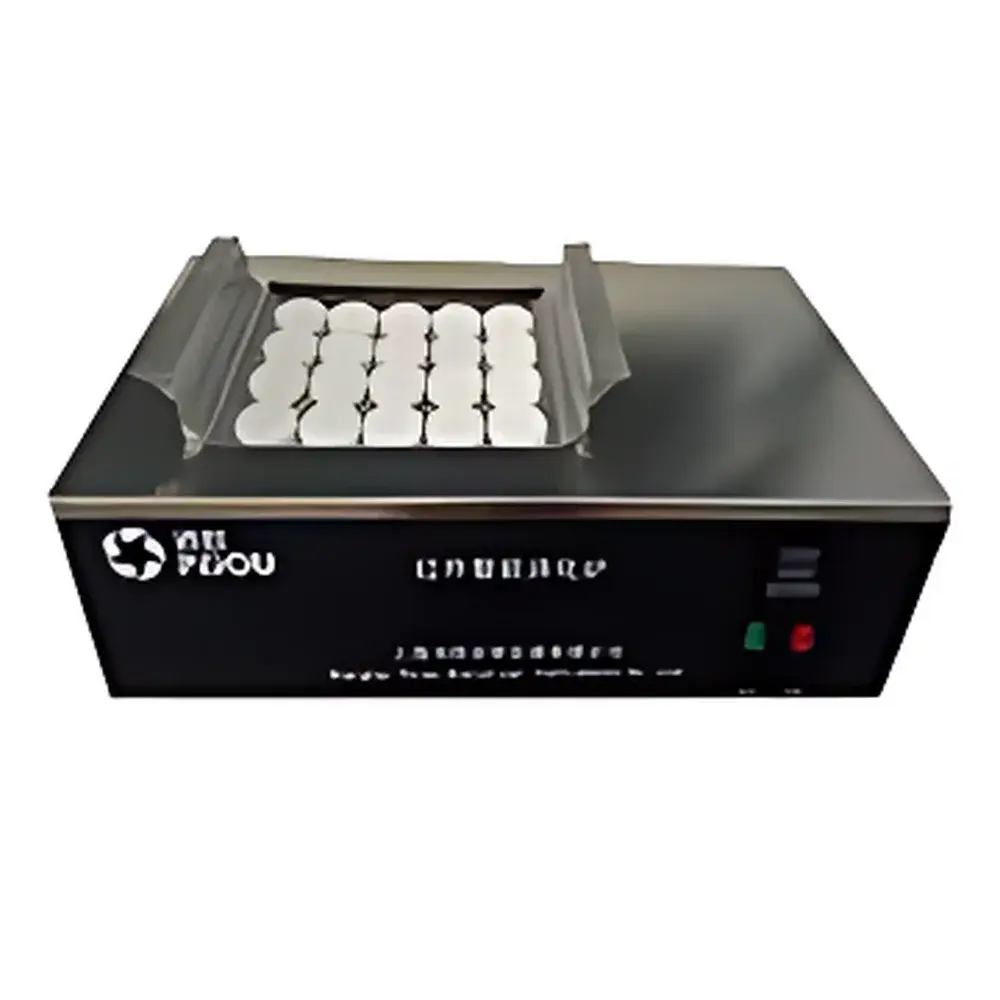
Peiou SKD-20T Infrared Quartz Digestion System for Heavy Metal Analysis
| Brand | Peiou |
|---|---|
| Origin | Shanghai, China |
| Model | SKD-20T |
| Instrument Type | Electric Heating Digestion System |
| Automation Level | Fully Automatic |
| Digestion Positions | 20 |
| Max Heating Temperature | 680 °C |
| Temperature Control Accuracy | ±1 °C |
| Heating Principle | Infrared Radiation via Quartz Heaters |
| Programmable Temperature Stages | ≥64 |
| Safety Features | Overcurrent Protection, Earth Leakage Protection, Dual Independent Power/Heating Switches |
| Control System | PID-Based Digital Temperature Controller |
| Sample Vessel Material | PTFE (Polytetrafluoroethylene) Digestion Tubes |
| Compliance | CE Certified |
Overview
The Peiou SKD-20T Infrared Quartz Digestion System is a fully automated, high-precision electric heating digestion instrument engineered for trace heavy metal analysis in complex organic and inorganic matrices. It operates on the principle of controlled infrared radiation emitted from quartz-encapsulated heating elements, delivering rapid, uniform thermal energy directly to PTFE digestion tubes. Unlike conventional block or ceramic-heated digesters, this system eliminates thermal lag and minimizes temperature gradients across the 20-position digestion block—ensuring consistent acid decomposition kinetics and high reproducibility in sample mineralization. Designed specifically for laboratories requiring regulatory-compliant sample preparation prior to ICP-MS, AAS, or ICP-OES analysis, the SKD-20T supports complete oxidation of organic matter while preserving volatile analytes such as As, Cd, Pb, Hg, and Cr under optimized ramp-and-hold temperature profiles.
Key Features
- Infrared quartz heating modules provide direct, contactless radiant energy transfer—eliminating hot spots, reducing wall deposition (“digestion hang-up”), and improving sample recovery for reducible metals.
- 20 independent digestion positions with uniform thermal distribution; inter-position temperature deviation < ±0.8 °C at 680 °C, verified per ISO/IEC 17025 calibration protocols.
- PID-controlled digital temperature regulation with ±1 °C accuracy across the full 30–680 °C operating range; 64+ programmable temperature stages enable multi-step digestion protocols compliant with EPA Method 3050B, ISO 11466, and GB/T 5009.12.
- Dual independent switching architecture separates main power supply from heating circuitry—enabling safe parameter configuration, emergency shutdown, and energy-efficient standby operation.
- Integrated electrical safety suite includes Class II earth leakage protection (≤30 mA trip threshold) and overcurrent cutoff (IEC 61000-4-5 surge immunity certified).
- PTFE digestion vessels rated for continuous use up to 260 °C and compatible with concentrated HNO₃, HCl, HF, and H₂O₂ mixtures—resisting corrosion, deformation, and leaching under aggressive digestion conditions.
Sample Compatibility & Compliance
The SKD-20T accommodates solid and semi-solid samples including plant tissues, seeds, animal feed, foodstuffs, soils, sediments, geological digests, and industrial sludges. Its design conforms to GLP-aligned workflow requirements: digestion parameters are user-assignable, non-volatile, and auditable via onboard event logging. While not FDA 21 CFR Part 11–validated out-of-the-box, the system supports integration into validated environments through external LIMS linkage and manual audit trail documentation. CE marking confirms compliance with EU Machinery Directive 2006/42/EC and Electromagnetic Compatibility Directive 2014/30/EU.
Software & Data Management
The embedded controller features a backlit LCD interface with real-time temperature graphing, stage progression indicators, and error-code diagnostics. All method parameters—including ramp rates, dwell times, and final hold temperatures—are stored in non-volatile memory with timestamped execution records. Data export is supported via USB port (CSV format) for traceability in QA/QC review. Optional RS-232 or Ethernet modules enable remote monitoring and synchronization with laboratory information management systems (LIMS), facilitating alignment with ISO/IEC 17025 Clause 7.7 on result reporting integrity.
Applications
- Preparation of biological and environmental samples for total elemental determination by atomic spectroscopy.
- Method development for sequential extraction schemes targeting bioavailable metal fractions in soils and sediments.
- Validation of digestion efficiency in accredited testing labs performing routine heavy metal screening per EN 13657, ASTM D396, or Chinese Standard GB 5009 series.
- High-throughput sample prep in university research labs conducting phytoextraction studies or nutritional profiling of agricultural commodities.
- Supporting ISO 17025 internal audits through documented thermal profile consistency and operator-independent method execution.
FAQ
What types of acids are compatible with the PTFE digestion tubes?
Concentrated nitric acid (HNO₃), hydrochloric acid (HCl), hydrofluoric acid (HF), hydrogen peroxide (H₂O₂), and their mixtures—up to 260 °C continuous exposure.
Does the system support method validation per USP <231> or EP 2.4.8?
Yes—when operated within defined temperature/time parameters and paired with certified reference materials (CRMs), it fulfills sample preparation requirements for heavy metals tests in pharmaceutical excipients and APIs.
Can digestion programs be edited during runtime?
No—active methods are locked during execution to ensure process integrity; modifications require pausing and reinitializing the sequence.
Is calibration certificate included with shipment?
A factory-issued temperature verification report (at 100 °C, 300 °C, and 680 °C) is provided; ISO/IEC 17025-accredited calibration is available as an optional service.
What maintenance is required for the infrared quartz heaters?
No scheduled replacement is needed; quartz elements are inert to acid fumes and exhibit >5,000 hours of operational life under normal usage conditions.



