
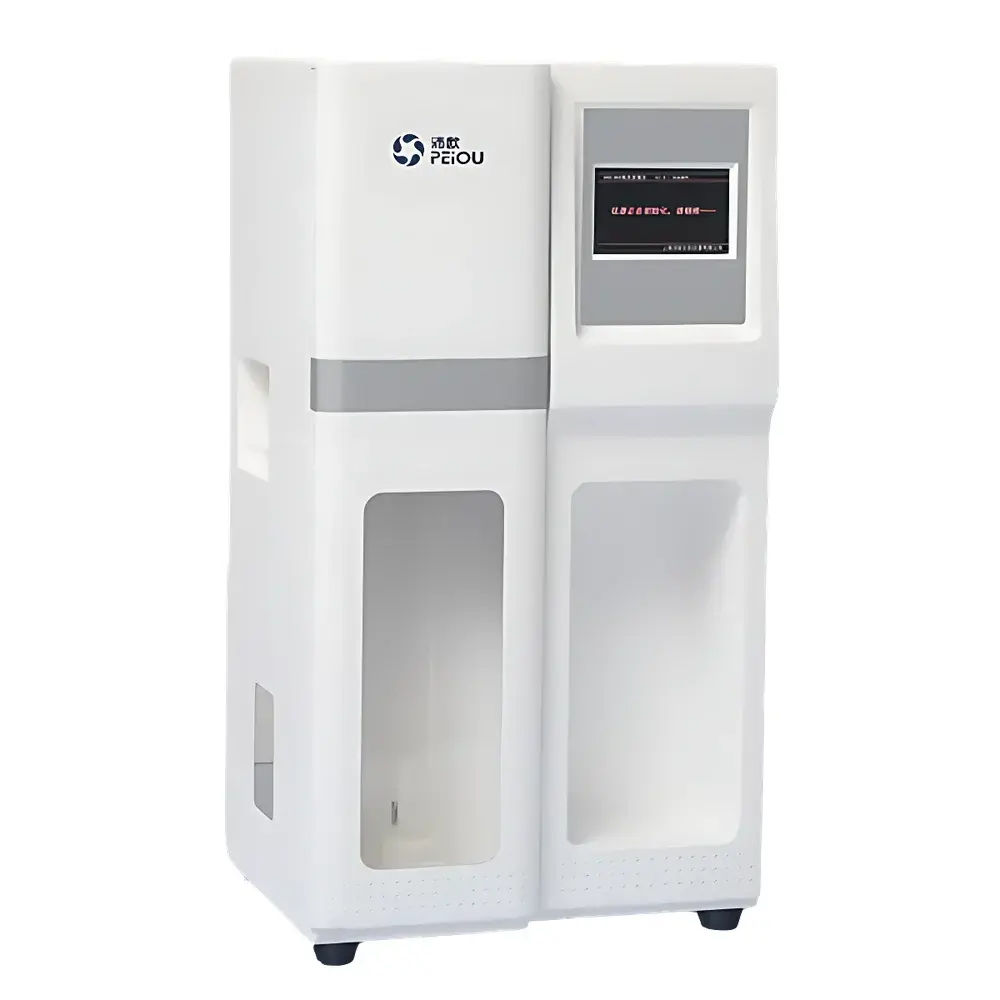
Peiou SKD-300 Cation Exchange Capacity (CEC) Analyzer
| Brand | Peiou |
|---|---|
| Origin | Shanghai, China |
| Model | SKD-300 |
| Instrument Type | Fertilizer/Nutrient Analyzer |
| Measurement Range | 0.07–140 mmol/L |
| Recovery Rate | >99.5% |
| Repeatability | RSD ≤0.5% |
| Distillation Time Setting | 0–99 min |
| Distillation Speed | 3–8 min/sample |
| Boric Acid Delivery | Constant-pressure automated dosing |
| Sample Weight | Variable (method-dependent) |
| Programmable Methods | 10 stored protocols |
| Display | LED digital |
| Distillation Power | Adjustable up to 1500 W |
| Rated Voltage | AC 220 V ±10% |
| Dimensions | 370 × 300 × 680 mm |
| Housing Material | ABS engineering plastic (acid/alkali resistant) |
| Tubing | High-temp, chemically inert custom polymer |
| Safety Features | Dry-run protection, emergency stop button, auto-cleaning cycle |
Overview
The Peiou SKD-300 Cation Exchange Capacity (CEC) Analyzer is a dedicated benchtop instrument engineered for precise, reproducible quantification of soil cation exchange capacity — a fundamental parameter in soil fertility assessment, agronomic planning, and environmental risk evaluation. CEC reflects the total negative charge on soil colloids (clay minerals and humic substances), governing retention and availability of essential plant nutrients (e.g., K⁺, Ca²⁺, Mg²⁺, NH₄⁺) and contaminants (e.g., heavy metal cations). The SKD-300 implements the standardized ammonium acetate–distillation method (per ISO 11260, ASTM D4373, and Chinese standard NY/T 295–1995), wherein exchangeable cations are displaced by NH₄⁺ under controlled pH and ionic strength, followed by quantitative distillation of liberated NH₃ into boric acid solution and subsequent titration or photometric detection. This principle ensures traceability to reference methods while enabling automation of labor-intensive steps.
Key Features
- Automated sequential operation: Integrated microcontroller governs acid addition, timed exchange incubation, steam distillation, boric acid delivery, and post-run cleaning — minimizing operator intervention and inter-analyst variability.
- Constant-pressure boric acid dosing system: Ensures volumetric consistency across runs, directly contributing to <0.5% RSD in replicate analyses and compliance with GLP data integrity requirements.
- Chemically inert fluid path: All internal tubing is fabricated from high-purity, temperature-stable polymer rated for continuous exposure to 6 M HCl, 10 M NaOH, and saturated ammonium acetate — eliminating leaching, swelling, or degradation over extended service life.
- Robust mechanical architecture: One-piece injection-molded ABS housing provides structural rigidity and full resistance to corrosive vapors and splashes; no metal fasteners or painted surfaces exposed to reagents.
- Programmable method storage: Ten user-defined protocols store optimized parameters for diverse soil types (e.g., low-CEC sandy soils vs. high-CEC vertisols), including acid volume, exchange time, distillation duration, and power ramp profiles.
- Comprehensive safety suite: Real-time water-level monitoring halts heating upon reservoir depletion; dual thermal cutoffs prevent overheating; front-panel emergency stop interrupts all active functions within 100 ms.
Sample Compatibility & Compliance
The SKD-300 accommodates air-dried, sieved (<2 mm) soil samples per ISO 10381-1 and USDA Soil Survey Laboratory protocols. It supports both routine batch analysis (up to 24 samples/day at 5-min average cycle time) and low-throughput research workflows requiring method validation. Instrument performance aligns with ISO/IEC 17025:2017 clause 5.9 (method validation) when operated with certified reference materials (e.g., NIST SRM 2710a, 2711a). Data output meets audit requirements for FDA 21 CFR Part 11 (when paired with compliant LIMS) via timestamped, non-erasable LED display logs and manual record transcription. The analyzer complies with IEC 61010-1 for electrical safety and EN 61326-1 for electromagnetic compatibility in laboratory environments.
Software & Data Management
As a standalone hardware platform, the SKD-300 does not include embedded software or network connectivity. All operational parameters and results are displayed via high-contrast LED numeric indicators. Users manually record distillation times, titrant volumes, and calculated CEC values in laboratory notebooks or external spreadsheets. For laboratories implementing electronic records, the instrument’s repeatable timing control (±0.2 s accuracy), fixed reagent delivery precision, and stable thermal output enable integration into validated paperless workflows when combined with calibrated burettes or photometric detectors. Method documentation, calibration certificates, and maintenance logs must be retained per ISO/IEC 17025 clause 7.5.
Applications
- Agronomic soil testing laboratories assessing base saturation, lime requirement, and fertilizer recommendation efficiency.
- Environmental remediation sites evaluating cation-binding capacity for heavy metal immobilization potential (e.g., Pb²⁺, Cd²⁺, Cu²⁺).
- Research institutions studying clay-humus interactions, soil organic matter dynamics, and long-term land-use impacts on colloid charge density.
- Regulatory agencies performing compliance testing against national soil quality standards (e.g., China GB 15618–2018, EU Soil Thematic Strategy benchmarks).
- Teaching laboratories demonstrating ion exchange theory, buffer capacity, and soil colloidal chemistry principles with hands-on instrumentation.
FAQ
What extraction method does the SKD-300 implement?
It follows the ammonium acetate (pH 7.0) displacement method, compatible with ISO 11260 and ASTM D4373.
Can the SKD-300 be used for exchangeable sodium percentage (ESP) determination?
Yes — when coupled with flame photometry or ICP-OES for Na⁺/Ca²⁺/Mg²⁺ quantification in the extract, following standard exchange procedures.
Is the distillation tube included with the instrument?
Yes — one 550 mL borosilicate glass distillation tube is supplied; additional tubes are available as consumables.
What maintenance is required beyond routine cleaning?
Annual verification of boric acid delivery volume (gravimetric check), pressure regulator calibration, and seal inspection is recommended.
Does the SKD-300 support GLP-compliant electronic data capture?
No — it is a non-networked, display-only instrument; full GLP compliance requires external recording systems and procedural controls.
Related Products







