
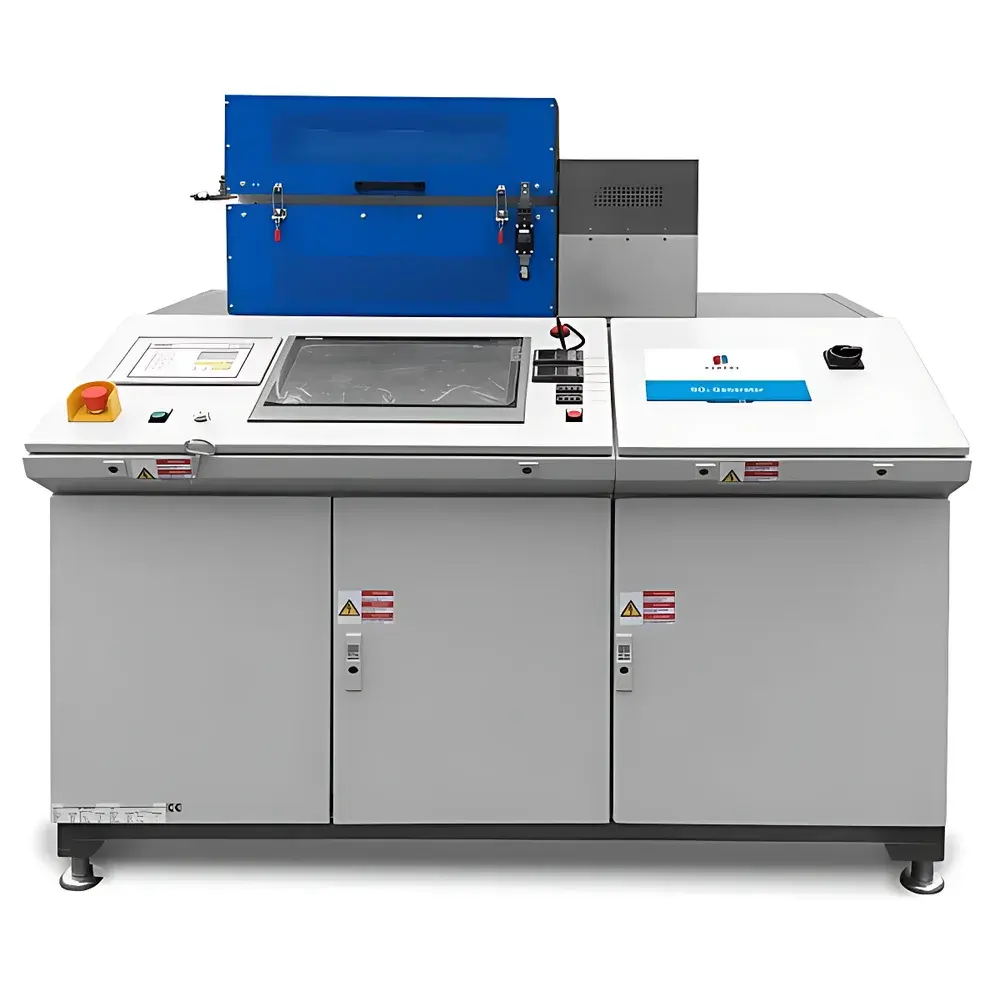
Pentol SO3 Generator for Flue Gas Conditioning and Industrial Surface Treatment
| Brand | Pentol |
|---|---|
| Origin | Germany |
| Model | SO3 Generator |
| Instrument Type | Continuous Emission Monitoring System (CEMS) Component |
| Measurement Accuracy | ±5% |
| Repeatability | ±5% |
| Response Time | 1 s |
| Long-Term Stability | ±5% |
| Target Analyte | SO₃ |
| Catalyst | V₂O₅ |
| SO₂ Feed Rate | 2–200 L/h |
| Air Dilution Flow | 100–5,000 L/h |
| Max Operating Temperature | 1000 °C |
| Heating Rate (to 500 °C, no load) | 20 K/min |
| Power Supply | 400 V / 30 A / 7 kW |
| Dimensions (L×W×H) | 1800 × 1400 × 1200 mm |
| Weight | 429 kg |
Overview
The Pentol SO₃ Generator is a precision-engineered catalytic gas synthesis system designed for controlled, continuous generation of sulfur trioxide (SO₃) in industrial flue gas conditioning and surface treatment applications. It operates on the principle of catalytic oxidation of sulfur dioxide (SO₂) using vanadium pentoxide (V₂O₅) as a high-efficiency heterogeneous catalyst within a precisely temperature-regulated quartz or ceramic-lined reactor zone. The system draws liquid SO₂ from a pressurized cylinder, vaporizes it under controlled conditions, dilutes it with clean compressed air, heats the mixture to 400–450 °C (within the optimal catalytic window), and achieves SO₂-to-SO₃ conversion efficiencies exceeding 70% — significantly higher than traditional fuming sulfuric acid (oleum) methods. Its integration into CEMS infrastructure enables real-time, stable SO₃ dosing for electrostatic precipitator (ESP) optimization, while its modular architecture supports GMP-aligned operation in pharmaceutical container passivation and chromium-free metal surface functionalization.
Key Features
- PLC-based automation with fully programmable start-up, steady-state operation, and safe shutdown sequences — validated for uninterrupted 8-week continuous duty cycles
- Dual-gas mass flow control: independent regulation of SO₂ (2–200 L/h) and compressed air (100–5,000 L/h), both at 3 bar inlet pressure, ensuring stoichiometric consistency and reproducible SO₃ output
- Single-zone high-temperature heating system with Type K thermocouples, ceramic-sheathed sensors, and ±10 K thermal uniformity across the 300–900 °C operating range; maximum temperature capability of 1000 °C for catalyst regeneration protocols
- Integrated SOₓ leak detection subsystem: electrochemical or IR-based sensor network triggers automatic reactor isolation and purge upon detection of ambient SO₂ or SO₃ above predefined thresholds
- CE-marked design compliant with EU Machinery Directive 2006/42/EC and Electromagnetic Compatibility Directive 2014/30/EU; engineered for Class 1, Division 2 hazardous location compatibility per IEC 60079 standards
- Rugged stainless-steel frame with 429 kg operational mass and 1000 mm service clearance requirement — optimized for permanent installation in utility boiler houses or industrial R&D labs
Sample Compatibility & Compliance
The Pentol SO₃ Generator is compatible with standard ISO 8573-1 Class 2 compressed air (oil-free, dew point ≤ −40 °C) and commercial-grade liquid SO₂ meeting ISO 8573-1 purity specifications (≥99.95%, trace H₂O < 10 ppmv). It is explicitly validated for use in flue gas conditioning per ASTM D6784-22 (Standard Test Method for Elemental, Oxidized, Particle-Bound and Total Mercury in Flue Gas Streams) and aligned with EN 14181 (Automated Measuring Systems for Emissions) requirements for auxiliary CEMS components. All control logic and event logging conform to FDA 21 CFR Part 11 data integrity principles when interfaced with validated SCADA or LIMS platforms. System documentation supports GLP/GMP audit readiness, including calibration traceability to NIST-traceable SO₂ reference standards.
Software & Data Management
The embedded Siemens S7-1200 PLC provides deterministic real-time control with onboard data logging (1 Hz sampling) of reactor temperature, gas flows, catalyst bed ΔT, and safety interlock status. Historical datasets are exportable via Ethernet/IP or Modbus TCP to external historian systems (e.g., OSIsoft PI, Ignition SCADA). Optional Pentol ControlSuite™ software adds trend visualization, alarm management (IEC 62443-compliant), electronic batch records, and automated report generation compliant with ISO/IEC 17025 clause 7.8. Audit trails capture all operator actions, parameter changes, and system faults with user ID, timestamp, and reason-for-change fields — fully satisfying ALCOA+ (Attributable, Legible, Contemporaneous, Original, Accurate, Complete, Consistent, Enduring, Available) data governance criteria.
Applications
- Flue Gas Conditioning (FGC): Precise SO₃ injection upstream of ESPs to reduce fly ash resistivity via sulfuric acid film formation, improving collection efficiency by 15–30% in high-resistivity coal-fired units
- Pharmaceutical Container Passivation: Generation of ultra-dry, particle-free SO₃ for forming stable sulfate layers on borosilicate glass vials — replacing carcinogenic Cr(VI) treatments per USP analytical instrument qualification guidelines
- Advanced Surface Engineering: Controlled sulfonation of aluminum, stainless steel, and titanium substrates prior to thermal spray coating or anodizing — enhancing adhesion strength and corrosion resistance per ASTM B117 and ISO 9227 salt fog test protocols
- Research & Development: Catalytic kinetics studies of V₂O₅-based oxidation mechanisms, SO₃ adsorption isotherms on sorbents, and low-concentration SO₃ sensor validation under dynamic flow conditions
FAQ
What is the typical SO₃ output concentration range achievable with this generator?
SO₃ concentrations from 10 ppmv to 500 ppmv are routinely achieved in 100–5000 L/h air streams, depending on SO₂ feed rate, dilution ratio, and catalyst activity — calibrated using NIST-traceable UV-Vis spectroscopy.
Does the system require periodic catalyst replacement?
V₂O₅ catalyst life exceeds 12 months under continuous operation at ≤450 °C; performance monitoring via conversion efficiency trending (SO₂-in vs. SO₃-out via FTIR) determines replacement timing.
Can the generator be integrated into an existing CEMS network?
Yes — analog 4–20 mA outputs for temperature, flow, and status signals; digital interface via Modbus RTU over RS-485 or Ethernet/IP for full bidirectional communication with third-party DCS/SCADA.
Is operator training provided with commissioning?
Pentol-certified field engineers deliver on-site installation verification, SOP development, and hands-on operational training covering startup procedures, emergency shutdown, leak response, and routine maintenance per EN 62061 functional safety standards.
What safety certifications does the unit hold beyond CE marking?
It carries TÜV Rheinland certification per IEC 61508 SIL 2 for safety-related functions, and ATEX Category 3G (Zone 2) approval for use in potentially explosive atmospheres containing SO₂/SO₃ mixtures.







