
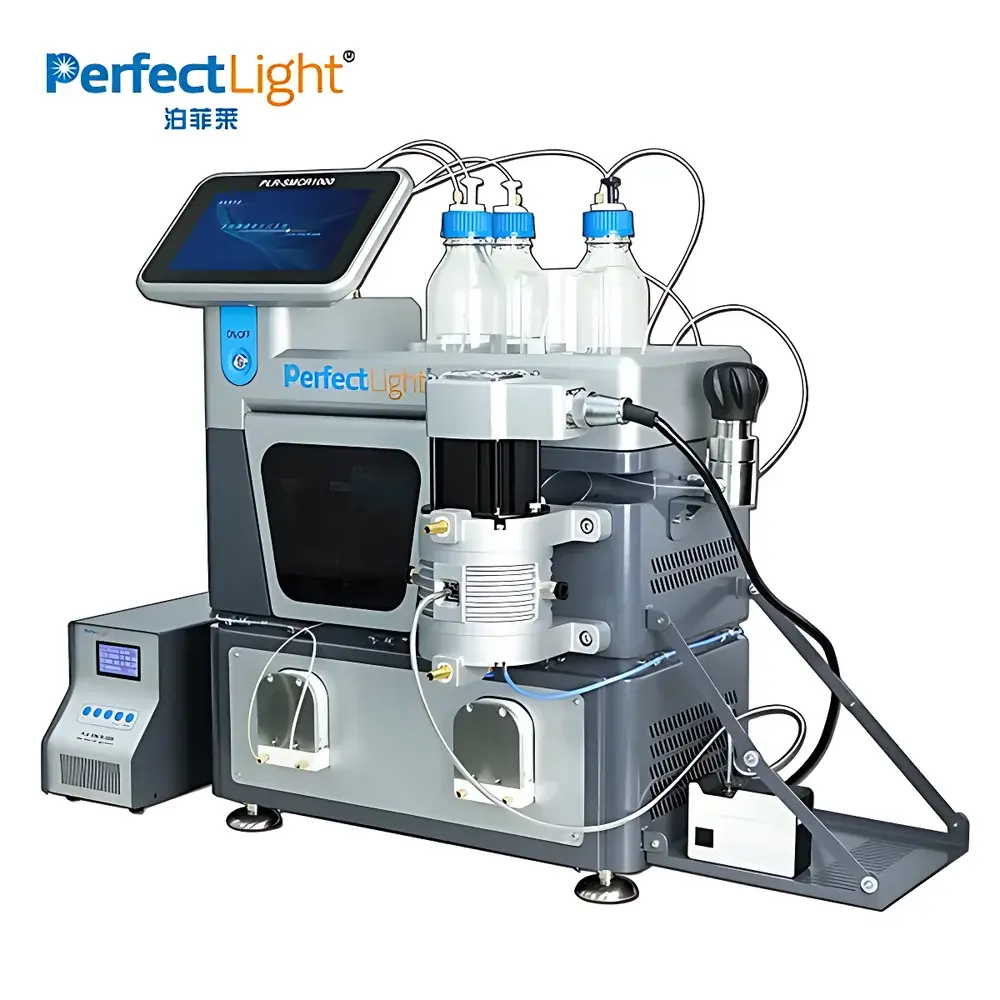
PerfecLight PLR-SMCR1000 Multiphase Microchannel Photochemical Reaction System
| Brand | PerfecLight |
|---|---|
| Origin | Beijing, China |
| Model | PLR-SMCR1000 |
| Pressure Rating | ≥0.6 MPa |
| Optical Path Depth | 0.1–10 mm |
| Liquid Flow Range | 0.5–8.0 mL/min |
| Gas Flow Range | 0–20 mL/min |
| Residence Time | 0.625–20 min |
| LED Wavelength Range | 255–760 nm |
| LED Power | 10–120 W |
| Overall Heat Transfer Coefficient | ≥250 kW/(m³·K) |
| Temperature Control Range | −10°C to +80°C |
Overview
The PerfecLight PLR-SMCR1000 Multiphase Microchannel Photochemical Reaction System is an engineered platform for continuous-flow photochemistry research and process development. It operates on the principles of microfluidic photonics and controlled multiphase hydrodynamics—specifically leveraging Taylor flow regimes—to enable precise irradiation, rapid mass/heat transfer, and reproducible reaction control in both homogeneous and heterogeneous photochemical transformations. Unlike conventional batch photoreactors, where light penetration is limited by optical path length (typically centimeters), the PLR-SMCR1000 employs millimeter-scale transparent microchannels (0.1–10 mm internal dimension), reducing effective photon attenuation depth and increasing volumetric photon flux density. This architecture achieves up to 75% effective irradiated surface area, significantly enhancing quantum yield and shortening reaction residence times by orders of magnitude. The system is designed for rigorous laboratory-scale methodology development, scalability assessment, and mechanistic investigation of photoinduced reactions—including radical generation, energy/electron transfer, and photocatalytic cycles—under industrially relevant continuous operation.
Key Features
- Millimeter-scale fused-silica or high-transmittance polymer microchannel reactor with optical path depths optimized for uniform photon delivery across UV–Vis spectrum (255–760 nm)
- Taylor flow–enabled gas–liquid and liquid–liquid biphasic operation via four independently controlled inlet streams (3 liquid, 1 gas), supporting reactions involving O₂, Cl₂, CO₂, or other gaseous reagents
- High thermal management capability: overall heat transfer coefficient ≥250 kW/(m³·K), enabling rapid dissipation of photothermal effects and suppression of localized hot spots and secondary thermal degradation pathways
- Pressure-rated microfluidic architecture (≥0.6 MPa) for safe handling of volatile reagents, pressurized gases, and exothermic photochemical events
- Modular reactor volume options (5 mL and 10 mL), allowing systematic residence time tuning from 0.625 to 20 minutes—critical for controlling selectivity in multistep or competitive photochemical pathways
- Integrated temperature control unit with precision cooling/heating (−10°C to +80°C), essential for stabilizing reactive intermediates (e.g., chiral radicals, triplet states) and suppressing racemization in asymmetric photocatalysis
Sample Compatibility & Compliance
The PLR-SMCR1000 accommodates a broad range of photochemically active substrates—including aryl halides, diazonium salts, α-carbonyl compounds, and transition metal complexes—across diverse solvent systems (MeCN, DMF, THF, EtOH, aqueous buffers). Its modular fluidic interface supports inert-atmosphere operation when coupled with the PLS-MAC1005 atmosphere controller, meeting GLP-compliant handling requirements for air- and moisture-sensitive reagents. All wetted materials comply with USP Class VI and ISO 10993 biocompatibility standards. While not certified for GMP manufacturing, the system’s design aligns with ICH Q5A/Q5B principles for analytical method development and supports data integrity practices compatible with FDA 21 CFR Part 11–ready software configurations (when integrated with validated third-party acquisition platforms).
Software & Data Management
The PLR-SMCR1000 does not include proprietary closed-loop control software but features standardized analog/digital I/O (0–10 V, RS-485, TTL) for seamless integration with commercial process control systems (e.g., LabVIEW, MATLAB, DeltaV) and real-time analytical instrumentation. When interfaced with fiber-optic UV-Vis spectrometers, it enables in-line monitoring of absorbance kinetics—permitting dynamic feedback adjustment of flow rates, LED intensity, or temperature setpoints based on real-time conversion metrics. Audit trails, parameter logging, and timestamped spectral datasets can be archived in vendor-neutral formats (CSV, HDF5) for traceability in regulatory submissions or peer-reviewed publication workflows.
Applications
- Method development for photocatalytic C–C, C–N, and C–O bond formations under continuous flow
- Kinetic profiling of photoinduced cycloadditions, decarboxylations, and dehalogenations
- Scale-up feasibility studies bridging batch screening to pilot-scale tubular photoreactors
- Investigation of interfacial mass transfer limitations in gas–liquid photocatalysis (e.g., CO₂ reduction, aerobic oxidations)
- Stabilization and downstream processing of transient photogenerated intermediates (e.g., aryl cation radicals, nitrenes)
- Wavelength-dependent quantum efficiency mapping for heterogeneous photocatalysts (e.g., TiO₂, g-C₃N₄, Ir/Ni dual catalytic systems)
FAQ
What types of light sources are supported beyond the standard LED array?
The system accepts external collimated light sources (e.g., Xe arc lamps with monochromators, tunable lasers) via its modular optical coupling port, provided beam diameter and divergence fall within ±1° acceptance angle and ≤15 mm input aperture constraints.
Can the system operate under anaerobic conditions for oxygen-sensitive photoredox catalysis?
Yes—when used with the optional PLS-MAC1005 atmosphere controller and high-integrity Swagelok fittings, the entire fluidic path (including feed vessels and collection traps) maintains O₂ levels <1 ppm during extended runs.
Is reactor fouling observed during prolonged operation with heterogeneous photocatalysts?
Fouling is minimized by Taylor flow-induced wall shear stress (>100 Pa) and periodic backflush capability; routine cleaning protocols using ultrasonication in acetone or dilute HNO₃ are validated for catalyst-coated microchannels.
How is photometric calibration performed for quantitative actinometry?
Users may insert NIST-traceable chemical actinometers (e.g., potassium ferrioxalate, Aberchrome 540) into bypass loops; spectral irradiance profiles are mapped using calibrated CCD-based spectroradiometers prior to kinetic experiments.
Does the system support automated parameter sweeps for DoE (Design of Experiments) workflows?
Yes—via programmable syringe pump triggers and external PLC coordination, full factorial or response-surface experimental designs can be executed with synchronized logging of flow, temperature, irradiance, and spectral output.





