
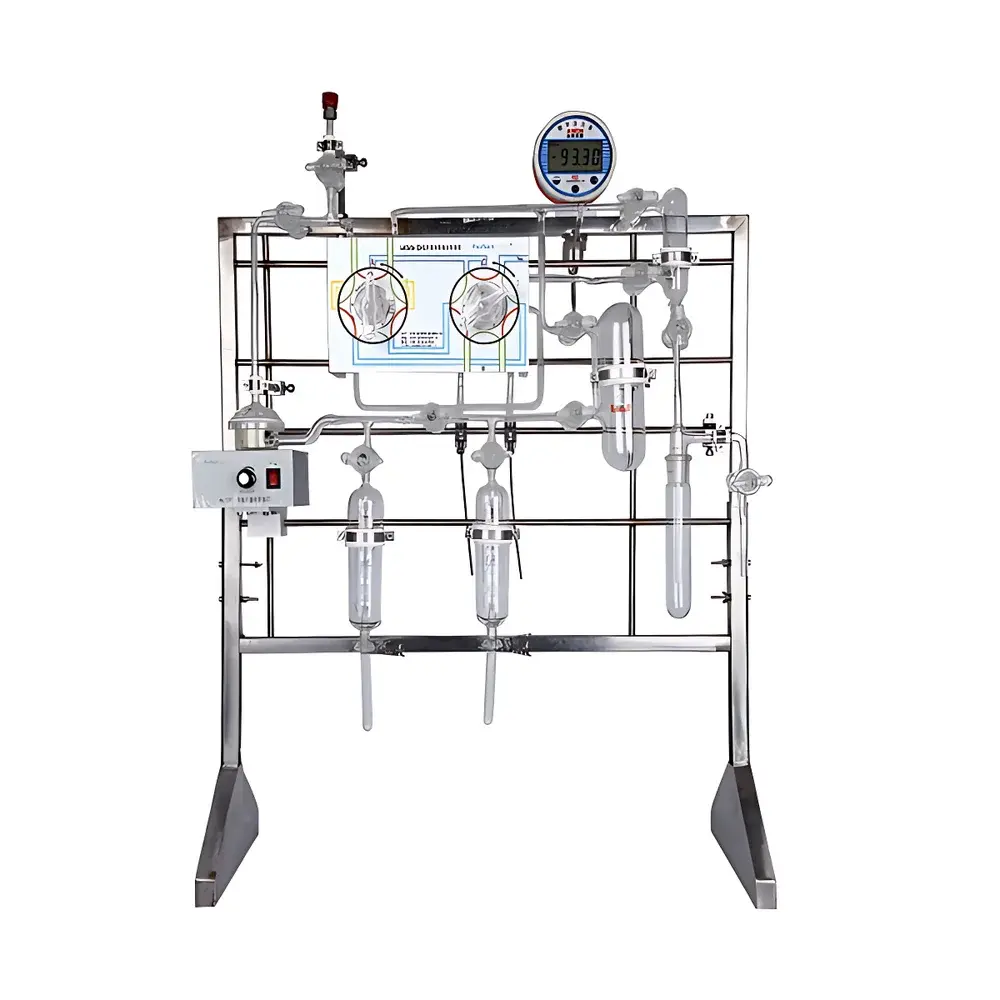
PerfectLight Labsolar-IIIAG Photocatalytic Reaction System
| Brand | PerfectLight |
|---|---|
| Origin | Beijing, China |
| Model | Labsolar-IIIAG |
| Temperature Range | −40 °C to 200 °C |
| Reaction Vessel Count | 1 |
| Reaction Volume | 150 mL |
| Vacuum Level | ≤0.1 MPa (absolute) |
| Gas Loop Flow Path ID | 3 mm |
| Quantitative Loop Volume | 1.5 mL |
| Gas Storage Bottle Capacity | 250 mL |
| Condenser Type | Spherical Reflux Condenser |
| Cold Trap | Integrated |
| Vacuum Pump | Single-Stage Rotary Vane, ≥6 L/s |
| Valve Count | 13 |
| Sealing Grease | Dow Corning High-Performance Vacuum Grease (−40 °C to 200 °C) |
| Construction Material | Borosilicate Glass (3.3), Chemically Inert |
| Gas Sampling | Manual Online Sampling via Glass Multi-Position Valve with Quantitative Loop |
| Magnetic Drive Circulation Pump | Brushless, Wire-Free, ≥4000 rpm |
| Linearity (H₂) | R² > 0.999 (100 μL–10 mL) |
| Repeatability (RSD) | <3% (n=4) |
Overview
The PerfectLight Labsolar-IIIAG Photocatalytic Reaction System is a purpose-built, all-glass gas-phase photocatalytic evaluation platform engineered for quantitative, reproducible measurement of light-driven catalytic reactions under controlled inert or reactive atmospheres. It operates on the principle of closed-loop gas circulation coupled with online sampling and external gas chromatographic analysis—enabling real-time quantification of gaseous products such as H₂, O₂, CH₄, CO, and C₂H₆ generated during photocatalytic water splitting, CO₂ reduction, or selective organic transformations. Its fully borosilicate glass construction eliminates metallic surface adsorption, ion leaching, and catalytic interference—critical for low-concentration product detection and quantum yield determination per ISO 10678 and ASTM E2662 standards. The system supports both UV–vis and visible-light irradiation setups and integrates seamlessly with external light sources (e.g., 300 W Xe lamps, LED arrays, or solar simulators) via standardized optical ports.
Key Features
- All-borosilicate-glass architecture (Duran® 3.3 equivalent) ensures chemical inertness, thermal stability (−40 °C to 200 °C), and zero metal-mediated side reactions.
- Double seven-port glass sampling manifold prevents carrier gas mis-draw during sequential sampling—eliminating dilution artifacts and ensuring stoichiometric integrity of evolved gases.
- Wire-free magnetic-drive circulation pump (≥4000 rpm) provides high-torque, spark-free gas recirculation—fully compliant with H₂ safety protocols (IEC 60079-0) and eliminating electrolytic hydrogen generation artifacts.
- Integrated spherical reflux condenser and cryogenic cold trap separate volatile condensables (e.g., H₂O, methanol, acetone) prior to GC injection or vacuum pumping—protecting analytical columns and extending pump service life.
- 13 precision-ground borosilicate glass valves with matched valve plug/seat lapping ensure leak-tight operation (<1 kPa/24 h pressure decay at ambient temperature) and long-term sealing reliability under repeated thermal cycling.
- Opto-isolated I/O interfaces suppress electromagnetic interference from external lighting systems or power supplies—essential for stable signal acquisition in low-level gas detection.
Sample Compatibility & Compliance
The Labsolar-IIIAG accommodates standard and custom-designed photocatalytic reactors—including top-irradiated quartz batch reactors, side-irradiated cylindrical cells, and three-electrode photoelectrochemical cells with transparent conductive substrates (FTO, ITO). Its 150 mL reaction volume and 250 mL auxiliary storage bottle support scalable gas-phase kinetics studies, while the 3 mm internal diameter loop minimizes flow resistance and residence time dispersion. All wetted materials comply with USP Class VI and ISO 10993-5 biocompatibility requirements for inertness. The system meets GLP-aligned documentation practices for traceable calibration (gas standard curves), audit-ready parameter logging, and manual intervention logs—facilitating regulatory submissions under FDA 21 CFR Part 11 when paired with compliant chromatography data systems.
Software & Data Management
While the Labsolar-IIIAG operates as a hardware-controlled platform without embedded firmware, it is designed for interoperability with industry-standard chromatography data systems (CDS) including Thermo Chromeleon, Agilent OpenLab CDS, and Shimadzu LabSolutions. Calibration curves for H₂ (100 μL–10 mL, R² > 0.999), O₂, and hydrocarbons are generated using certified gas standards traceable to NIST SRMs. Quantitative loop injection (1.5 mL) enables precise, operator-independent sample introduction. All manual operations—including valve actuation sequence, vacuum initiation, and sampling timing—are documented in laboratory notebooks per ISO/IEC 17025 clause 7.7; digital log integration is supported via external USB-triggered timestamping modules compatible with ELN platforms such as LabArchives or Benchling.
Applications
- Quantum efficiency (AQY) determination of photocatalysts under monochromatic or polychromatic illumination (per ISO 25922 and JIS R 1701).
- Kinetic profiling of H₂/O₂ evolution ratios in overall water splitting systems—distinguishing stoichiometric vs. non-stoichiometric pathways.
- Time-resolved CO₂ photoreduction product distribution analysis (CO, CH₄, C₂H₄, CH₃OH) under varied partial pressures and co-catalyst loadings.
- Stability assessment of photoanodes/cathodes in PEC cells via 24–168 h gas evolution monitoring under AM 1.5G illumination.
- Adsorption–desorption equilibrium studies of reactant gases (H₂O, CO₂, O₂) on catalyst surfaces using programmed temperature desorption (TPD)-compatible vacuum protocols.
FAQ
Can the Labsolar-IIIAG be used for liquid-phase photocatalysis?
Yes—when configured with a gas-tight septum-sealed reactor and headspace sampling mode, though its primary design emphasis remains on gas-phase product quantification.
Is the system compatible with mass spectrometry (MS) detection?
Yes—via direct coupling to a residual gas analyzer (RGA) or quadrupole MS using a heated transfer line and pressure-matching throttle valve; optional vacuum interface kits are available.
What vacuum grease is recommended for maintenance?
Dow Corning HV 100 or equivalent high-vacuum silicone grease rated for −40 °C to 200 °C and low vapor pressure (<1×10⁻⁶ Torr at 25 °C) is specified and supplied with each unit.
How is calibration traceability ensured?
Calibration is performed using NIST-traceable gas standards (e.g., Air Liquide CertiGas™); certificate numbers and dilution factors must be recorded in the lab’s instrument qualification file per ISO/IEC 17025 Section 6.6.
Does the system support automated sequential sampling?
Not natively—but third-party programmable valve controllers (e.g., VICI Valco) can be integrated via TTL trigger inputs for unattended multi-point kinetic runs.



