
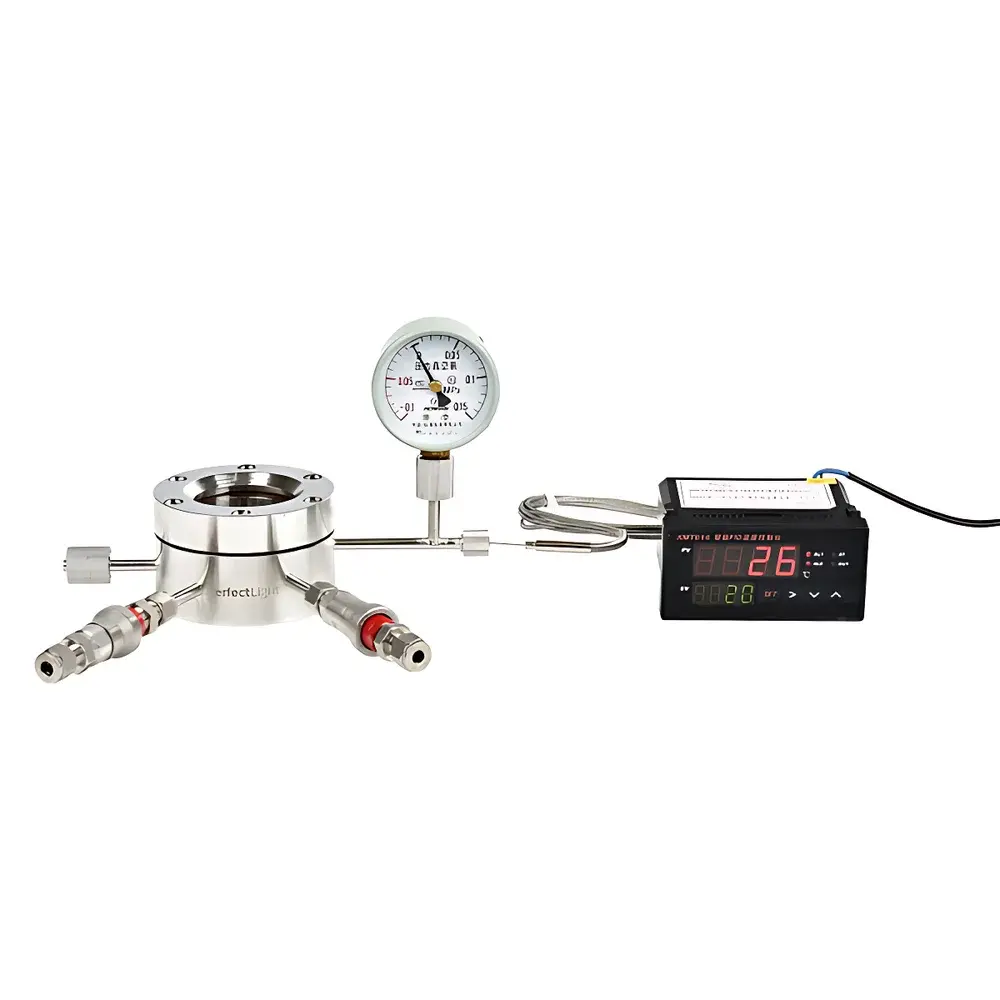
PerfectLight PLR-GPTR Gas–Solid Phase Photo-Thermal Catalytic Reactor
| Brand | PerfectLight |
|---|---|
| Origin | Beijing, China |
| Model | PLR-GPTR |
| Reactor Volume | 50 mL |
| Construction Material | Stainless Steel |
| Operating Pressure | Medium-Pressure (up to 0.3 MPa) |
| Heating Capability | None (base model) |
| Temperature Sensing | Internal Thermocouple for Catalyst Bulk Temperature |
| Pressure Monitoring | Integrated Pressure Sensor |
| Gas Inlet/Outlet | 6 mm OD Stainless Steel Quick-Connect Fittings |
| Catalyst Configuration | Flat-Bed Powder Placement |
| Compliance | Designed for ASTM E2539-21 (Photocatalytic Reactor Testing), ISO 22197-1 (Air Purification Performance), and GLP-aligned experimental traceability |
Overview
The PerfectLight PLR-GPTR Gas–Solid Phase Photo-Thermal Catalytic Reactor is an engineered benchtop reactor system designed specifically for mechanistic investigation of heterogeneous photocatalysis and photo-thermal catalysis under controlled gaseous environments. It operates on the principle of simultaneous or sequential irradiation and thermal activation of solid catalysts—enabling rigorous differentiation between purely thermal pathways, photothermal effects, and true photon-driven surface reactions. Its flat-bed reactor geometry maximizes gas–catalyst interfacial contact area while minimizing diffusion limitations typical of packed-bed configurations. The reactor chamber is constructed from high-grade stainless steel (AISI 316), rated for continuous operation up to 0.3 MPa and ambient-to-300 °C (when equipped with the T-series integrated heater). Unlike conventional batch autoclaves, the PLR-GPTR integrates in-situ thermocouple-based bulk temperature measurement directly within the catalyst bed—ensuring accurate thermal referencing during light-on and light-off conditions.
Key Features
- Flat-bed catalyst configuration: Enables uniform illumination and enhanced gas permeation across powder catalyst layers, critical for kinetic studies requiring reproducible mass transfer conditions.
- Integrated pressure transducer and calibrated Type-K thermocouple: Provides real-time monitoring of system pressure and catalyst bulk temperature—essential for isothermal photo-thermal comparison experiments.
- Stainless steel 6 mm OD quick-connect gas fittings: Supports both batch-mode dosing and continuous-flow operation; compatible with standard gas chromatography (GC), mass spectrometry (MS), and FTIR gas analyzers via standardized Swagelok interfaces.
- Modular thermal design: Base model (PLR-GPTR) supports external heating sources (e.g., heating mantles or hot plates); T-series variants (e.g., PLR-GPTR50T) feature embedded resistive heating elements with 10-segment programmable temperature profiles and ±0.5 °C control stability.
- Compact footprint and standardized mounting interface: Facilitates integration into multi-reactor arrays or optical tables; accommodates collimated LED or Xe-lamp irradiation systems with quartz viewport compatibility (optional).
Sample Compatibility & Compliance
The PLR-GPTR is validated for use with powdered heterogeneous catalysts—including TiO2, g-C3N4, MOFs, perovskites, and supported transition metals—in inert, reducing, or oxidizing atmospheres (N2, H2, CO2, O2, synthetic air). Its pressure rating (0.3 MPa) aligns with standard safety thresholds for laboratory-scale gas-phase catalysis under non-explosive conditions. All wetted parts meet ASTM A276 requirements for corrosion-resistant austenitic stainless steel. The system supports GLP-compliant data acquisition when paired with validated third-party DAQ hardware and software—enabling audit-ready temperature/pressure logging with timestamped metadata. While not certified to ASME BPVC Section VIII, it conforms to ISO 4777 (Laboratory Reactors – Safety Requirements) and incorporates dual mechanical overpressure protection via rupture disc (optional add-on).
Software & Data Management
The PLR-GPTR operates as a hardware platform without proprietary firmware; temperature and pressure signals are delivered via analog (0–5 V or 4–20 mA) or digital (RS485 Modbus RTU) outputs for seamless integration with industry-standard SCADA, LabVIEW, or Python-based control environments. When used with PerfectLight’s optional PLS-DAQ module, users gain access to time-synchronized logging at 10 Hz resolution, automated light/dark cycle triggering, and CSV export compliant with FAIR data principles. All logged parameters include UTC timestamps, sensor calibration IDs, and operator-defined experiment tags—supporting traceability under FDA 21 CFR Part 11 when deployed with electronic signature-enabled acquisition software.
Applications
- CO2 hydrogenation to CH4, CO, or C2+ hydrocarbons under simulated solar irradiation
- Photocatalytic VOC abatement (e.g., formaldehyde, toluene) under ambient and elevated temperatures
- Thermally assisted nitrogen fixation using plasmonic or defect-engineered catalysts
- Kinetic isotope effect (KIE) studies in gas-phase dehydrogenation or oxidation
- Structure–activity correlation mapping across catalyst libraries under matched photo-thermal conditions
FAQ
Can the PLR-GPTR operate under vacuum?
No—the base configuration is rated for positive pressure only (0–0.3 MPa gauge); vacuum operation requires optional vacuum-rated seals and is not supported out-of-the-box.
Is quartz window integration available?
Yes—custom quartz viewport assemblies (UV-grade fused silica, 25.4 mm diameter, AR-coated) can be factory-installed for collimated irradiation setups.
What catalyst loading range is recommended for the 50 mL version?
Typical catalyst bed depth is 2–5 mm for optimal light penetration and gas diffusion; maximum recommended mass is 1.2 g for TiO2-based powders (bulk density ~0.4 g/cm³).
Does the system support automated gas switching?
Yes—when interfaced with external solenoid valve manifolds (e.g., VICI Valco or Parker Series 2), the PLR-GPTR enables programmable multi-gas dosing sequences synchronized to temperature and irradiation profiles.
Are calibration certificates provided for sensors?
NIST-traceable calibration reports for pressure transducers and thermocouples are available upon request (additional lead time and fee apply).



