
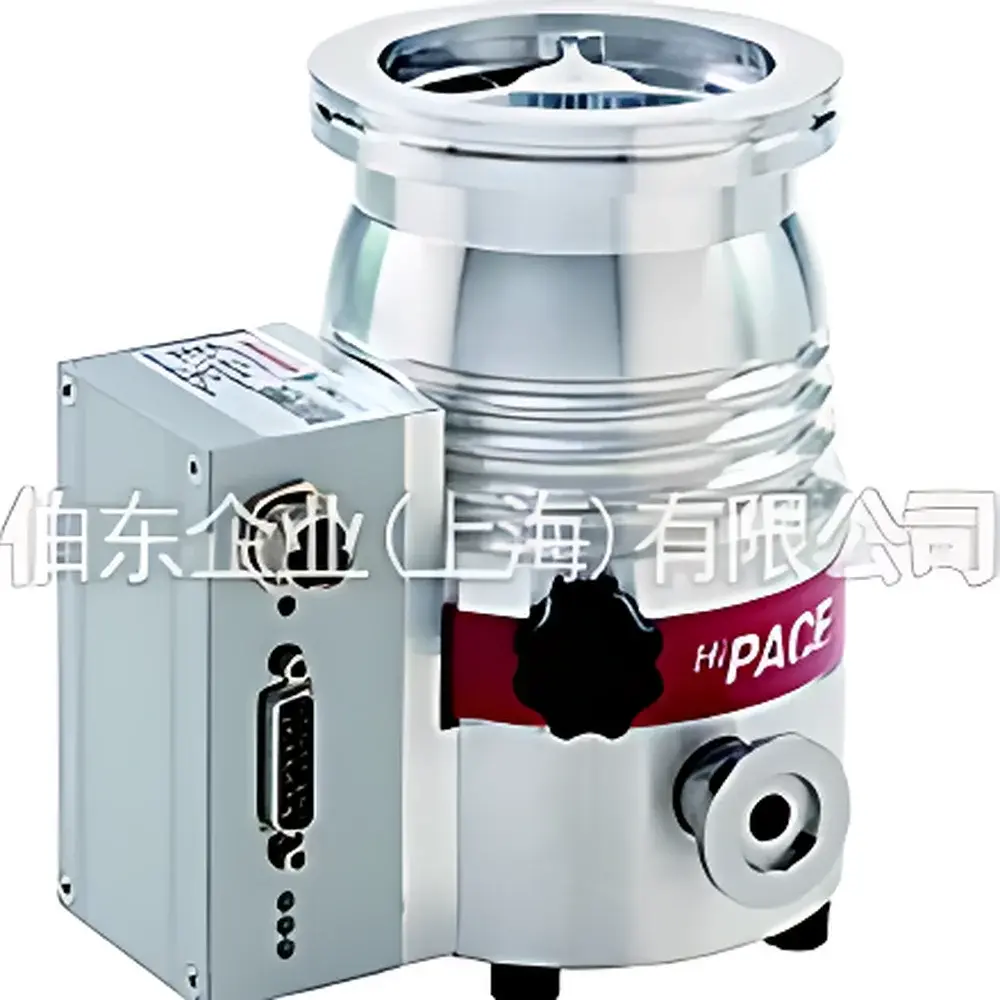
Pfeiffer HiPace 80 Turbo Molecular Pump
| Brand | Pfeiffer Vacuum |
|---|---|
| Origin | Germany |
| Pump Type | Oil-Free Turbo Molecular Pump |
| Model | HiPace 80 |
| Nominal Pumping Speed (N₂) | 71 L/s |
| Compression Ratio (N₂) | >1×10¹¹ |
| Ultimate Pressure (N₂) | <1×10⁻⁷ hPa |
| Maximum Starting Pressure (N₂) | 2.2 mbar |
| Pumping Speed (He) | 58 L/s |
| Pumping Speed (H₂) | 48 L/s |
| Inlet Flange | DN 63 ISO-K / DN 63 CF-F / DN 40 ISO-KF |
| Cooling | Natural Air Cooling |
| Enclosure Rating | IP54 |
| Certifications | UL/CSA, Semiconductor S2 |
| Mounting | Omnidirectional |
| Weight | 1.75 kg |
Overview
The Pfeiffer HiPace 80 is a compact, oil-free turbo molecular pump engineered for high-reliability vacuum generation in demanding scientific and industrial applications. Based on the principle of momentum transfer—where high-speed rotating turbine blades impart kinetic energy to gas molecules to direct them toward the exhaust—it achieves ultra-high vacuum (UHV) conditions with exceptional pumping speed and compression ratio across light and heavy gases. With a nominal nitrogen pumping speed of 71 L/s and a compression ratio exceeding 1×10¹¹ for N₂, the HiPace 80 delivers robust performance in systems requiring rapid pump-down, low base pressure, and minimal backstreaming risk. Its all-metal, bearingless rotor design eliminates hydrocarbon contamination, making it ideal for surface-sensitive processes such as electron microscopy, residual gas analysis (RGA), and thin-film deposition.
Key Features
- Oil-free, all-metal construction ensures zero hydrocarbon contamination and full compatibility with UHV and cleanroom environments.
- Integrated drive electronics enable plug-and-play operation; no external controller required for basic functionality.
- IP54-rated housing provides protection against dust ingress and water splashes, supporting stable deployment in industrial settings including semiconductor fabrication bays and analytical labs.
- Omnidirectional mounting capability allows flexible integration into space-constrained or vertically oriented vacuum chambers without performance degradation.
- Natural air cooling eliminates dependence on external chillers or compressed air lines—reducing system complexity and operational overhead.
- Compliance with Semiconductor Equipment and Materials International (SEMI) S2 safety standards and UL/CSA certification confirm suitability for Class 100 cleanrooms and regulated manufacturing workflows.
Sample Compatibility & Compliance
The HiPace 80 maintains consistent performance across a wide range of process gases—including N₂, He, H₂, Ar, O₂, and reactive species—enabling reliable operation in diverse vacuum applications. Its high compression ratio (>1×10¹¹ for N₂; >1×10⁹ for He) ensures effective isolation between forevacuum and high-vacuum stages, minimizing back-diffusion of oil vapors from backing pumps. The pump meets ISO 27917-1 (vacuum technology — terminology) and conforms to key regulatory frameworks governing laboratory and production equipment: it supports GLP-compliant data integrity when paired with Pfeiffer’s TPG36x series controllers featuring audit-trail-capable firmware (aligned with FDA 21 CFR Part 11 requirements). All variants are manufactured in Pfeiffer’s certified German facilities under ISO 9001:2015 and ISO 14001 quality and environmental management systems.
Software & Data Management
The HiPace 80 communicates via RS-485, CAN bus, or optional Profibus DP interface, enabling seamless integration into centralized vacuum control architectures. When operated with Pfeiffer’s HiPace Control Software (v3.x+) or third-party SCADA platforms (e.g., LabVIEW, Siemens SIMATIC), real-time parameters—including rotational speed, bearing temperature, vibration status, power consumption, and fault logs—are continuously monitored and archived. Firmware updates preserve backward compatibility and introduce enhanced diagnostics, such as predictive bearing wear estimation based on spectral vibration analysis. All operational data can be exported in CSV or XML format for traceability in QA/QC documentation, maintenance scheduling, and ISO/IEC 17025-accredited calibration records.
Applications
- Analytical Instrumentation: Electron microscopy (SEM/TEM), residual gas analyzers (RGA), small-scale mass spectrometers, and surface science tools requiring stable ≤1×10⁻⁷ hPa base pressure.
- Semiconductor Processing: Physical vapor deposition (PVD), load-lock evacuation, wafer inspection, molecular beam epitaxy (MBE), and bonding chambers where particulate-free, chemically inert pumping is critical.
- Research & Development: Plasma physics experiments, particle accelerator beamlines, cryogenic vacuum systems, nanomaterial synthesis reactors, and quantum computing infrastructure.
- Industrial Vacuum Systems: Medical device sterilization chambers, vacuum brazing furnaces, lamp and display manufacturing lines, and helium leak detection stations.
FAQ
What is the maximum allowable inlet pressure for safe startup?
The HiPace 80 may be started at pressures up to 2.2 mbar (N₂ equivalent); operation above this threshold requires pre-evacuation via a suitable backing pump.
Can the HiPace 80 be mounted upside-down or horizontally?
Yes—its symmetrical rotor dynamics and absence of oil reservoirs permit installation in any orientation without derating or performance loss.
Is remote monitoring supported out of the box?
Standard models include RS-485 communication; optional Profibus DP or EtherCAT modules are available for industrial Ethernet integration.
What maintenance intervals are recommended?
Under typical lab use, preventive maintenance—including visual inspection, vibration baseline verification, and firmware update—is advised every 12 months; no routine lubrication or bearing replacement is required within the first 20,000 operating hours.
Does the HiPace 80 comply with FDA or EU GMP requirements for pharmaceutical applications?
While not a GMP-certified device per se, its design, documentation package (including DQ/IQ/OQ templates), and audit-trail-ready controllers meet the technical prerequisites for inclusion in validated pharmaceutical vacuum systems compliant with Annex 11 and EU GMP Chapter 4.



