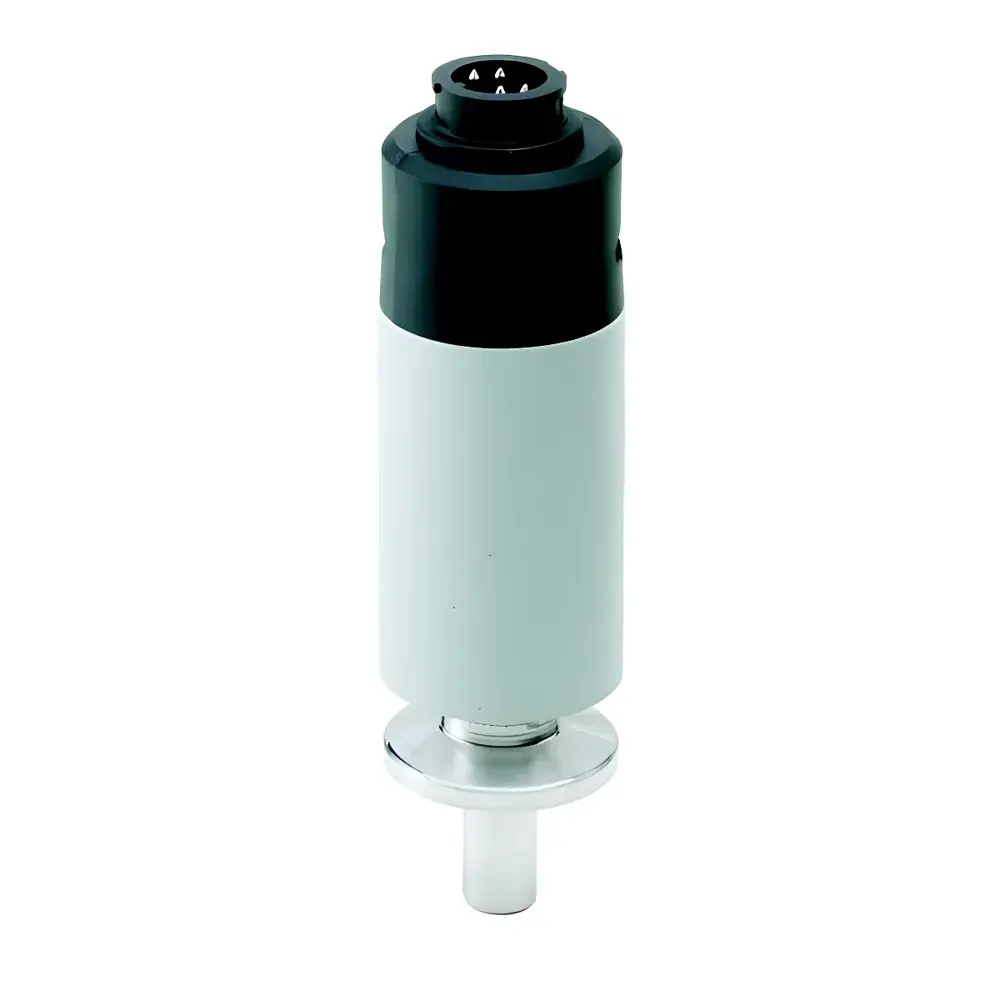
Pfeiffer Vacuum TPR 010 Pirani Vacuum Gauge
| Brand | Pfeiffer Vacuum |
|---|---|
| Origin | Germany |
| Manufacturer | Pfeiffer Vacuum GmbH |
| Product Line | ModulLine |
| Flange Type | DN 10 ISO-KF |
| Max. Measurement Range | 1,000 hPa |
| Min. Measurement Range | 8 × 10⁻⁴ hPa |
| Operating Temperature (Sensor Cable) | 0–70 °C |
| Bakeout Temperature | 100 °C |
| Filament Material | Tungsten/Nichrome |
| Insulator Material | FPM (Fluoroelastomer) |
| Chamber Wall Material | AlSiMg |
| Protective Filter | Sintered Bronze |
| Weight | 0.14 kg |
| Compliance | CE, RoHS, ISO 9001-certified manufacturing |
Overview
The Pfeiffer Vacuum TPR 010 is a compact, robust Pirani vacuum gauge designed for reliable and stable pressure measurement in the rough vacuum range (1,000 hPa down to 8 × 10⁻⁴ hPa). Based on thermal conductivity principles, the TPR 010 operates by monitoring the heat loss from a heated filament suspended in the gas phase—where thermal dissipation correlates directly with gas density and thus absolute pressure. Unlike capacitance manometers or cold cathode gauges, Pirani sensors offer cost-effective, drift-resistant operation without requiring high-voltage excitation or complex calibration routines. The TPR 010 is engineered as a modular component within Pfeiffer’s ModulLine system architecture, enabling seamless integration into vacuum control loops, OEM equipment, and laboratory vacuum systems where space, thermal stability, and long-term repeatability are critical.
Key Features
- Compact DN 10 ISO-KF flange interface ensures minimal footprint and rapid installation in tight spaces—ideal for vacuum chambers, gloveboxes, and analytical instrument forelines.
- Integrated sintered bronze protective filter minimizes contamination risk from particulates and oil vapors while maintaining response time integrity.
- Tungsten/nichrome filament assembly with FPM (fluoroelastomer) insulation provides mechanical resilience and chemical resistance against common process gases including H₂O, N₂, O₂, Ar, and hydrocarbon vapors.
- Rated bakeout temperature of 100 °C enables in-situ degassing of sensor housing during system conditioning—critical for ultra-low-outgassing applications such as surface science and thin-film deposition.
- Standard sensor cable rated for continuous operation between 0–70 °C ambient, supporting integration into both benchtop and industrial environments without external cooling or shielding.
- Compliant with CE marking requirements and manufactured under ISO 9001 quality management systems—ensuring traceable production, material certification, and consistent metrological performance across units.
Sample Compatibility & Compliance
The TPR 010 is optimized for use with dry, non-corrosive, non-condensable gases. It delivers accurate readings in air, nitrogen, argon, helium, hydrogen, and other common technical gases—though gas-specific calibration factors may be applied via software for enhanced accuracy in mixed-gas or specialty environments. It is not intended for use with aggressive halogenated compounds, strong oxidizers (e.g., Cl₂, F₂), or condensable vapors (e.g., solvents, water vapor above dew point) without additional protection. The AlSiMg chamber wall construction meets standard UHV-compatible machining tolerances and surface finish specifications. While the TPR 010 itself does not carry ISO/IEC 17025 accreditation, its design conforms to the functional safety and electromagnetic compatibility (EMC) requirements outlined in EN 61326-1 and EN 61000-6-3, making it suitable for GLP-compliant laboratories and regulated manufacturing settings where documented sensor performance is required.
Software & Data Management
The TPR 010 operates as an analog-output device (0–10 V DC proportional to log pressure), compatible with Pfeiffer’s SmartView control software, VACUU·VIEW digital controllers, and third-party PLCs or DAQ systems supporting standard voltage input scaling. When paired with a Pfeiffer VDU (Vacuum Display Unit) or integrated into a ModulLine-based controller network, the gauge supports real-time logging, alarm thresholding, and trend analysis with timestamped data export in CSV format. Audit trails—including sensor identification, firmware version, and operational history—are retained per unit and can be retrieved via RS-485 or USB interface. For FDA-regulated environments, full 21 CFR Part 11 compliance is achievable when deployed with validated software platforms that enforce electronic signatures, user access controls, and immutable data storage protocols.
Applications
- Rough vacuum monitoring in vacuum furnaces, freeze dryers, and packaging systems.
- Process pressure feedback in plasma etching, sputtering, and electron beam evaporation tools.
- Leak detection pre-screening and system evacuation verification prior to high-vacuum pump activation.
- OEM integration into analytical instruments such as mass spectrometers, residual gas analyzers (RGAs), and environmental test chambers.
- Teaching labs and R&D facilities requiring affordable, maintenance-free pressure sensing with reproducible calibration stability over 12+ months.
FAQ
Can the TPR 010 be used in ultra-high vacuum (UHV) systems?
No—the TPR 010 is specified for the rough vacuum range only (up to 1,000 hPa and down to 8 × 10⁻⁴ hPa). For pressures below 10⁻³ hPa, a cold cathode (IKR) or Bayard-Alpert (BAG) gauge is required.
Is the sensor compatible with aggressive cleaning solvents?
The FPM insulator and sintered bronze filter provide moderate chemical resistance, but direct exposure to chlorinated or fluorinated solvents is not recommended. Cleaning should be limited to dry nitrogen purging or mild isopropanol wipe-downs.
Does the TPR 010 require periodic recalibration?
Under stable operating conditions and clean gas environments, recalibration is typically unnecessary for 12–24 months. However, annual verification against a reference standard is advised for GMP/GLP workflows.
What is the typical response time at low pressure?
The 90% step response time is ≤1.5 seconds at pressures above 10⁻¹ hPa; it increases gradually below 10⁻² hPa due to reduced thermal conduction kinetics.
Can multiple TPR 010 units be daisy-chained on one controller?
Yes—when used with Pfeiffer’s VDU series or ModulLine-compatible controllers, up to four analog sensors can be connected via individual channel inputs with independent scaling and alarm configuration.